

Industry
Electrical Estimating & Consulting
Challenge
Too much of electrical estimating still runs on repetitive manual takeoff — counting, coloring, and checking — which caps capacity, slows turnaround, and burns out rising estimators.
Results
Drawer AI cut a representative 10-hour lighting takeoff to about 10 minutes, reduced reliance on outside takeoff support, and created the potential to do the work of five or six estimators with a leaner team — while speeding the handoff from estimating to operations.
Key Product
Electrical Takeoff
You’re looking at 10 hours in this particular situation... and probably another two hours for reviewing... Drawer AI does it in about 10 minutes.

About Accurate Current Design & Consulting
Founded by 42-year electrical industry veteran Robert Kissick, Accurate Current Design & Consulting helps electrical estimating teams increase capacity and modernize their workflows — without building large estimating departments or leaning on outside takeoff support.
How one 42-year electrical industry veteran saw Drawer AI and said: “You’ve got to be kidding me.”
After more than four decades in electrical construction, Robert Kissick has seen estimating change a lot. He has worked as an electrician, senior estimator, chief estimator, business development leader, and consultant. He has watched the industry move from hand-marked drawings to databases, estimating systems, PDF-based takeoff workflows, BIM, and now AI-powered automation.
So when Robert first saw Drawer AI, he was not easily impressed. He had seen plenty of software promises before. But this one was different.
“When I saw the program, I was like, ‘You’ve got to be kidding me.’ It’s taking away all of the tedious nature of counting.”
Robert Kissick
Robert is the founder of Accurate Current Design & Consulting and has worked with several electrical contracting organizations, including E-Tech Energy Solutions and Owen Electric Company. In his consulting role, he supports estimating and business development efforts, and has introduced Drawer AI as a smarter way for these teams to increase estimating capacity without building a large traditional estimating department or relying heavily on outside takeoff support.
For Robert, the appeal was simple: Drawer AI automates the repetitive parts of electrical takeoff that eat up time, wear down estimators, and slow down the estimating process. It does not remove the need for electrical knowledge. It gives experienced people a much faster starting point.
“Electrical contractors do not need another generic software tool. They need AI that understands the work, automates the tedious parts, and gives estimators a real advantage. That is what Drawer AI is built to do.”
Den Lavrik, CEO, Drawer AI
The Challenge: Estimating Teams Need More Capacity, Not More Clicking
Electrical estimating requires real expertise. A strong estimator has to understand drawings, scope, systems, materials, labor, constructability, and all the small details that can make or break an estimate. But too much of the traditional workflow still depends on repetitive manual work: counting fixtures, marking devices, checking symbols, reviewing takeoffs, and making sure nothing was missed.
Robert described the old workflow clearly. A senior estimator may own the final estimate, while lead and junior estimators support the count-and-takeoff process. In many teams, newer estimators spend months or years doing what Robert calls “count and color” work before they move into higher-value estimating responsibilities. It is necessary work, but it is also slow, tedious, and not exactly the best way to keep rising talent excited about the industry.
For Accurate Current Design & Consulting, Drawer AI created a better path. Instead of adding more people just to handle tedious takeoff functions or sending more work to outside estimating resources, the team could use AI-powered automation to get the first pass done faster and keep the review process in experienced hands.
That matters because estimating capacity is not just an operations issue. It is a business issue. When estimating teams are overloaded, companies risk slower turnaround, missed opportunities, and unnecessary strain on the people who know the work best.
The Breakthrough: 10 Hours to 10 Minutes
The clearest proof point Robert shared was lighting takeoff on a representative office-building scenario. In a traditional workflow, a 100,000-square-foot office buildout could require hours of setup, hours of takeoff, and additional review time just to complete lighting fixture counts. Robert estimated that type of workflow could take around 10 hours once setup, counting, and review were included.
“You’re looking at 10 hours in this particular situation, just as a quick example, and probably another two hours for reviewing and making sure everything’s done correctly. Drawer AI does it in about 10 minutes.”
Robert Kissick
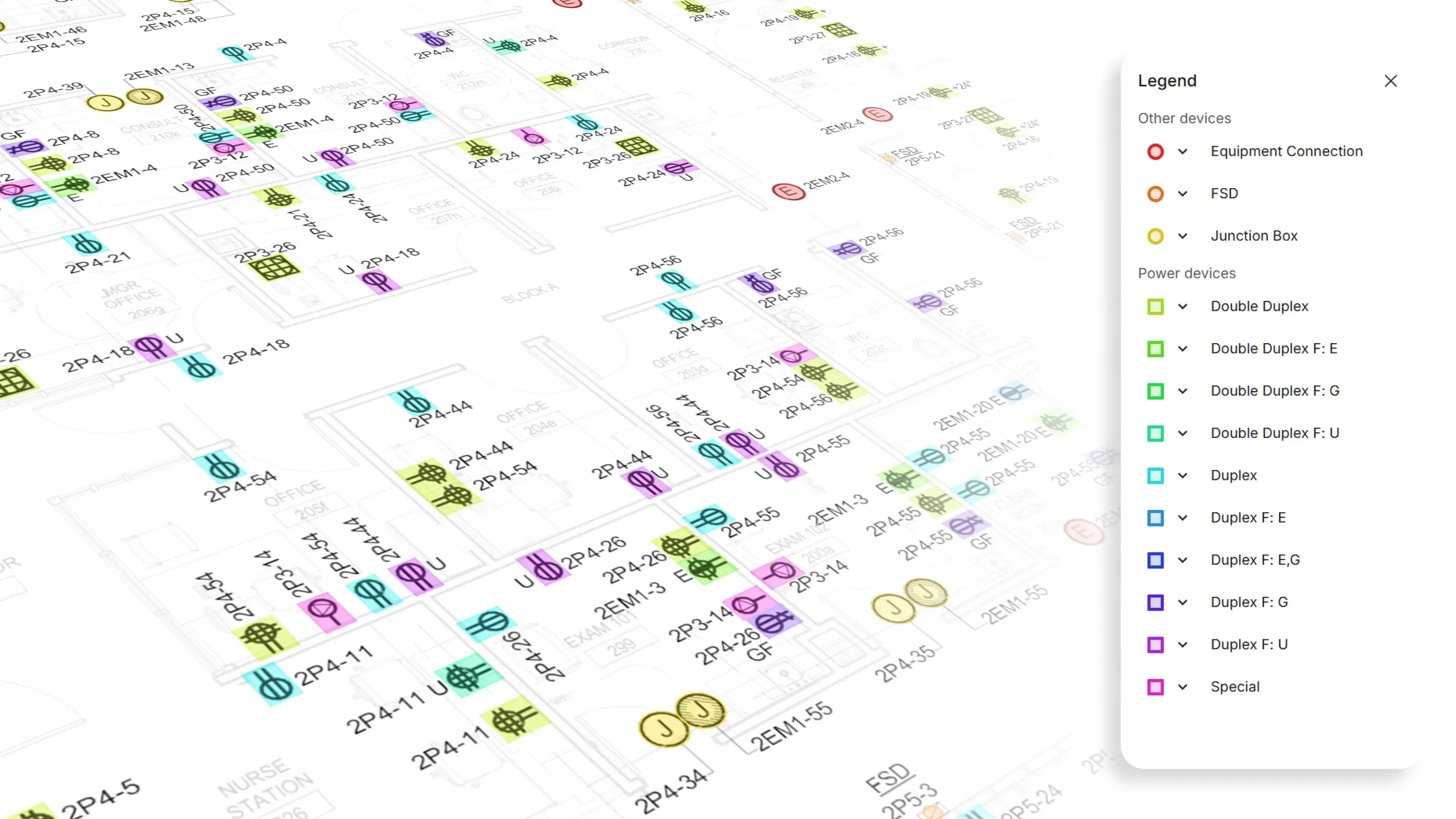
That is the kind of AI story construction leaders actually care about. Not hype. Not theory. A real workflow that used to take hours can now move almost instantly into a review-ready first pass.
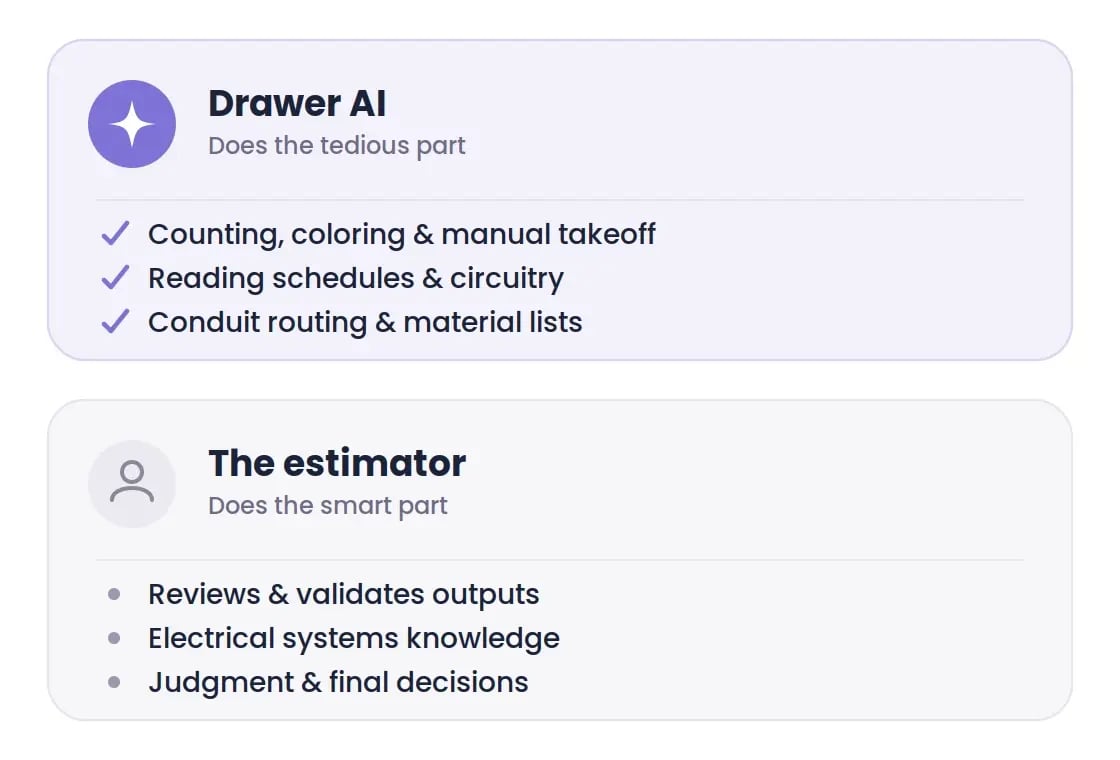
Robert is also clear that Drawer AI is not a magic button. Drawings are not perfect, so no software output should be treated as perfect. Estimators still need to know what they are looking at, understand the electrical system, and review the work. The difference is that Drawer AI removes much of the manual grind so estimators can spend more time checking, adjusting, and making decisions.
In other words, AI does the tedious part. The estimator does the smart part.
More Than Counting
What surprised Robert most was that Drawer AI went beyond basic takeoff. At first, he expected it to count symbols and save time. That alone would have been enough to justify the investment. But as he started using the platform, he saw that Drawer AI could also help read schedules, locate panels, identify circuitry, support branch takeoff, show conduit routing, create material information, and improve the handoff from estimating to operations.
“I thought, ‘Okay, this thing’s just going to count everything for me and I just got to go back in and do the rest.’ Even if it only just did the counting and didn’t do all this additional stuff, it still would have been worth it. But I was surprised at how far it actually went.”
Robert Kissick
That broader workflow is where Drawer AI starts to feel like a new generation of estimating technology. It is not just replacing manual PDF takeoff workflows. It is helping electrical contractors create a faster, more visible, more useful estimating process from the beginning.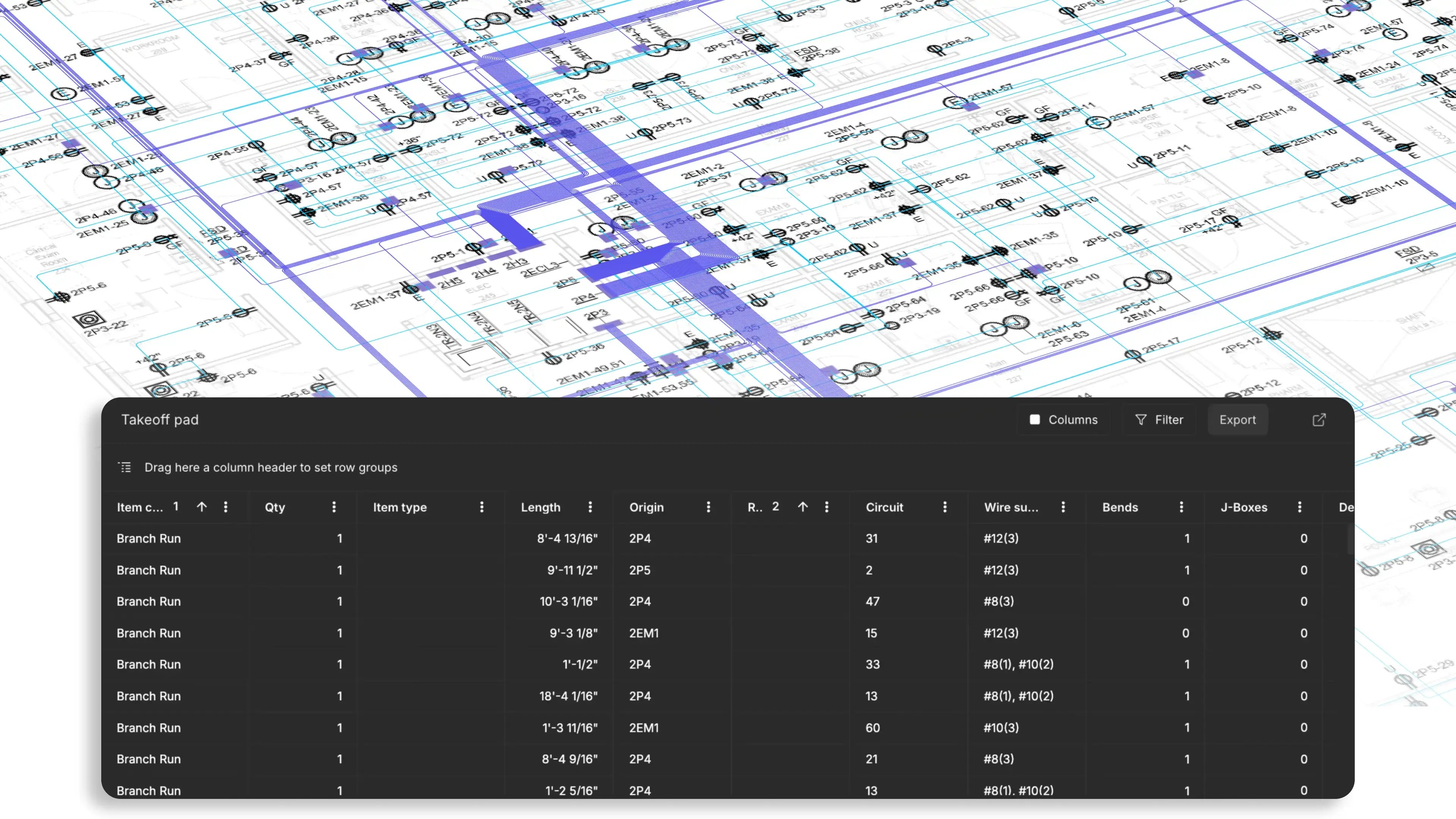
For Accurate Current Design & Consulting, that means less time spent building the first pass from scratch and more time focused on review, accuracy, and business development.
Results: More Estimating Power Without More Overhead
For Accurate Current Design & Consulting, one of the biggest advantages of Drawer AI is the ability to increase estimating capacity without adding unnecessary overhead. Robert explained that the platform helps reduce the need for outside estimating support by allowing people inside the organization to assist more effectively with estimate preparation.
He also sees a larger staffing impact. Based on his experience managing estimating teams, Robert believes work that may have required five or six estimators in the past could potentially be handled by a much smaller, more efficient team when Drawer AI is used correctly.
That is a powerful management story. In a market where experienced estimators are hard to find and even harder to keep, Drawer AI gives leaders a practical way to reduce bottlenecks, increase output, and make better use of the talent they already have.
AI-Powered Estimating Wins
In its early use of Drawer AI, Accurate Current Design & Consulting has identified several clear workflow advantages:
- Reduced an estimated 10-hour lighting takeoff and review workflow to approximately 10 minutes in a representative office-building scenario.
- Helped reduce reliance on outside estimating support.
- Created the potential to perform work traditionally supported by five or six estimators with a smaller, more efficient team.
- Automated repetitive counting, coloring, and manual takeoff tasks.
- Helped accelerate first-pass takeoffs for lighting fixtures, power devices, systems devices, schedules, circuitry, and branch routing.
- Supported a more visible QA/QC process by showing what has been taken off, what is missing, and what needs correction.
- Helped create a stronger bridge between estimating and operations through material lists, conduit routing, and BIM-related workflow potential.
A Better Path for the Next Generation of Estimators
Robert also sees Drawer AI as a way to make estimating more attractive for newer talent. Traditional estimating career paths often require junior estimators to spend years doing repetitive takeoff work before they get to the more interesting parts of the job. That may be how the industry has always done it, but it is not necessarily how the industry should keep doing it.
With Drawer AI, newer estimators can spend less time buried in count-and-color work and more time learning how to review drawings, understand systems, validate outputs, and think like estimators. Robert believes a development path that once took several years could potentially be compressed significantly when AI is used correctly.
“The long tedious nature of what usually is a junior estimator for a couple years, then he becomes a lead, and it’s like a four-year process to get somebody to a senior level… now that function can be knocked down to a year or less.”
Robert Kissick
That makes Drawer AI valuable beyond a single estimate. It helps companies rethink how they train people, how they use experienced estimators, and how they keep new talent engaged in the work.
From Estimating to Operations
Drawer AI also helps address a long-standing issue in construction: getting information out of the estimator’s head and into the hands of the operations team. In traditional workflows, once a job is won, teams often need additional meetings to explain how the estimate was built, what assumptions were made, and how the work was taken off.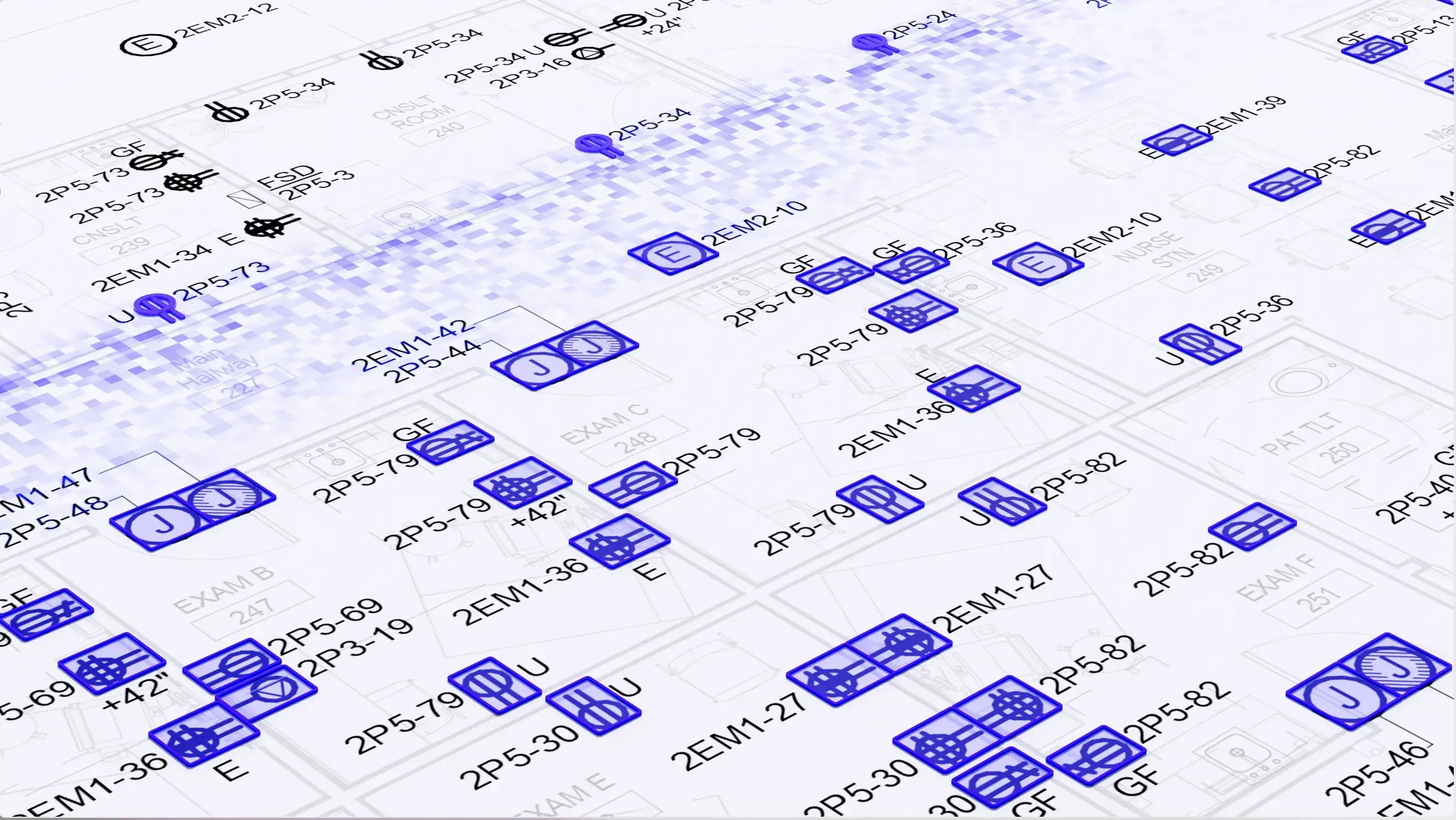
Robert sees Drawer AI helping reduce that friction by making takeoff information more visible. With conduit routing, material lists, schedule information, and clearer takeoff outputs, operations teams can better understand what estimating saw and how the estimate was put together.
“It eliminates that secondary meeting of getting it out of the estimator’s head into the operations and installation team’s head. We can now show it to them.”
Robert Kissick
That is a big deal. A faster estimate is valuable. A faster estimate that also creates a better handoff is even better.
Why AI Matters Now
For construction executives, AI is no longer a future conversation. It is already changing how teams work, and estimating is one of the clearest places to see the impact. Electrical contractors are under pressure to bid faster, manage risk, train talent, improve handoffs, and do more with leaner teams.
“The companies that adopt AI inside their estimating workflows now are going to create a meaningful competitive advantage. Drawer AI gives teams the ability to move faster, automate repetitive work, and make experienced estimators even more powerful.”
Den Lavrik, CEO, Drawer AI
Robert sees the same shift from the estimator’s side. After 42 years in the industry, he compares the move to Drawer AI to going from a rotary phone to a cell phone. It is not a small upgrade. It is a different way of working.
The Outcome: Less Tedious Work, More Estimating Power
For Accurate Current Design & Consulting, Drawer AI has become part of a more modern, AI-powered estimating workflow. The platform helps automate repetitive counting, reduce manual effort, improve first-pass takeoff speed, support QA/QC, and create a stronger bridge between estimating and operations.
The result is not AI replacing expertise. It is AI making expertise more powerful.
Estimators still need to understand the drawings. They still need to know electrical systems. They still need to review, validate, and make judgment calls. But they no longer need to spend the same amount of time buried in tedious counting and manual takeoff tasks that can now be automated.
For Robert, that is what makes Drawer AI such an important breakthrough. After 42 years in electrical construction, he sees Drawer AI as a tool that can help companies move faster, reduce bottlenecks, train the next generation of estimators, and bring real AI advantage into preconstruction.
Drawer AI helps Accurate Current Design & Consulting replace the grind of legacy takeoff workflows with a new generation of AI-powered estimating. It gives teams a faster start, leaders a smarter way to scale, and estimators more time to focus on the work that actually requires their experience.
Ready to Bid More, Win More? Start Today.