

Intermountain Electric cut high-volume takeoffs from days to hours
By reducing certain tasks from multiple 15-hour days to just a few hours with Drawer AI software and an estimator-led QA/QC process.
Drawer AI Case Study

Faster counts. Better consistency. Fewer hours lost to clicking, counting, and measuring.
By reducing certain tasks from multiple 15-hour days to just a few hours with Drawer AI software and an estimator-led QA/QC process.
Dramatic Time Savings
Cuts high-volume takeoffs from multiple 15-hour days to a few hours, freeing estimators for higher-value review.
95% on Branch Routing
Gets estimators roughly 95% of the way on branch measurements before QA, replacing run-by-run measuring with quick review.
Consistent Deliverables
Standardized first-pass outputs reduce variation across estimators and clean up downstream handoffs.
Estimator-Led QA/QC
Drawer AI speeds the repetitive work while estimators review, validate, and QA/QC before anything enters estimating systems.
Electrical estimating has never been for the faint of heart.
There are deadlines. Drawing updates. Last-minute changes. Thousands of symbols. Receptacles that seem to multiply overnight. And somewhere in the middle of it all, estimators are expected to turn a mountain of drawings into a clean, accurate, buildable number. For the estimating team at Intermountain Electric, Inc., that work used to mean a lot of manual clicking, counting, measuring, checking, and re-checking. Bluebeam helped for a while. Experience helped. Long days helped when they had to. But the team knew there had to be a faster way to get through the repetitive parts of electrical takeoff without giving up control of the estimate.
That is where Drawer AI came in. Intermountain Electric has now used Drawer AI seriously for approximately eight to ten months. The team uses the platform to accelerate first-pass counts for lighting, power, receptacles, and branch routing; reduce time spent on repetitive manual measurement; and create more consistent takeoff outputs across estimators.
And on high-volume takeoff work, the difference is significant. In one example, a task that previously took multiple 15-hour days was completed with Drawer AI in just a few hours. That is not just a time savings story. That is a “let’s get our nights and weekends back” story.
“You can take somebody that doesn’t know a whole lot and have a really high-quality deliverable in a pretty short amount of time.”
Jon Schneck, Project Controls Manager, Intermountain Electric, Inc.
Every electrical estimator knows the drill. A project lands on your desk. You open the drawings. And there they are: lights, receptacles, devices, branch runs, panel schedules, fixture schedules, and hundreds of little “spots and dots” waiting to be counted. One by one. Again. And again. On smaller projects, that may not be a big deal. But on larger commercial jobs, hospitals, core/shell projects, and anything with a high volume of end-use devices, those repetitive tasks eat up serious time. Before Drawer AI, Intermountain Electric relied on manual and Bluebeam-based workflows for many of these tasks. But the team was spending too much time on repetitive clicking, counting, and manual measurement.
The challenge was not just speed. It was also consistency.
Different estimators may take off the same project in slightly different ways. One person organizes quantities one way. Another person does it another way. Even when the work is accurate, those differences can create downstream friction. Intermountain Electric needed a faster and more consistent way to create first-pass takeoffs, without removing estimator judgment from the process. They did not need AI to replace the estimator. They needed AI to take the grind out of the work.
Intermountain Electric uses Drawer AI as a faster first pass for electrical takeoff work. The team uses Drawer AI to support:
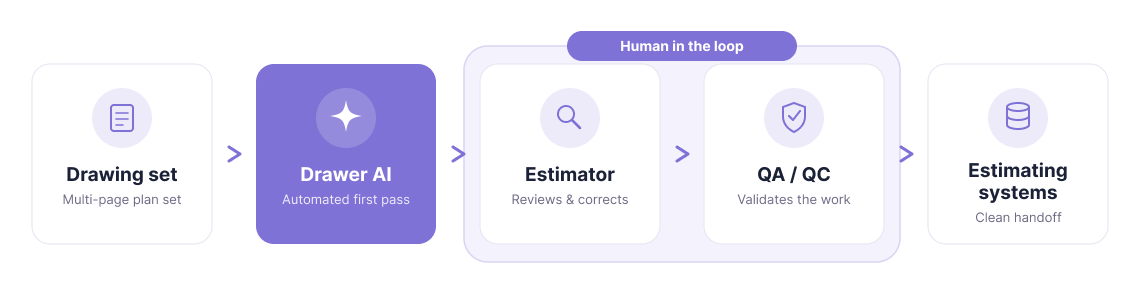
The key is how the team uses it.
Drawer AI is not treated like a magic button. It is not “press go and hope for the best.” Instead, the team uses Drawer AI to get to a stronger first pass faster. Then estimators review the output, correct where needed, QA/QC the work, and move forward with confidence. That balance matters. Drawer AI speeds up the repetitive parts of takeoff, but Intermountain Electric keeps estimator expertise exactly where it belongs: in control.
For Intermountain Electric, Drawer AI has replaced Bluebeam workflows for several manual takeoff tasks, including certain power takeoff, circuiting, panel-related work, and repetitive device counts. That shift matters because Drawer AI is built specifically for electrical contractors.
Instead of using a general-purpose tool to manually click through drawings, estimators can work in a platform designed to understand electrical symbols, schedules, branch routing, and the workflows that matter most to electrical estimating teams. The result is less time spent clicking through the same types of devices and more time spent reviewing and validating the work.
Or, as one team member put it when describing life before Drawer AI:
“Before, I was just clicking in Bluebeam, stressing out.”
Intermountain Electric Estimating Team
One of the biggest wins for the team has been branch routing.
Branch measurements are one of those tasks that seem simple until you are measuring run after run after run across a large drawing set. Drawer AI helps estimators get roughly 95% of the way there on branch measurements before QA review. That does not mean the estimator skips review. It means the estimator starts from a much better place.
“Getting 95% of the way there on branch instead of having to do one measurement here, one measurement here, one measurement here — that amount of time saving makes it absolutely worth it.”
Intermountain Electric Estimating Team
For larger projects, that can be the difference between spending days building a first pass manually and getting to review much faster.
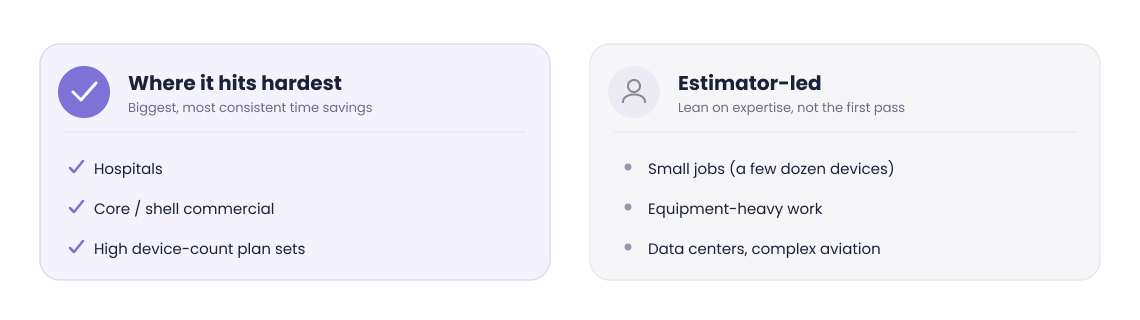
The Intermountain Electric team is clear about where Drawer AI delivers the biggest impact.
Drawer AI is most valuable on larger projects with high volumes of end-use devices, including hospitals, core/shell commercial projects, and other jobs with a lot of lighting fixtures, receptacles, power devices, and branch runs.
For very small projects, manual takeoff may still be faster. For equipment-heavy work, such as certain data centers or complex aviation projects, the estimator still needs to apply more specialized review.
That honesty makes the story stronger. Drawer AI is not being positioned as everything for everyone. It is being used where it makes the most sense. And when it fits, the team sees real value.
“When it hits, it hits really hard.”
Intermountain Electric Estimating Team
Speed gets the attention. Consistency may be the quiet win.
Before Drawer AI, different estimators could approach takeoff work differently. That is normal. Everyone has their own process. But when a department is trying to move faster and hand off cleaner information, consistency matters. Drawer AI helps create more consistent takeoff outputs across estimators. It gives the team a common starting point, which helps reduce variation and improve downstream deliverables.
“Having a standardized version has been really helpful downstream. We’ve been having an issue as a department with non-standardized things. I’ll take things off slightly differently than he will.”
Intermountain Electric Estimating Team
For Intermountain Electric, that means Drawer AI is not just saving time for one estimator. It is helping the team work from a more consistent baseline.
Drawer AI has also helped newer estimators get to quality deliverables faster. New estimators still need training, mentorship, and review. But Drawer AI gives them a more intuitive way to start working through takeoffs, understand quantities, and build confidence in the process. That is especially important in a market where experienced estimators are hard to find and teams need newer talent to become productive faster.
With Drawer AI, newer team members can contribute to the workflow more quickly, while experienced estimators still provide the review and oversight needed to protect quality.
“Getting 95% of the way there on branch instead of having to do one measurement here, one measurement here, one measurement here — that amount of time saving makes it absolutely worth it.”
Intermountain Electric Estimating Team
For Intermountain Electric, Drawer AI has become a practical way to modernize electrical estimating.
The team has used Drawer AI to:
Most importantly, Drawer AI keeps the estimator in control. Electrical estimating will always require expertise. There are too many details, too many variables, and too much risk for any team to simply press a button and walk away.
But the repetitive work? The endless counting? The manual measuring? The constant clicking through the same symbols project after project? That is exactly where AI can help. For Intermountain Electric, Drawer AI gives the estimating team a stronger first pass, a more consistent workflow, and more time to focus on review, validation, and judgment.
Or put another way: Drawer AI helps Intermountain Electric spend less time counting the dots and more time connecting them.
“Drawer AI helps our team get to a better first-pass takeoff faster. It does not replace the estimator. It gives us a stronger starting point, then our team can review, QA/QC, and move forward with more confidence.”
Jon Schneck, Project Controls Manager, Intermountain Electric, Inc.

You’ve seen how Drawer AI can streamline your takeoff process and save you time. Now, it’s time to put it to work for you!