AI





Artificial intelligence is rapidly transforming the construction industry, offering a range of advantages and opening up new opportunities for businesses. As the adoption rate continues to climb, construction firms are realizing that AI is not just a futuristic concept, it's a practical tool that is shaping the way projects are planned, managed, and executed. In 2023, 26% of construction firms had integrated AI into their operations. By 2025, that number is expected to reach 37% (Deloitte February 27, 2025, State of digital adoption in the construction industry 2025). This accelerating trend makes it clear that companies will either be leveraging AI themselves or competing against others who do.
Table of Сontents
Yet, the term “AI in construction” can mean twenty different things depending on who is selling the solution. For electrical contractors, this article aims to clarify what artificial intelligence can actually do for your business today, what it cannot, and where the technology is headed. By cutting through the noise, electrical professionals can make informed decisions about how to harness AI for greater efficiency, safety, and profitability.
Among all the applications of artificial intelligence in construction, electrical takeoff and estimating is the most mature and proven area for electrical contractors. These AI-powered tools are changing the way contractors’ approach one of the most time-consuming and error-prone aspects of project planning.
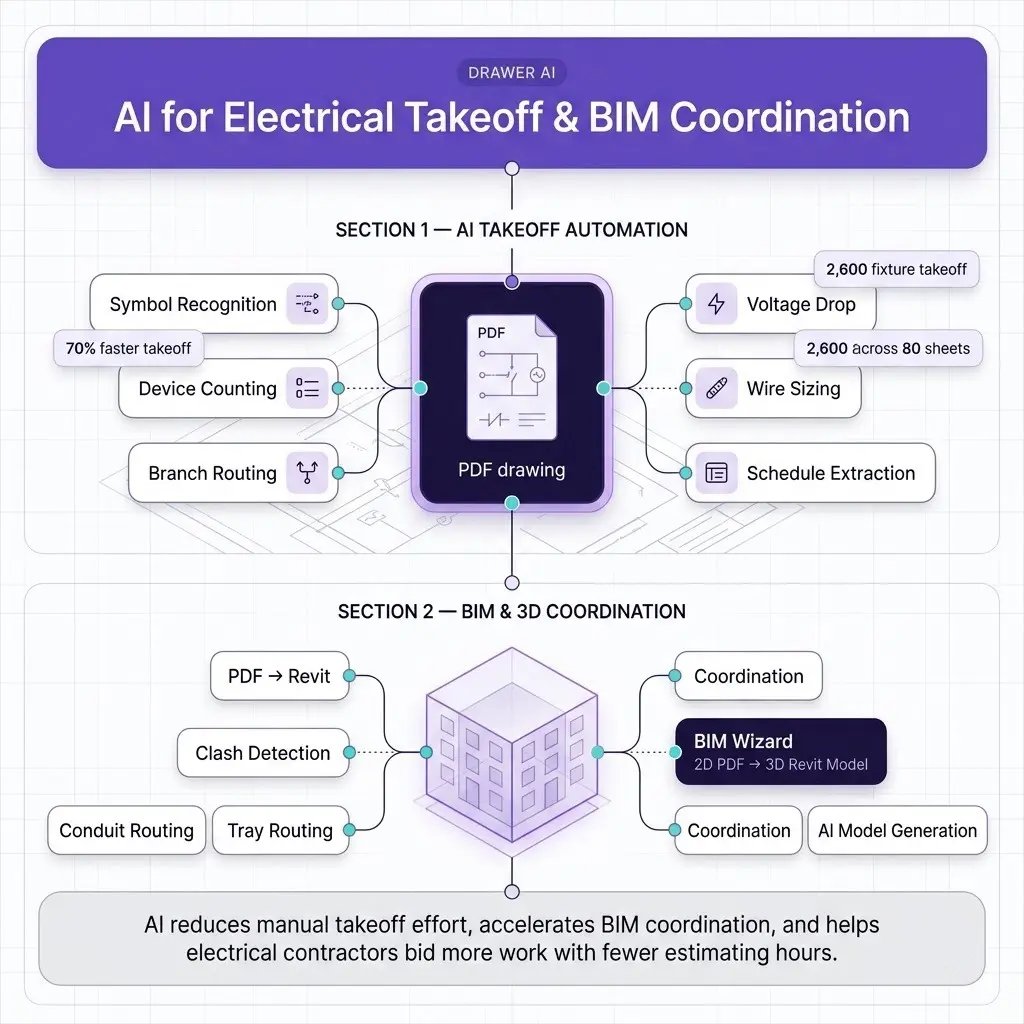
At their core, these systems can automatically detect and interpret symbols from PDF drawings, count devices, extract schedules, route branches, calculate wire sizes, and assess voltage drop. These capabilities drastically reduce the manual effort required for takeoff and enable contractors to deliver accurate estimates much faster.
A handful of products lead this space:
The productivity gains from adopting these AI tools are substantial. Drawer AI users report up to a 70% reduction in takeoff time, turning multi-day jobs into work that finishes in a single sitting. That gives senior estimators their day back for the parts of bidding that actually need judgment: scope analysis, supplier conversations, risk allowances. Automation also catches the typo-and-miscount errors that creep in when a human clicks through 80 sheets of drawings, which is where estimating margin usually leaks.
A concrete example: Drawer AI can identify 2,600 lighting fixtures across 80 sheets of drawings in a few minutes, work that used to take days of manual counting. That speed translates into more bids submitted, faster turnaround to GCs, and tighter resource planning. Contractors who run AI through their full bid cycle are simply bidding more work than the ones who don't.
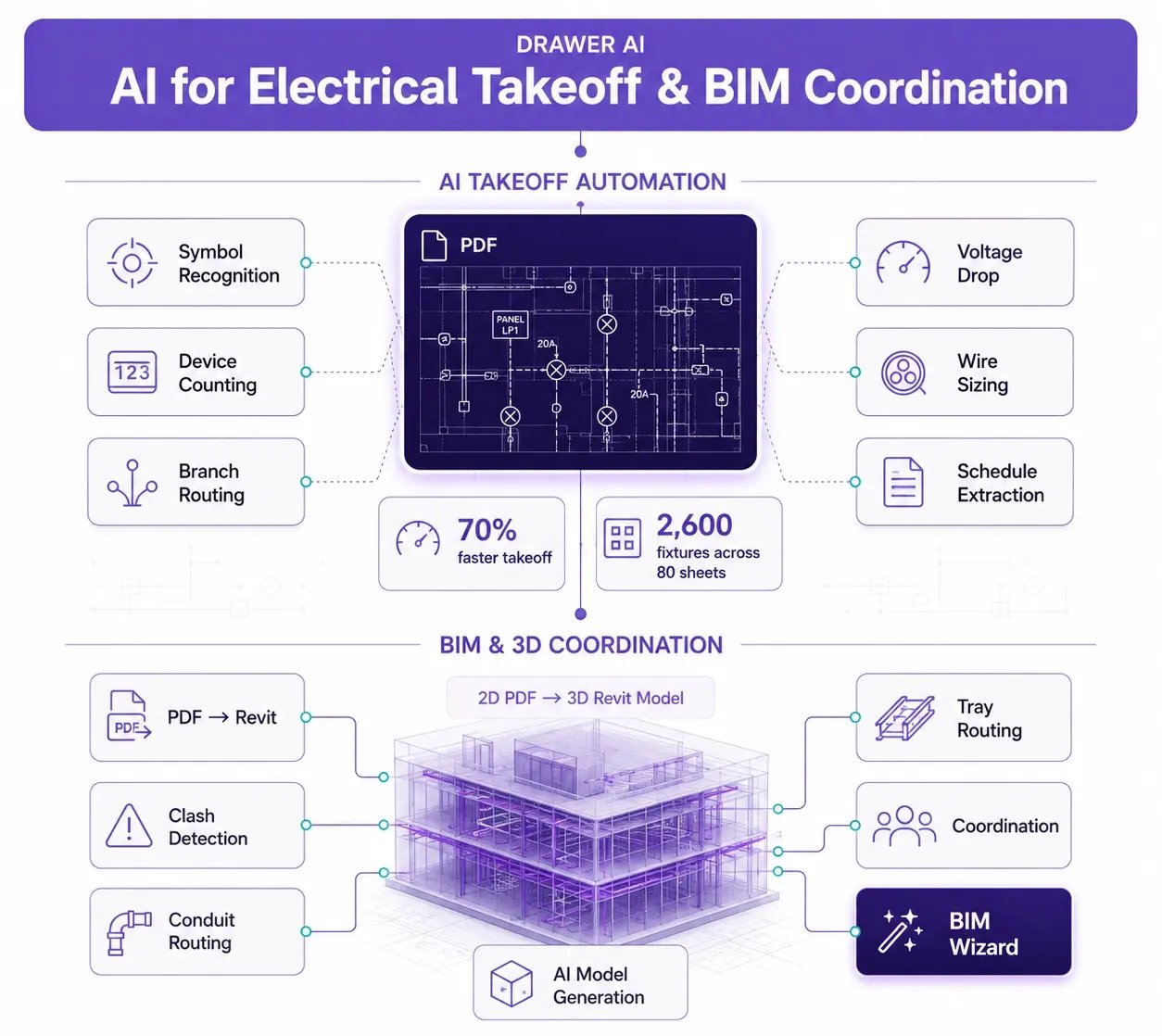
BIM and 3D coordination is the next AI frontier for electrical contractors. The challenge: most BIM tools assume you already have a fully built Revit model, which is exactly what most electrical subs don't have. They receive 2D PDF plans from the architect and have to build the model themselves before any coordination can start.
Drawer AI's BIM Wizard solves that problem head-on. It generates 3D Revit models directly from 2D PDF plans, skipping the manual modeling step that used to take weeks of drafter time.
Once the 3D model exists, AI handles two big jobs: conduit and tray routing inside the model, and clash detection against mechanical and structural systems. Catching a conduit-versus-duct conflict on screen costs nothing; catching it in the ceiling above a finished hospital corridor costs five figures and a change order.
Other tools in this space:
What sets Drawer AI's BIM Wizard apart is the starting point. The other tools assume you already have a Revit model. BIM Wizard builds one from your PDF plans, which is the workflow most electrical subs actually have.
Artificial intelligence is beginning to play a role in cost forecasting and market intelligence for electrical contractors, although its applications in this area are still developing. AI-powered tools are increasingly used to predict material price swings, including fluctuations in the costs of copper, aluminum, and switchgear. By analyzing vast amounts of historical project data, these systems aim to identify patterns and anticipate changes in pricing, helping contractors make more informed decisions when planning bids and budgets.
In addition to material cost forecasting, AI platforms are designed to project labor costs by examining previous project outcomes and market trends. The analysis of historical data allows for better pricing strategies, providing contractors with insights into how labor costs might shift over time. However, while AI offers valuable forecasting capabilities, it is not yet considered reliable enough for precise bid pricing. Most contractors continue to rely on supplier quotes and established sources like NECA labor units for their estimates, using AI as an additional layer rather than a replacement for traditional methods.
Several companies are working to advance pricing intelligence tools, such as Gordian and RSMeans integrations, which leverage AI to provide market insights and support cost estimation. These platforms seek to enhance the accuracy of forecasts by combining AI-driven analysis with industry-standard data sources. Despite these innovations, most electrical contractors still trust direct supplier quotes and tried-and-true labor unit calculations for their bidding processes.
Artificial intelligence is beginning to transform document management and the generation of Requests for Information (RFIs) in the electrical contracting industry. AI-enabled platforms now have the capability to read and analyze specifications and contracts, automatically flagging potential risks and identifying scope gaps that might otherwise be overlooked during manual reviews. This proactive approach helps contractors spot issues earlier in the project lifecycle, reducing the likelihood of costly mistakes or misunderstandings.
One notable advancement is the use of AI to detect inconsistencies within project drawings and documentation, enabling the automatic generation of RFIs. By comparing and cross-referencing documents, AI can identify areas where clarification is needed, streamlining communication between project stakeholders and expediting the resolution of ambiguities. In addition, AI-powered systems can track addenda and changes to project documents in real time, ensuring that all team members are working from the most current information without the need for manual tracking.
Several tools are emerging in this space. DocumentCrunch leverages AI to assess contract risk, while Procore has introduced AI-driven features to streamline document workflows. Despite the promise of these technologies, adoption remains in its early stages, with most contractors yet to fully implement AI solutions in their document management processes.
Artificial intelligence is beginning to reshape how electrical contractors approach field productivity and tracking of installed quantities. One of the primary applications involves comparing estimated quantities versus those actually installed on-site. By leveraging AI, contractors can more accurately monitor project progress and identify discrepancies between planned and completed work, reducing surprises and supporting more effective project management.
AI-powered analysis of field photos, including images captured by drones and site cameras, is emerging as a valuable tool for tracking project advancement. These systems can automatically process visual data to assess installation status and measure quantities in real time, minimizing the need for manual counts and site walks. Additionally, AI can analyze this information to provide insights into labor productivity, helping teams understand where efficiencies can be gained and where delays may be occurring.
While these capabilities represent some of the most futuristic uses of AI in construction, they are not yet standard practice among electrical subcontractors. Concepts like site-sync and drone-based progress tracking point to where the industry is heading, offering a glimpse of a future in which AI-driven tools are fully integrated into the daily operations of project teams.
AI is genuinely useful in the categories above. Here's the honest list of what it still can't do for an electrical contracting business, and probably won't for some time.
The pattern: AI replaces repetition, not expertise. Estimators and PMs who use AI well will out-produce the ones who don't, but the job itself, interpreting, deciding, negotiating, applying trade knowledge, stays with the human.
Looking ahead over the next two to five years, the integration of artificial intelligence in electrical construction is expected to progress in practical, transformative ways. While these advancements remain forward-looking, they are grounded in the current trajectory of industry innovation and emerging technologies.
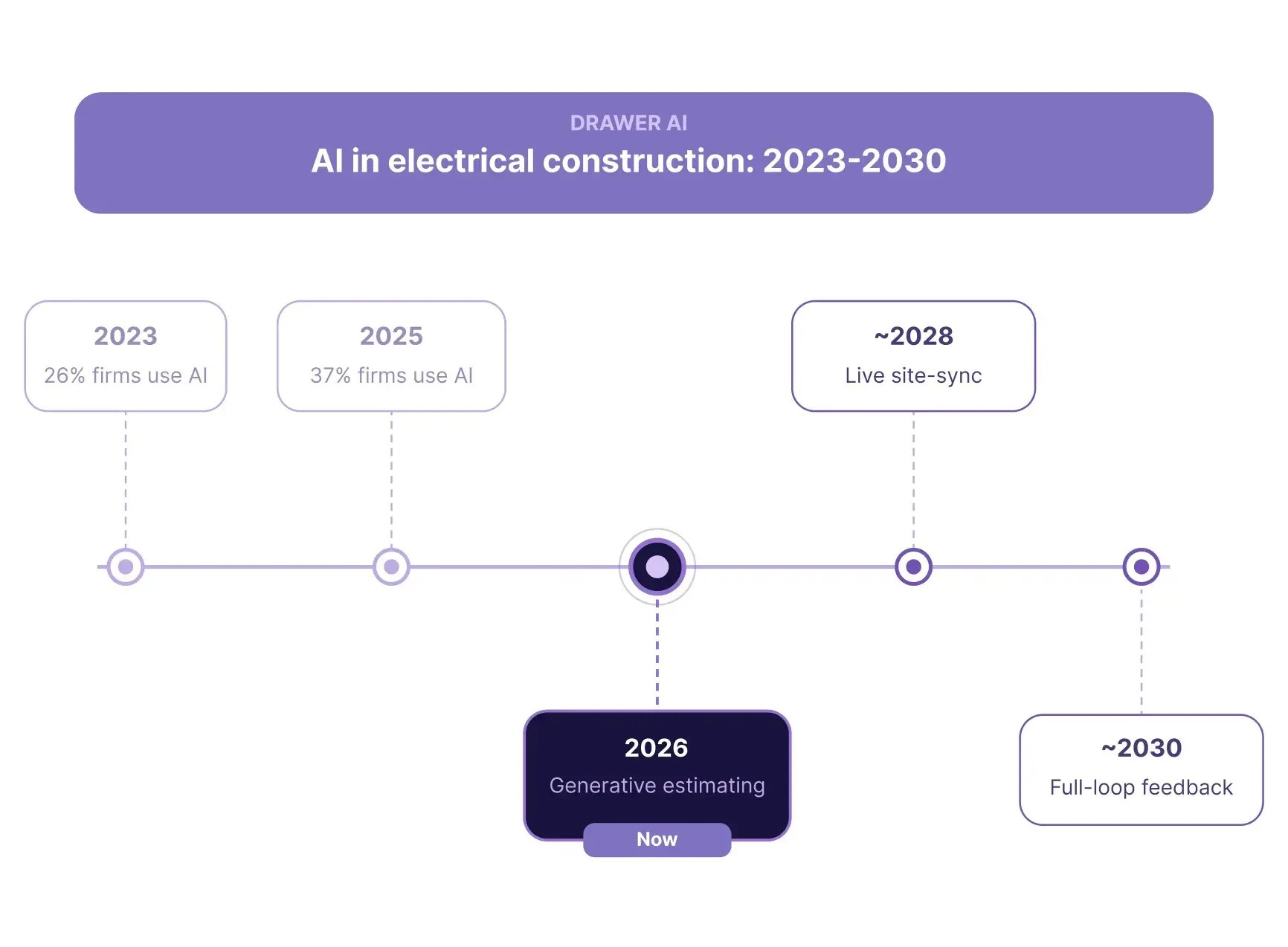
These advancements reflect a realistic roadmap for AI in electrical construction, echoing industry trends and laying the groundwork for more sophisticated applications in the years ahead.
Picking the right AI tool is a procurement decision, not a hype decision. The questions below are vendor-neutral; ask them on every demo call before you sign anything.
1. Was the model trained on electrical drawings specifically, or generic construction? Symbol libraries, branch routing, and panel schedules are very different from general construction takeoff. Generic models often miss the details that matter most to an electrical estimator.
2. Can I test it on my own drawings, not the vendor's demo files? Demo files are curated. Your bid set is messy, marked up, and full of vendor-specific symbols. The product needs to handle that, not a sanitized PDF.
3. What does the output look like: Excel, PDF, Revit? Make sure the format drops cleanly into the estimating system, BIM model, or proposal template you actually use. A tool that won't export to your workflow is one you'll abandon in two months.
4. What happens when the AI gets it wrong? Is there a built-in QA or review step? Every AI tool makes mistakes. The good ones make those mistakes visible and easy to correct; the bad ones bury them under a confidence score.
5. What's the pricing model: per project, per seat, or per month? Understand the unit economics before you commit. A per-project price that looks cheap on a single bid can scale into a problem when you're running 40 takeoffs a month.
The framework is vendor-neutral by design. We'll note that Drawer AI scores well on all five (electrical-specific training, demos on your own drawings, built-in QA), but the same questions sort real products from marketing slides regardless of who you're evaluating.
AI for electrical contractors is no longer a future bet. Takeoff and BIM are mature. Cost forecasting and field tracking are getting there. The contractors pulling ahead in 2026 are the ones who picked one mature use case (usually takeoff), got it producing real bids, and then expanded from there.
Want to see what AI takeoff looks like on your own drawings? Book a Drawer AI demo and run it against your last bid set. You'll know within an hour whether it earns a seat in your workflow.

14425 Falcon Head Blvd
Building E, Suite 100,
Austin, TX 78738
Created by Estimators, Powered by AI and Innovation
Copyright © 2026 Drawer AI. All rights reserved.