
AI




Proper branch circuit rating is essential to ensure electrical safety, maintain compliance with applicable codes, and produce accurate panel schedules. Selecting the correct rating for branch circuits helps prevent potential hazards, such as overloading, and supports the reliability and efficiency of electrical systems.
This will address the key factors that determine the rating of a branch circuit. It will also provide an overview of best practices based on the National Electrical Code (NEC) to guide proper selection and implementation of branch circuit ratings.
Table of Сontents
A branch circuit is a fundamental component of any electrical distribution system. In practical terms, it is the portion of the wiring system that runs between the final overcurrent protective devices such as a circuit breaker or fuse in the panelboard and the outlets or loads it supplies. This means that after the breaker or fuse, all wiring leading to devices like receptacles, lighting fixtures, or appliances is part of the branch circuit. For more information, see https://drawer.ai/blog/branch-circuits-vs-feeders.
Branch circuits are rated for specific current capacities, typically 15 or 20 amperes for general-purpose lighting and receptacle circuits. Higher ratings are used for dedicated circuits supplying larger appliances, such as ranges, dryers, or air-conditioning equipment. Lighting circuits often use lower ratings, while circuits for receptacles and appliances may require higher ratings depending on the load. The focus of this discussion is on how these ratings are determined to ensure safety and compliance, rather than the basic definition of a branch circuit.
The National Electrical Code (NEC) establishes the foundation for determining branch circuit ratings to ensure electrical safety and reliability. The NEC provides clear guidelines on how to select appropriate ratings for branch circuits, taking into account the type of load, the intended use, and the capacity of conductors and overcurrent protective devices.
According to the NEC, the rating of a branch circuit must match or exceed the expected load. The code specifies minimum ampacity requirements for conductors and dictates the maximum allowable load for each branch circuit. For example, general-purpose branch circuits are typically rated at 15 or 20 amperes, which are common ratings for receptacle and lighting circuits in residential and commercial buildings. These ratings are chosen to prevent overheating, reduce the risk of fire, and deliver consistent performance for connected devices.
The NEC also outlines the need to consider the type of connected loads—such as continuous or noncontinuous—and to apply ampacity adjustments where necessary. For instance, if a branch circuit is expected to serve continuous loads, the code requires derating of the circuit's capacity to add a margin of safety. This is to ensure that conductors and protective devices are not subjected to prolonged stress that could lead to failure.
In summary, NEC’s requirements for branch circuit ratings serve as the benchmark for safe electrical design. These regulations guide the selection of conductor sizes, overcurrent protective devices, and circuit ratings based on the anticipated electrical demand, the nature of the loads, and the environment in which the wiring is installed. Proper application of NEC rules ensures compliance, enhances safety, and maintains the integrity of electrical systems.
The 2026 NEC continues to require that branch circuits be rated according to the amount of current they need to carry safely. This means that the circuit wiring and the circuit breaker or fuse must be able to handle the load without overheating or tripping unnecessarily. For everyday use, most lighting and outlet circuits are rated at either 15 or 20 amps, which is enough for most household and office needs.
The code also says that if you know a circuit will be used for something that runs for a long time—like a heater or a bank of lights you expect to stay on for hours—you need to make sure the circuit can handle that extra demand. This is done by reducing the amount of current the circuit is allowed to carry, creating a buffer for safety.
In practice, following the NEC means checking the expected loads, picking the right wire size and breaker, and making sure everything matches up. This keeps the system safe, prevents fires, and ensures that devices work as expected.
The rating of a branch circuit is determined by several fundamental factors that work together to ensure safety, reliability, and compliance with the National Electrical Code (NEC). Understanding these determinants is essential for designing electrical systems that operate efficiently and protect against hazards. The following subpoints break down the core considerations:
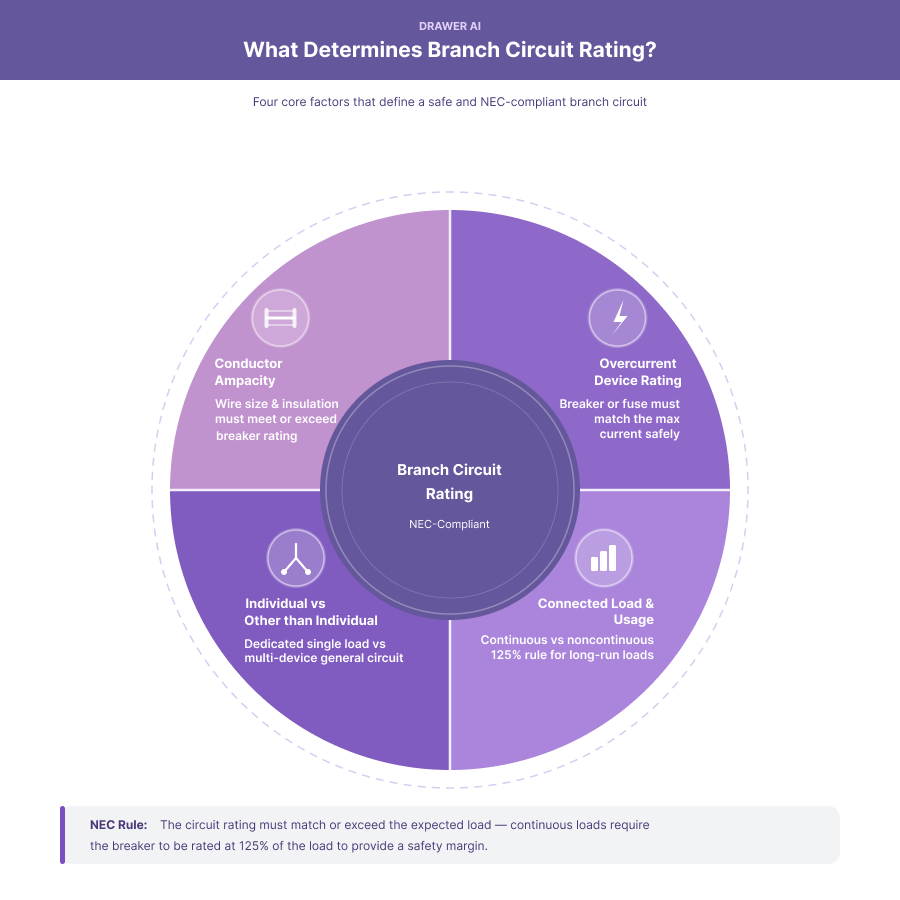
A branch circuit’s rating begins with the selection of the overcurrent protection device, such as a circuit breaker or fuse. This device is responsible for interrupting the flow of electricity if the current exceeds safe levels. The rating of the breaker or fuse must match the maximum current the circuit is expected to carry without causing unnecessary tripping or overheating. By specifying the correct rating for the overcurrent device, the system is protected from potential fire risks and equipment damage.
Conductor ampacity refers to the maximum amount of current that the circuit wiring can safely carry. This is determined by the size and type of conductors used, as well as their insulation and installation environment. The ampacity rating must be equal to or greater than the rating of the overcurrent device to prevent the wires from overheating. Choosing the proper wire size ensures that the conductors can handle the load and maintain overall system integrity.
The expected load on the branch circuit is a critical determinant for its rating. This includes the total amount of current drawn by all devices and appliances connected to the circuit. Circuits must be rated to handle both continuous and noncontinuous loads. For continuous loads—those running for extended periods—the NEC requires the circuit to be derated to add a margin of safety. Accurately assessing the connected load and how the circuit will be used ensures that the circuit will operate safely and efficiently.
Branch circuits can be classified as individual or “other than individual,” depending on their intended purpose. Individual branch circuits are dedicated to a single appliance or piece of equipment, such as a motor or range, and are rated based on the specific requirements of that device. “Other than individual” branch circuits, such as general-purpose circuits, are designed to supply multiple devices and are rated based on the combined expected load. This distinction helps tailor the circuit rating to the application, ensuring safe and proper operation.
For instance, a general-purpose lighting circuit in a home is typically rated at 15 or 20 amperes. The breaker is selected to match this rating, and the wire chosen must have an ampacity of at least 15 or 20 amps. The expected load—such as several light fixtures and outlets—is calculated to ensure it does not exceed the circuit’s rating. This setup provides a balance between safety, reliability, and everyday functionality.
The 2023 National Electrical Code (NEC) introduces a new option allowing for 10‑amp branch circuit ratings in certain circumstances. This update is specifically geared toward “other than individual branch circuits,” meaning these circuits are not dedicated to a single appliance or piece of equipment. However, a key restriction is that 10‑amp branch circuits cannot be used to supply receptacle outlets.
The intent behind this provision is to address applications with small, well‑defined loads. Typical examples include circuits for LED lighting systems or alarm panels, where the electrical demand is limited and predictable. By allowing a lower ampacity rating, the NEC provides more flexibility for designers in situations where a full‑sized branch circuit would be excessive for the intended load.
For electrical designers and estimators, the introduction of the 10‑amp circuit option brings both opportunities and considerations. These circuits may be appropriate where the connected load is minimal and clearly defined, such as specialized lighting or control systems. However, it is important to avoid using them in situations where additional load might be added in the future, or where receptacle outlets are required. Careful planning is essential to ensure the circuit remains compliant with code requirements and continues to operate safely throughout its lifecycle.
Branch circuit ratings are determined by a combination of factors, including the expected load, breaker rating, conductor ampacity, and the specific needs of the devices or appliances connected to the circuit. Below are several examples that illustrate how these factors interact in the real world to determine the appropriate circuit rating.
A dedicated circuit is installed for a kitchen refrigerator. The appliance manufacturer specifies a requirement for a 15-amp circuit. The breaker is selected to match this rating, and the conductor must have an ampacity of at least 15 amps. The key factor determining the rating here is the appliance’s load requirement, which dictates both the breaker size and the minimum wire gauge needed for safe operation.
For a general-purpose lighting circuit in a residential living room, several light fixtures and outlets are combined on a single circuit. The total expected load is calculated to ensure it does not exceed the circuit’s rating. A 20-amp breaker is chosen, and the conductor selected has an ampacity of at least 20 amps. Here, the combined expected load of all connected devices is the main factor guiding the rating, bounded by the breaker and conductor specifications.
In a commercial setting, a circuit is designed exclusively for an LED lighting system with a predictable and limited electrical demand. The load is small and well-defined, so a 10-amp breaker is used, and conductors are chosen accordingly. Since the circuit does not supply receptacle outlets and the load is minimal, the low ampacity rating is possible and appropriate. The determining factor here is the specific, limited load, which allows for a smaller circuit rating without compromising safety or code compliance.
When designing and installing branch circuits, adhering to National Electrical Code (NEC) guidelines is essential to ensure safety, reliability, and compliance. By following best practices for circuit ratings, professionals can avoid common pitfalls and maintain optimal performance in various applications. Below is a structured overview of recommended approaches for NEC‑aligned branch circuit ratings.
By following these best practices, electrical designers and installers can ensure that branch circuit ratings are properly aligned with NEC standards. This approach supports both safety and efficiency in residential, commercial, and specialized applications.
When designing and installing branch circuits in accordance with the National Electrical Code (NEC), several common mistakes can undermine safety and compliance. Recognizing these pitfalls is essential for electrical professionals aiming to maintain high standards and avoid costly errors.
By identifying these common mistakes and applying NEC-aligned guidance, professionals can consistently achieve safe, reliable, and compliant branch circuit installations.
In summary, recognizing common mistakes—such as overloading general-purpose circuits, improper use of lower ampacity ratings, and neglecting dedicated circuits for appliances—is crucial for ensuring safe and compliant electrical installations. By carefully assessing load requirements, matching ratings precisely, calculating combined loads, planning for future expansion, and using dedicated circuits for specific appliances, professionals can uphold National Electrical Code (NEC) standards and maintain system reliability. These NEC-aligned practices help prevent hazards and support long-term operational integrity.
To streamline your branch circuit planning and avoid these pitfalls, use Drawer AI. Drawer AI offers intelligent guidance aligned with NEC concepts, assisting professionals in accurate load calculation, circuit sizing, and future-proofing designs. Try the demo to see how it works in real projects and how it can improve your estimating workflow. Integrating Drawer AI into your workflow ensures safer installations and consistent code compliance, empowering you to deliver quality electrical work every time.

14425 Falcon Head Blvd
Building E, Suite 100,
Austin, TX 78738
Created by Estimators, Powered by AI and Innovation
Copyright © 2026 Drawer AI. All rights reserved.