AI




Understanding the role of branch circuits and feeders is fundamental for anyone working with electrical systems. This section provides clear definitions, explains the methods for calculating branch circuit requirements, and highlights the differences between branch circuits and feeders. By exploring these concepts, readers will gain the foundational knowledge necessary for designing safe, effective, and code-compliant electrical installations.
Table of Сontents
A clear understanding of branch circuits, feeders, and their calculations is essential for ensuring safety, meeting code compliance, and achieving efficient electrical system design. Proper knowledge helps prevent hazards, supports adherence to regulations, and optimizes the performance and reliability of electrical installations.
Branch circuits are the portions of an electrical system that deliver power from the distribution panel directly to individual loads, such as lighting or appliances. Feeders, on the other hand, are conductors that carry electricity from the main service equipment to distribution panels or subpanels, supplying groups of branch circuits.
Branch Circuit Definition
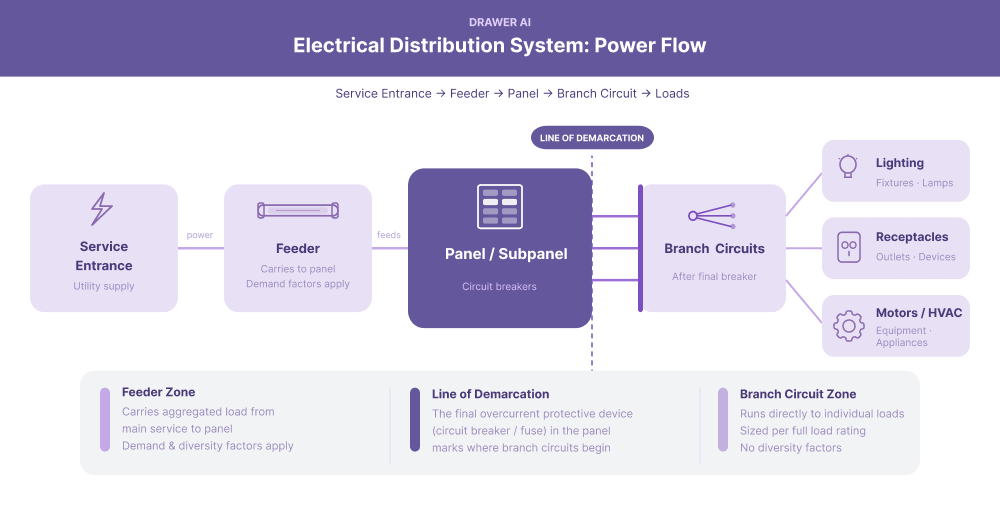
A branch circuit is the segment of an electrical system that begins immediately after the final overcurrent protective device such as a circuit breaker or fuse within a panelboard or distribution panel. This section of wiring, including all conductors and associated devices, is responsible for delivering power directly to the system’s outlets and equipment. It comprises all wiring and connections that distribute electricity to the end-use locations within a building or installation.
Starting and Ending Points in a Distribution Diagram
On a standard distribution diagram, the branch circuit is clearly distinguished by its starting and ending points. It starts at the output terminal of the last overcurrent protective device in the distribution system this is typically found in the main panelboard or subpanel. The branch circuit ends at the various loads it supplies, which may include outlets (such as wall receptacles), lighting fixtures, motors, appliances, or other connected devices. Essentially, the branch circuit represents the final path electricity takes before reaching devices that use electrical power.
Loads Served by Branch Circuits
Branch circuits are designed to provide power to a wide variety of end-use loads. Common examples include general lighting, wall receptacles (outlets for plugging in devices), motors (such as those used in HVAC systems or appliances), and an array of household or commercial appliances. Each branch circuit may be dedicated to a single type of load or serve multiple types, depending on the design and requirements of the electrical installation. The versatility of branch circuits allows them to support nearly all common electrical needs within a building, from simple lighting to complex equipment, while ensuring that each load receives power safely and efficiently.
Overview of Common Categories
Branch circuits are categorized based on the types of loads they serve and their specific functions within an electrical system. The three most common categories include general purpose branch circuits, individual branch circuits, and small-appliance or equipment-specific branch circuits. Each category is designed to address unique requirements regarding safety, performance, and code compliance, ensuring that the electrical system operates efficiently and reliably. Understanding these categories helps in planning, installation, and maintenance by matching circuit types to the intended loads and usage patterns.
General Purpose Branch Circuits
General purpose branch circuits are designed to supply power to various loads such as lighting fixtures and wall receptacles. These circuits are often used in areas like office zones, where multiple devices and lights may be connected to the same circuit. Their versatility makes them suitable for serving a wide range of electrical needs in residential, commercial, and industrial environments. Typically, these circuits are rated at 15 or 20 amperes, depending on the anticipated load and building codes – see our guide to branch circuit ratings for how these are set. They are commonly found in living rooms, bedrooms, and general office spaces, providing power for everyday electrical devices like lamps, computers, televisions, and small appliances. Designers must consider the combined load of all devices that might be used simultaneously to prevent overloading the circuit, which could lead to tripped breakers or potential hazards.
Individual Branch Circuits
Individual branch circuits are dedicated to a single large load, such as a motor or HVAC unit. These circuits are specifically designed to supply power to one device, ensuring that the load receives sufficient electricity without sharing the circuit with other devices. This approach enhances safety and performance for equipment that requires substantial power. For example, a dedicated circuit might be installed for an electric water heater, an air conditioner, or a heavy-duty workshop tool. Individual circuits usually have their own breaker and are sized based on the specific load’s requirements, including starting currents for motors or continuous operation for heating elements. This isolation prevents interference from other devices, reduces the chance of nuisance tripping, and complies with code mandates for certain appliances.
Small-Appliance or Equipment-Specific Branch Circuits
Small-appliance or equipment-specific branch circuits are used to supply power to particular devices or appliances. These circuits are often designed with specific requirements in mind, such as kitchen appliances or specialized equipment, providing tailored electrical support for their intended use. For instance, the National Electrical Code (NEC) typically requires at least two dedicated 20-ampere circuits for kitchen countertop outlets, ensuring that high-demand small appliances like toasters, coffee makers, or microwaves have reliable power. Similarly, equipment-specific circuits might be required for laundry rooms, bathrooms, or workshops, where specialized tools or devices are used. These circuits help prevent nuisance tripping and ensure that essential appliances have sufficient power without interference from other loads.
Choosing Between Individual and General-Purpose Branch Circuits
A designer or contractor selects an individual branch circuit when there is a need to supply power to a single large load, such as a motor, HVAC unit, or other substantial equipment. This ensures that the device operates efficiently and safely, without the risk of overloading the circuit. In contrast, general purpose branch circuits are chosen for areas where multiple smaller loads, like lighting and receptacles, need to be served by the same circuit. This approach optimizes wiring efficiency and supports the diverse electrical needs of spaces such as offices, homes, and commercial environments. The choice depends on factors such as load size, appliance manufacturer recommendations, code requirements, and the expected usage pattern of the space. Proper selection helps maintain system reliability, simplifies troubleshooting, and reduces the chances of unintentional power interruptions.
In summary, understanding the differences between these types of branch circuits is fundamental for safe, efficient, and code-compliant electrical design. Proper categorization and selection ensure that all connected devices receive appropriate power, minimize risks, and facilitate maintenance in residential, commercial, and industrial installations.
Branch circuit calculations play a critical role in electrical design, ensuring that each circuit is properly sized to safely and efficiently support the intended loads. By accurately determining the electrical demands of appliances, lighting, and equipment, designers and contractors can select circuits that minimize risks of overload, comply with code requirements, and provide reliable power distribution. Understanding how to perform these calculations is fundamental for both new installations and upgrades, as it helps maintain system integrity and facilitates troubleshooting in residential, commercial, and industrial settings.
Consider a scenario in a commercial space where eight lighting fixtures, each rated at 120 W, are installed and expected to operate continuously for more than three hours. First, calculate the total load: 8 fixtures × 120 W = 960 W. Since lighting is treated as a continuous load, apply the 125% factor: 960 W × 1.25 = 1,200 W. Convert watts to amperes for a 120 V circuit: 1,200 W ÷ 120 V = 10 A.
With a calculated continuous load of 10 A, select a breaker rated for at least 10 A. However, standard breaker sizes are 15 A or 20 A, so a 15 A breaker would be appropriate. Next, choose a conductor size that safely handles this current; typically, 14 AWG copper is used for 15 A circuits, but always confirm with local code requirements. This process ensures safe operation, prevents overload, and simplifies troubleshooting for commercial installations.
Understanding the distinction between feeder circuits and branch circuits is fundamental in electrical design and installation. Feeder circuits differ from branch circuits in their function and placement within the electrical system. Specifically, feeders are conductors that carry power from the service equipment or main distribution point to subpanels or distribution points. These feeders terminate before the branch circuit breakers, which mark the transition to branch circuits.
Feeder circuits are responsible for transferring electricity from the main service equipment or primary distribution board to secondary panels or distribution points. This occurs before the electricity is divided into individual branch circuits, which ultimately supply power to specific loads or devices. In contrast, branch circuits originate at the panel and run directly to the loads they serve.
The “line of demarcation” refers to the clear separation between different segments of the electrical distribution system. The typical sequence is: service entrance → feeder → panel → branch circuit → loads. This sequence illustrates how power flows from the main entry point, through feeders to panels, and then through branch circuits to individual devices or equipment.
Recognizing the difference between feeder and branch circuits is crucial for several reasons:
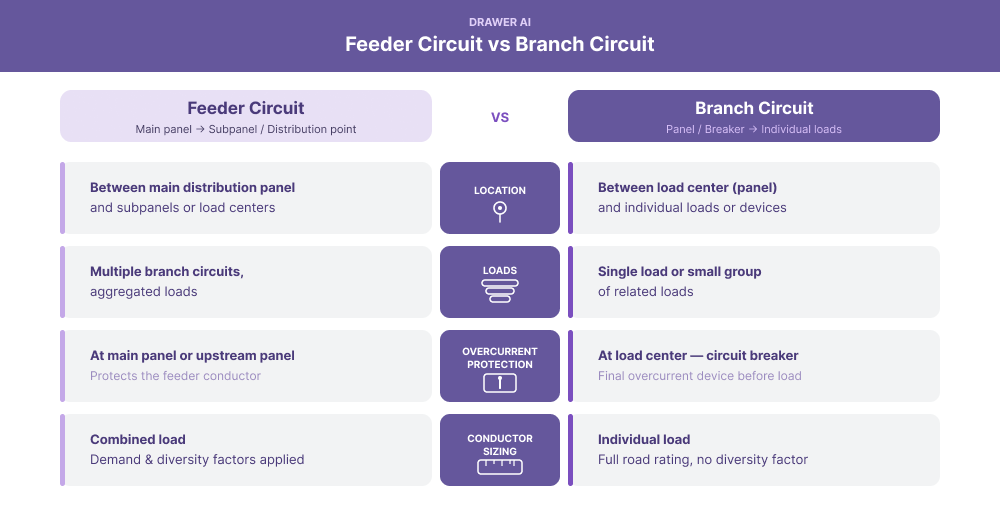
High-level feeder conductor considerations involve understanding the way feeders serve multiple branch circuits and the implications this has for conductor sizing.
Feeder conductor sizing is conceptually different from branch circuit sizing. While branch circuits are sized to serve specific individual loads, feeder conductors must be sized to carry the combined load of multiple branch circuits. This aggregation introduces additional factors and considerations into the sizing process.
Because feeders aggregate the loads of several branch circuits, it is common practice to apply demand and diversity factors. These factors account for the likelihood that not all loads will operate simultaneously, allowing for optimization in conductor sizing and overall system efficiency.
It is important to note that detailed procedures for feeder conductor sizing must be based on the National Electrical Code (NEC) and applicable jurisdictional codes. These procedures are complex and cannot be fully reproduced here; see our full guide to sizing conductors for branches and feeders for the NEC tables and worked examples, and always consult relevant codes for specific requirements.
Design tools are essential for managing multiple branch circuits that feed from a common feeder. These tools can simulate expected loads, track conductor sizes, and assist in coordinating the various requirements associated with feeder and branch circuit design. Tools like Drawer AI take this further by pulling device and circuit data directly from project drawings and sizing branch and feeder runs against NEC requirements, which cuts manual calculation errors on larger systems.
The differences between feeder circuits and branch circuits are important to understand when designing electrical systems. The following table provides a straightforward comparison based on key aspects.
|
Aspect
|
Feeder Circuit
|
Branch Circuit
|
|
Typical location in system
|
Between main distribution panel and subpanels or load centers
|
Between load center (panel) and individual loads (devices, outlets)
|
|
Typical loads served
|
Multiple branch circuits, aggregated loads
|
Single load or small group of related loads
|
|
Overcurrent protection location
|
At main panel or upstream panel
|
At load center or panel, typically at the circuit breaker
|
|
Conductor sizing considerations (conceptual)
|
Based on combined load, demand and diversity factors applied
|
Based on individual load, typically no diversity factor
|
|
Common mistakes
|
Failing to apply demand/diversity factors; undersizing due to incorrect aggregation
|
Oversizing or undersizing for the specific device; neglecting load type
|
When working with electrical systems, following established best practices helps ensure safety, compliance, and accuracy throughout the design and installation process. The following guidelines are recommended for effective fieldwork:
In summary, following best practices for electrical system design and installation—such as accurately distinguishing between feeders and branch circuits, docume nting key assumptions, utilizing standardized calculation methods, and adhering closely to the latest NEC and local codes—is critical for ensuring safety, compliance, and reliability. By maintaining a disciplined approach in these areas, you can reduce the risk of errors and facilitate smoother project execution.
To further streamline your workflow and enhance accuracy, consider integrating Drawer AI into your process. Leveraging this tool can help automate calculations, document assumptions, and ensure your work aligns with current codes and standards. If you're ready to take the next step, you can request a demo to see how it supports greater efficiency and peace of mind in your electrical projects.

14425 Falcon Head Blvd
Building E, Suite 100,
Austin, TX 78738
Created by Estimators, Powered by AI and Innovation
Copyright © 2026 Drawer AI. All rights reserved.