
AI





A commercial estimator can finish a takeoff, build a panel schedule, and still have a bad bid if the load calculation is wrong. The calculated load drives whether a feeder is large enough, whether a service can support the project, and whether the distribution equipment selected during estimating is even in the right range. The challenge is that connected load is not always the same as calculated load, and the rules change by occupancy and load type.
Table of Сontents
The 2026 NEC makes one major navigation change: branch-circuit, feeder, and service load calculations now live in Article 120, while the 2023 and 2020 editions place this material in Article 220. A NEC load calculation must therefore be tied to the edition named in the project documents. Because AHJ adoption always lags the newest edition, estimators need to recognize both numbering systems and verify that edition before pricing.
This guide stays commercial. We will build one 50,000 sq ft office example from general lighting through receptacles, demand factors, feeder/service load, and HVAC. The goal is to understand what belongs in the calculation, which reductions are permitted, and where an incorrect assumption can undersize the electrical system.
A commercial load analysis converts the loads shown on drawings, schedules, specifications, and equipment data into the minimum calculated electrical load that must be supported by a branch circuit, feeder, panel, or service. It is not simply the arithmetic sum of every breaker or every nameplate. The NEC separates load categories because lighting, receptacles, motors, HVAC equipment, and other loads do not all use the same calculation rules.
For an estimator, the purpose is practical: validate panel and feeder assumptions before pricing conductors, raceways, overcurrent devices, switchboards, transformers, and related labor. Engineers normally establish the design calculation, but estimators still need enough code fluency to recognize when a schedule, addendum, or takeoff assumption is inconsistent.
The phrase electrical load calculation describes the process; the governing NEC article tells you how to perform it. A defensible NEC load calculation follows three steps: identify connected loads, apply the code rules and permitted demand factors, then convert the resulting VA or kVA into current for the applicable system voltage. The exact 2026 article and table numbers are mapped in the next section.
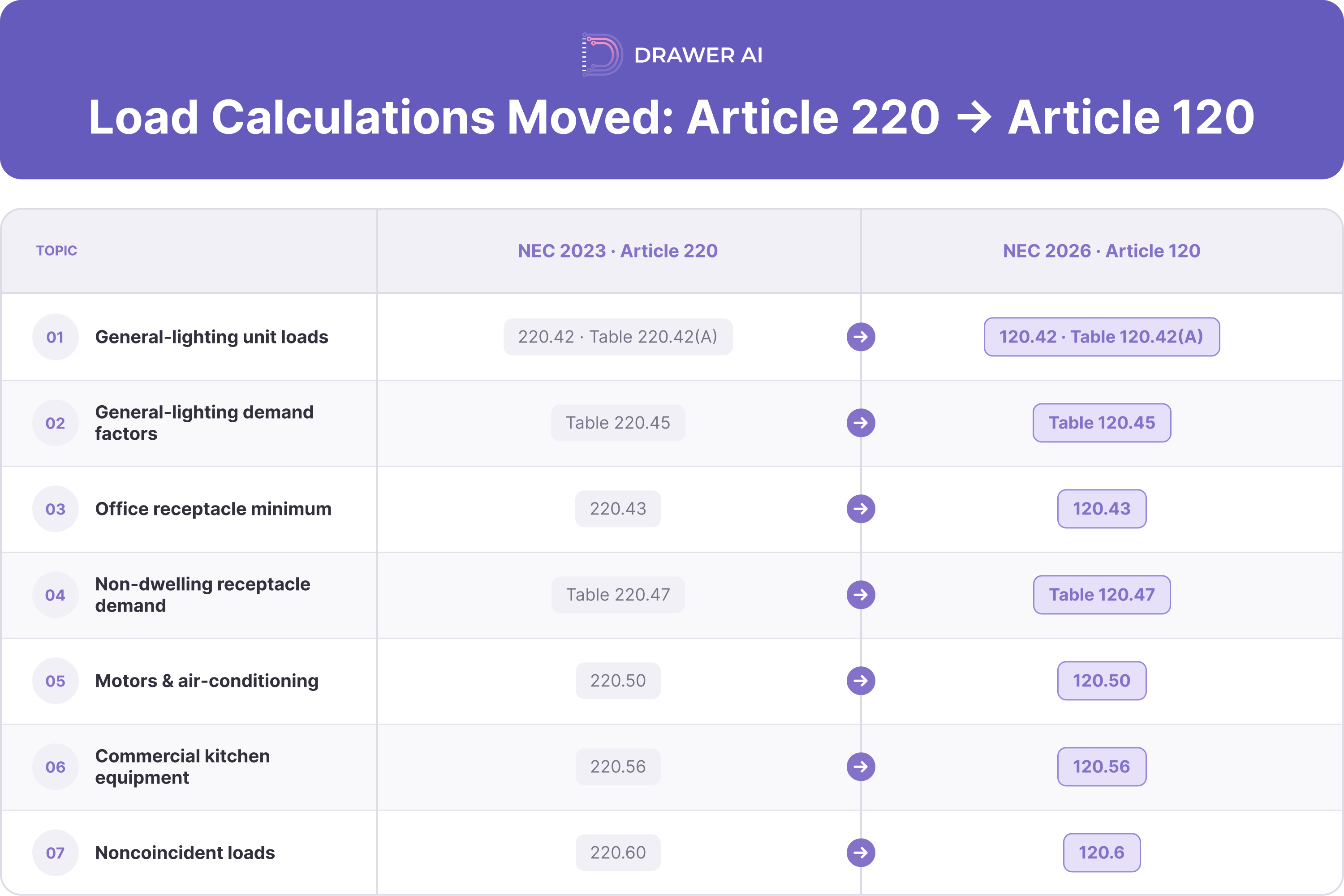
In NEC 2026, Article 120 is titled Branch-Circuit, Feeder, and Service Load Calculations. It replaces the Article 220 location familiar to estimators using the 2023 NEC. The technical workflow is recognizable, but the article number changes, so a bid review should never assume that a citation copied from an older worksheet is current.
For the commercial topics used in this guide, the crosswalk is straightforward: 2026 Section 120.42 and Table 120.42(A) [2023 Section 220.42 and Table 220.42(A)] cover non-dwelling general-lighting unit loads; Table 120.45 [2023 Table 220.45] covers general-lighting demand factors; Section 120.43 [2023 220.43] contains the office-building receptacle minimum; Table 120.47 [2023 Table 220.47] covers non-dwelling receptacle demand; Section 120.50 [2023 220.50] points to motor and air-conditioning rules; Section 120.56 [2023 220.56] covers commercial kitchen equipment; and Section 120.6 [2023 220.60] addresses noncoincident loads.
If a project is still on an older edition, confirm the adopted code and local amendments before using any section number or table value. Searches for load calculations nec guidance often mix editions, which is why the code year belongs on every working calculation and estimating worksheet.
Code source: NFPA 70, National Electrical Code (NEC), 2026 edition. Use the edition adopted by the project AHJ.
For non-dwelling occupancies, NEC 2026 Table 120.42(A) [2023 Table 220.42(A)] establishes minimum general-lighting unit loads by occupancy. This is where an estimator should start the lighting load calculation nec check: identify the actual occupancy, use the applicable VA per square foot, and multiply by the floor area determined under the calculation rules. Do not carry forward an old 3.5 VA/sq ft office value from a legacy worksheet without checking the edition.
Table 120.42(A) lists Office at 1.3 VA/sq ft. For this example, the 50,000 sq ft office therefore carries a minimum general-lighting load of 65,000 VA, or 65 kVA. Under Article 120, the load calculation itself no longer requires continuous loads to be taken at 125 percent; that adjustment applies later, when sizing conductors and overcurrent protection. Separately, the Table 120.42(A) unit values are not to be multiplied by an additional 125 percent for continuous loading. If the actual designed lighting load, handled under the applicable rules, controls instead, document that basis clearly. Also confirm how the floor area was established and whether the project documents divide the building into more than one occupancy. A mixed-use floor should not be priced by applying one office value to every square foot. Keep the occupancy basis beside the area takeoff so revisions to room use can be traced directly into the calculated lighting load.
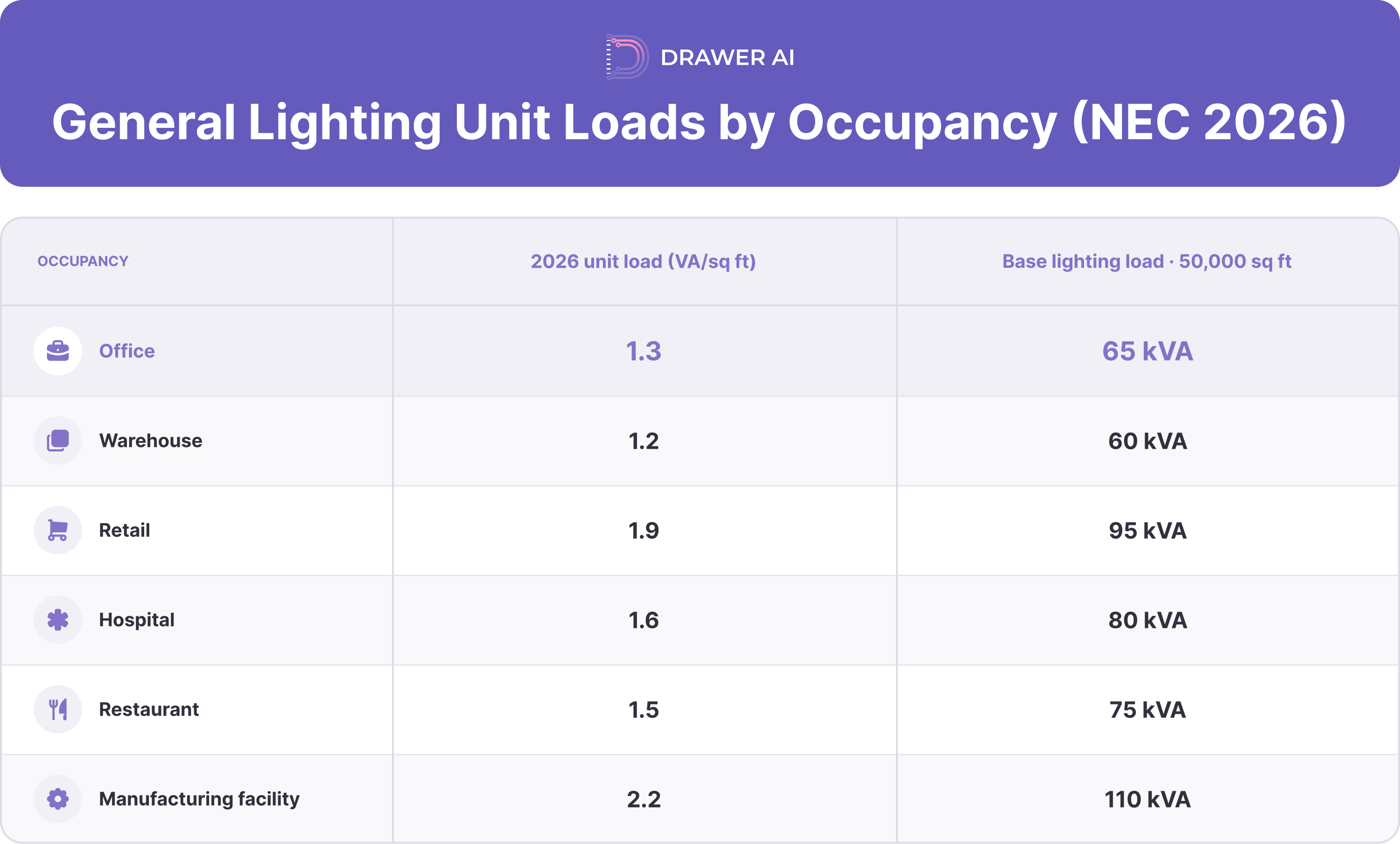
Source: NFPA 70, NEC 2026, Table 120.42(A). Excerpt only; obtain the full NEC for the complete table and notes.
50,000 sq ft x 1.3 VA/sq ft = 65,000 VA = 65 kVA
The office therefore carries 65 kVA of minimum general-lighting load at this stage. For an office, the lighting demand factor does not reduce that figure later; that distinction becomes critical in the demand-factor section.
General-use receptacles in non-dwelling occupancies are calculated separately from the office lighting load. Under NEC 2026 Section 120.14(I) [2023 Section 220.14(I)], a single or multiple receptacle on one yoke is generally calculated at not less than 180 VA. Multioutlet assemblies and outlets for specific equipment have their own rules, so the takeoff should distinguish ordinary office receptacles from dedicated equipment outlets instead of assigning 180 VA to everything on the plan.
Continue the same office example with 400 duplex receptacles. The count is by yoke, not by the two contact devices on a duplex receptacle.
400 yokes x 180 VA = 72,000 VA = 72 kVA connected receptacle load
That 72 kVA is connected load, not necessarily the value that lands in the service calculation. Table 120.47 [2023 Table 220.47] allows demand to be applied to non-dwelling receptacle load: the first 10 kVA at 100 percent and the remainder at 50 percent. The office-specific rule in Section 120.43 [2023 220.43] then requires the receptacle load to be at least the larger of that demand calculation or 1 VA/sq ft.
For a nec panel load calculation, this is the kind of second-step rule that prevents an estimator from stopping at a single table lookup. Dedicated copiers, break-room appliances, IT equipment, elevators, and other scheduled loads must also be evaluated under the rules that apply to each load.
A demand factor recognizes that the maximum operating load expected on a feeder or service can be lower than the sum of all connected loads. The demand factor in electrical calculations is not a blanket percentage chosen by the estimator; it is permission tied to a specific NEC table, occupancy, or load category. Applying the wrong row can produce a number that looks efficient while actually understating the required capacity.
Start with lighting. Table 120.45 [2023 Table 220.45] includes specific reductions for certain occupancies, including warehouses. Offices fall under the 'all others' category and remain at 100 percent. That means our 65 kVA office lighting figure stays 65 kVA. A common estimating error is to see a warehouse reduction in the table, apply it to an office, and create an artificial savings. Occupancy controls the row; the estimator does not get to choose the most favorable factor.
Now apply the receptacle rule. The 72 kVA connected receptacle load is reduced under Table 120.47:
First 10 kVA x 100% = 10 kVA
Remaining 62 kVA x 50% = 31 kVA
Table 120.47 result = 41 kVA
Office minimum check: 50,000 sq ft x 1 VA/sq ft = 50 kVA
Section 120.43 requires the larger value, so the office receptacle load used in the calculation is 50 kVA, not 41 kVA. Our running subtotal is therefore 65 kVA lighting + 50 kVA receptacles = 115 kVA before HVAC, motors, and other project-specific equipment.
This is the core logic behind a demand load calculation: connected load is the starting inventory, while calculated load is the code-adjusted value after the correct demand, diversity, noncoincident, and equipment-specific rules are applied. Demand can reduce some categories, leave others unchanged, or impose a minimum that overrides an apparently lower result. Keep every intermediate value visible in the worksheet so another estimator or engineer can audit the path from drawings to final kVA. For bid QA, keep the connected value, the governing demand factor, and the calculated value in separate worksheet columns.
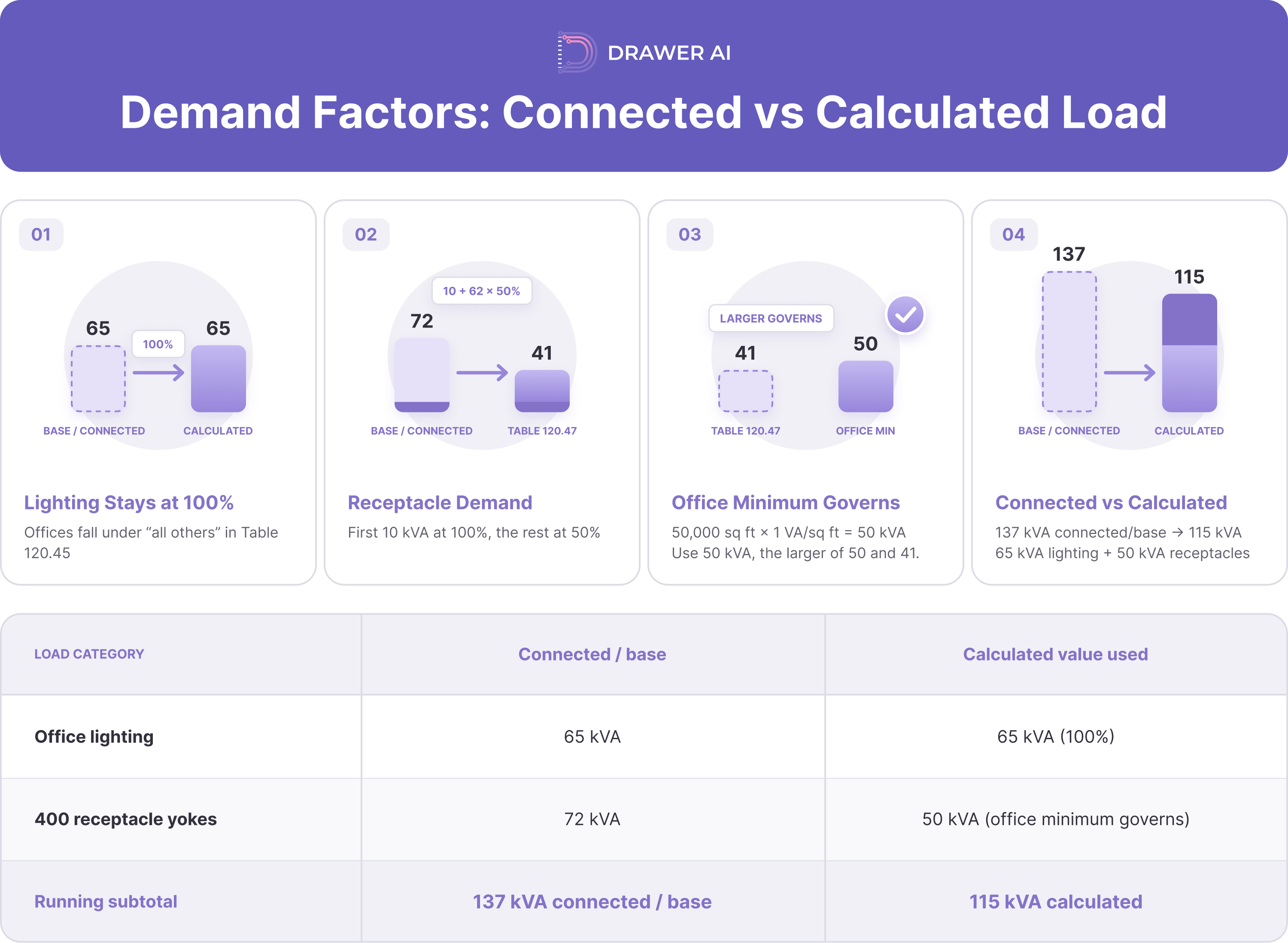
Source: NFPA 70, NEC 2026, Sections 120.43 and 120.45 and Table 120.47. Excerpted calculation logic only; consult the full code text.
Once the calculated VA is established, convert it to current at the actual system voltage and then size the feeder or service using the applicable NEC rules for conductors, terminals, overcurrent protection, and equipment ratings. The load calculation does not, by itself, select a conductor. It establishes the load that the downstream sizing rules must support.
For a three-phase system, the basic current conversion is VA divided by (1.732 x line-to-line voltage). For single-phase, divide VA by voltage. The result must still be reconciled with continuous-load rules where applicable, motor and HVAC requirements, neutral loading, terminal temperature limitations, ampacity adjustment and correction factors, parallel conductors, voltage drop requirements in the project specifications, and standard equipment ratings.
Suppose our final office calculation reaches 188 kVA after the mechanical loads described in the next section. On a 480Y/277 V, three-phase service:
188,000 VA / (1.732 x 480 V) = approximately 226 A
That 226 A is a calculated current, not an instruction to buy a 226 A breaker or a specific conductor. The estimator now checks the design documents and the applicable feeder/service and conductor rules to determine the actual equipment and conductor package. On a different voltage, the current changes even though the kVA does not.
After the service or feeder load is known, conductor ampacity, derating, raceway fill, terminal temperature, and voltage-drop checks become the next pricing step. See the related Conductor and Raceway Sizing: NEC Tables, Methods & Examples guide for that downstream sizing workflow. Keeping the load calculation separate from conductor sizing makes review cleaner and reduces double-counting of safety factors.
Commercial calculations become project-specific once mechanical and process loads enter the worksheet. NEC 2026 Section 120.50 [2023 220.50] directs motor calculations to Article 430 and air-conditioning loads to Article 440. Section 120.56 [2023 220.56] provides permitted demand factors for qualifying commercial kitchen equipment, while Section 120.6 [2023 220.60] permits noncoincident loads to be handled using the largest load or loads expected to operate at one time when the rule applies.
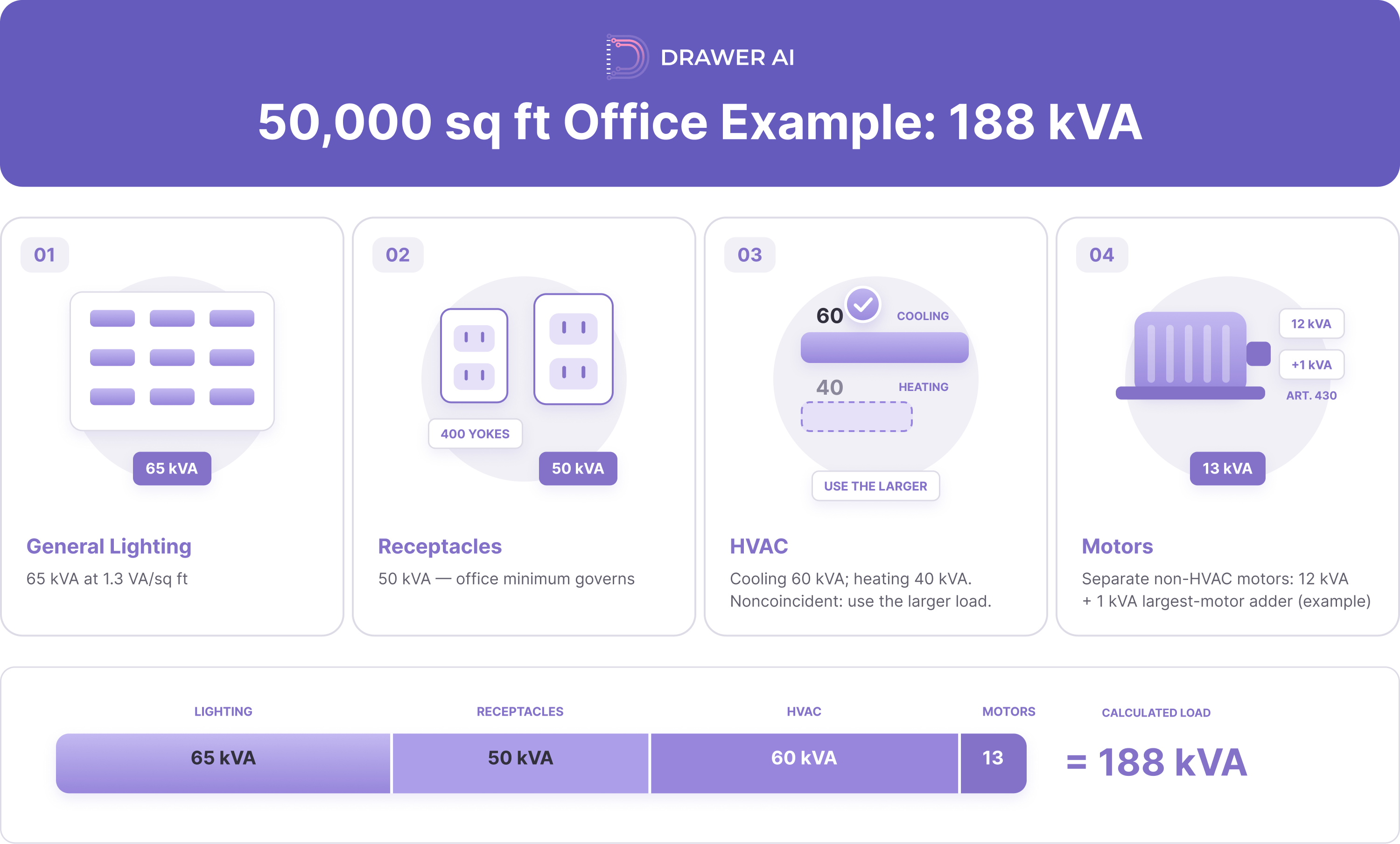
For the running office example, assume the mechanical schedule produces a 60 kVA calculated cooling load under Article 440 and a 40 kVA electric-heating load that is noncoincident with cooling. Use the 60 kVA cooling load rather than adding both. Assume separate non-HVAC motors total 12 kVA, with a 1 kVA adder for the largest motor under Article 430. These values are illustrative and must be replaced with project-specific equipment data.
65 kVA lighting + 50 kVA receptacles + 60 kVA HVAC + 13 kVA motors = 188 kVA
Other commercial occupancies may add different load categories or demand rules. Identify the actual equipment and apply only the governing code provisions.
Code source: NFPA 70, NEC 2026, Sections 120.50, 120.56, 120.6 and the referenced Articles 430 and 440.
Estimators do not replace the engineer of record, but they do price the consequences of the engineer's load assumptions. A mistaken occupancy factor can change service size. An omitted mechanical load can change feeder conductors and switchgear. An unnecessary demand reduction can make the estimate look competitive while pushing risk into procurement, submittals, or the field. Understanding the calculation gives the estimator a QA layer before quantities become dollars.
At Drawer AI, we use panel-schedule and circuit data to support electrical estimating workflows such as branch routing and conductor and wire-footage takeoff. We do not perform the project load calculation and we do not produce the bid. The estimator still owns the estimating review, while the engineer and AHJ govern the design and code acceptance. That separation matters: automation is useful when the input load data is sound, but it should never be treated as a substitute for checking the adopted NEC edition, the occupancy, and the project-specific assumptions.
A strong commercial workflow therefore keeps the calculation traceable. Record the code edition, source of each load, demand factor applied, noncoincident assumption, and final kVA/current. When an addendum changes a rooftop unit, tenant equipment, or panel schedule, you can update the affected line instead of rebuilding the estimate from memory.

14425 Falcon Head Blvd
Building E, Suite 100,
Austin, TX 78738
Created by Estimators, Powered by AI and Innovation
Copyright © 2026 Drawer AI. All rights reserved.