
AI



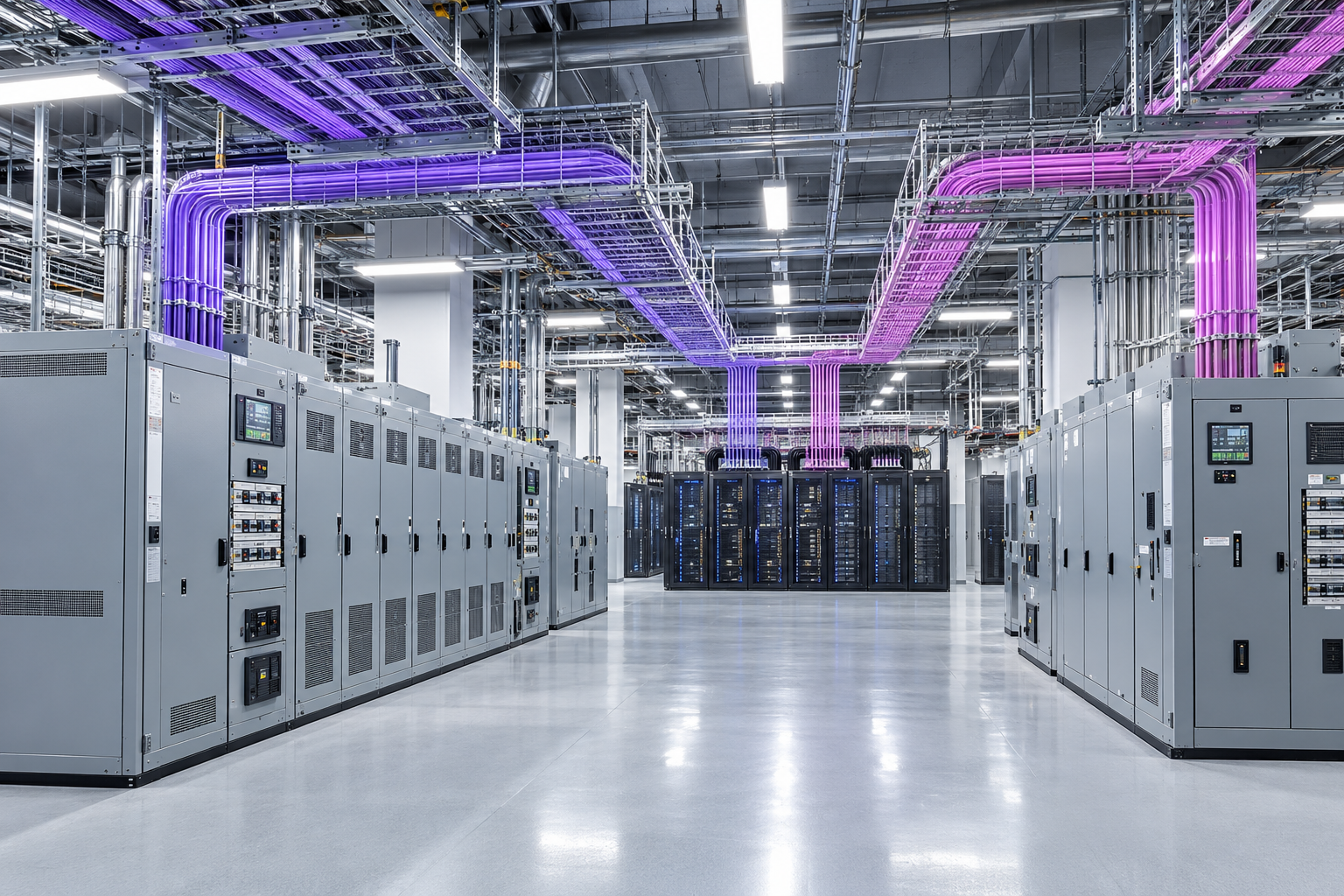

Data center electrical estimating presents a different challenge from a typical commercial project. An estimator may need to quantify thousands of nearly identical electrical devices across dozens of drawing sheets, account for redundant power distribution, and develop a competitive bid under a compressed deadline.
Table of Сontents
A single data hall can contain hundreds of server racks, each requiring dedicated power connections, branch circuits, and supporting distribution infrastructure. With A/B redundancy, many of those connections must be quantified separately for two independent electrical paths.
The difficulty is not simply counting devices. It is maintaining accurate quantities across equipment schedules, electrical plans, single-line diagrams, and multiple drawing revisions without missing or duplicating scope.
Manual takeoff can consume days before the estimator even begins pricing materials, labor, equipment, and installation requirements.
For teams asking how to estimate electrical for a data center, this guide explains how to take off and bid the electrical subcontract scope, including major distribution equipment, rack-level power, redundant systems, branch circuits, and supporting electrical infrastructure. It also examines how AI-assisted electrical takeoff can reduce repetitive counting and routing work while keeping the estimator responsible for technical review and final pricing.
A data center is a mission-critical facility, where electrical infrastructure must support continuous operation, equipment availability, and planned maintenance. For an electrical subcontractor, estimating mission-critical electrical work creates requirements that differ substantially from conventional commercial construction.
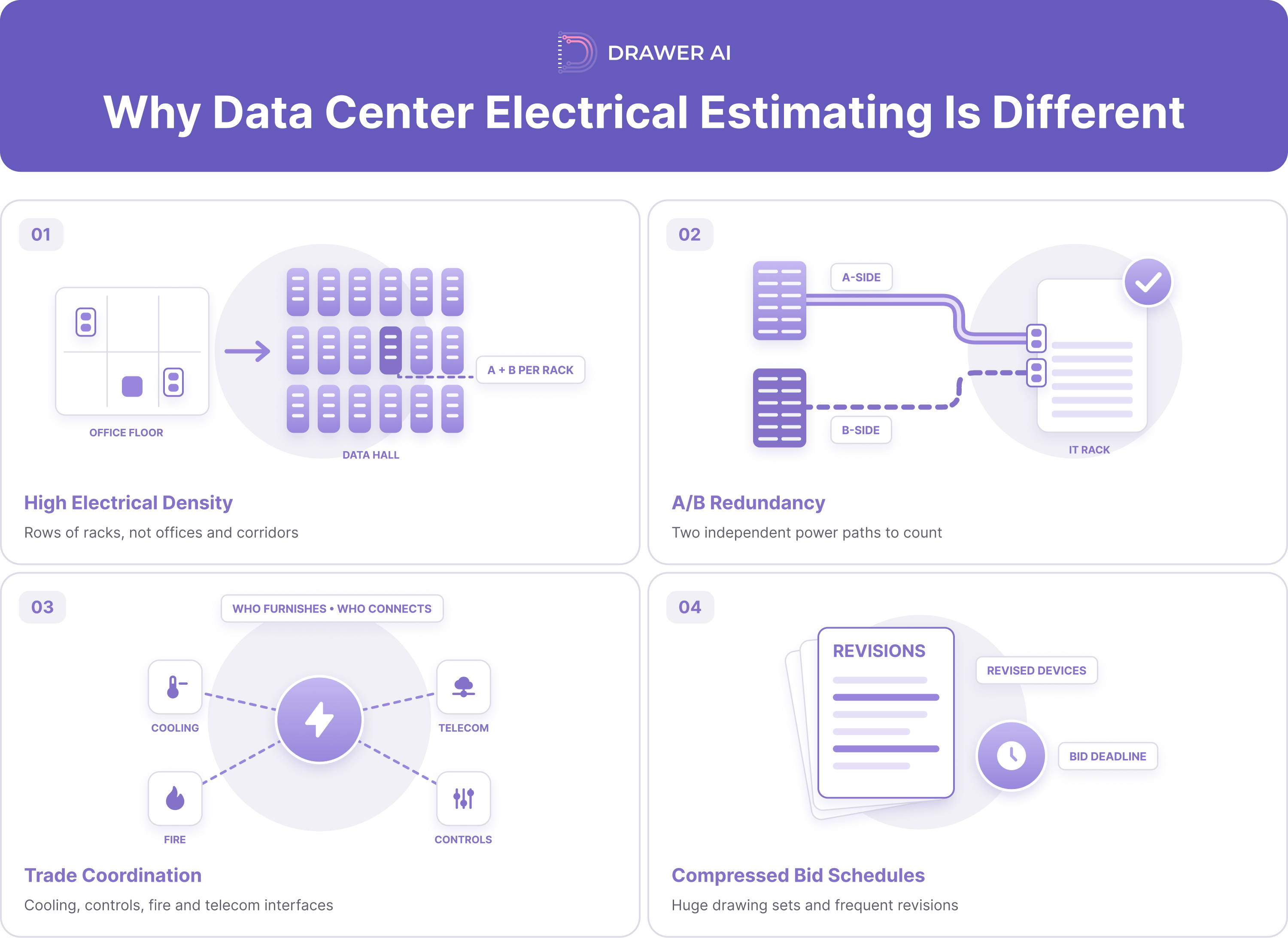
A standard commercial floor may distribute electrical devices across offices, corridors, and common areas. A data hall concentrates electrical demand within rows of equipment racks. Each rack may require multiple power connections, supported by upstream distribution equipment, dedicated circuits, and carefully planned pathways. The estimator must account for the quantity, type, location, and electrical characteristics of those connections rather than relying on a general allowance per square foot.
Data centers frequently incorporate redundant components and distribution paths. In an A/B arrangement, critical IT equipment can receive power from two separate distribution paths. Each path must be identified and quantified according to the project design.
Uptime Institute distinguishes between redundant components, concurrently maintainable distribution, and fault-tolerant architectures. The actual electrical scope depends on the facility’s specified topology rather than a universal redundancy multiplier.
A rack connection shown on the A-side distribution system cannot automatically be assumed to include its B-side counterpart.
Data center electrical work interfaces with mechanical cooling equipment, monitoring systems, fire protection, telecommunications, and controls. The estimator must review the division of responsibilities between trades and identify equipment furnished by others but installed or connected by the electrical contractor.
Large drawing packages and frequent revisions increase the risk of missing changes. A layout revision may affect hundreds of devices, branch circuits, and material quantities simultaneously. The objective is not only to complete the initial takeoff accurately, but also to maintain quantities that can be reviewed and updated efficiently.
The data center electrical scope depends on the contract documents, project delivery model, and procurement responsibilities. Commercial and industrial data center bids commonly include the following systems.
Determine whether each component is furnished by the electrical contractor, the owner, the utility, or another supplier.
Uninterruptible power supply (UPS) systems maintain critical loads during disturbances and transitions between power sources. Depending on the project, the electrical scope may include UPS equipment, battery connections, bypass arrangements, generator connections, transfer equipment, and associated feeders. Identify the boundaries between equipment procurement, manufacturer installation, electrical installation, testing, and commissioning.
Quantify redundant distribution systems separately. This includes the relevant switchboards, distribution panels, power distribution units (PDUs), remote power panels (RPPs), busway systems, feeders, and branch connections. Separate takeoff categories make it easier to identify missing equipment and reconcile each path against the electrical one-line.
Verify whether rack PDUs and IT equipment are owner-furnished or included in the electrical subcontract.
Additional scope may include grounding and bonding, lighting, emergency lighting, equipment-room power, mechanical equipment connections, electrical monitoring, and low-voltage infrastructure. Fire alarm and telecommunications work should be included only where assigned to the electrical contractor.
For code coordination, review the locally adopted edition of NFPA 70 (NEC). Where applicable to qualifying information technology equipment installations, consult NEC 2026 Article 645 [NEC 2023 Article 645]. The adopted edition and project conditions govern; this workflow discussion is not a substitute for code or engineering review. Define the contractual scope and list any assumptions before assigning quantities and prices to the bid.
The most time-consuming part of a data center electrical takeoff is often not the large equipment. It is the repetition of smaller devices and connections across extensive rack layouts.
Consider an illustrative data hall containing 240 equipment racks. Assume each rack requires two dedicated power connection assemblies, one supplied from the A-side system and one from the B-side system.
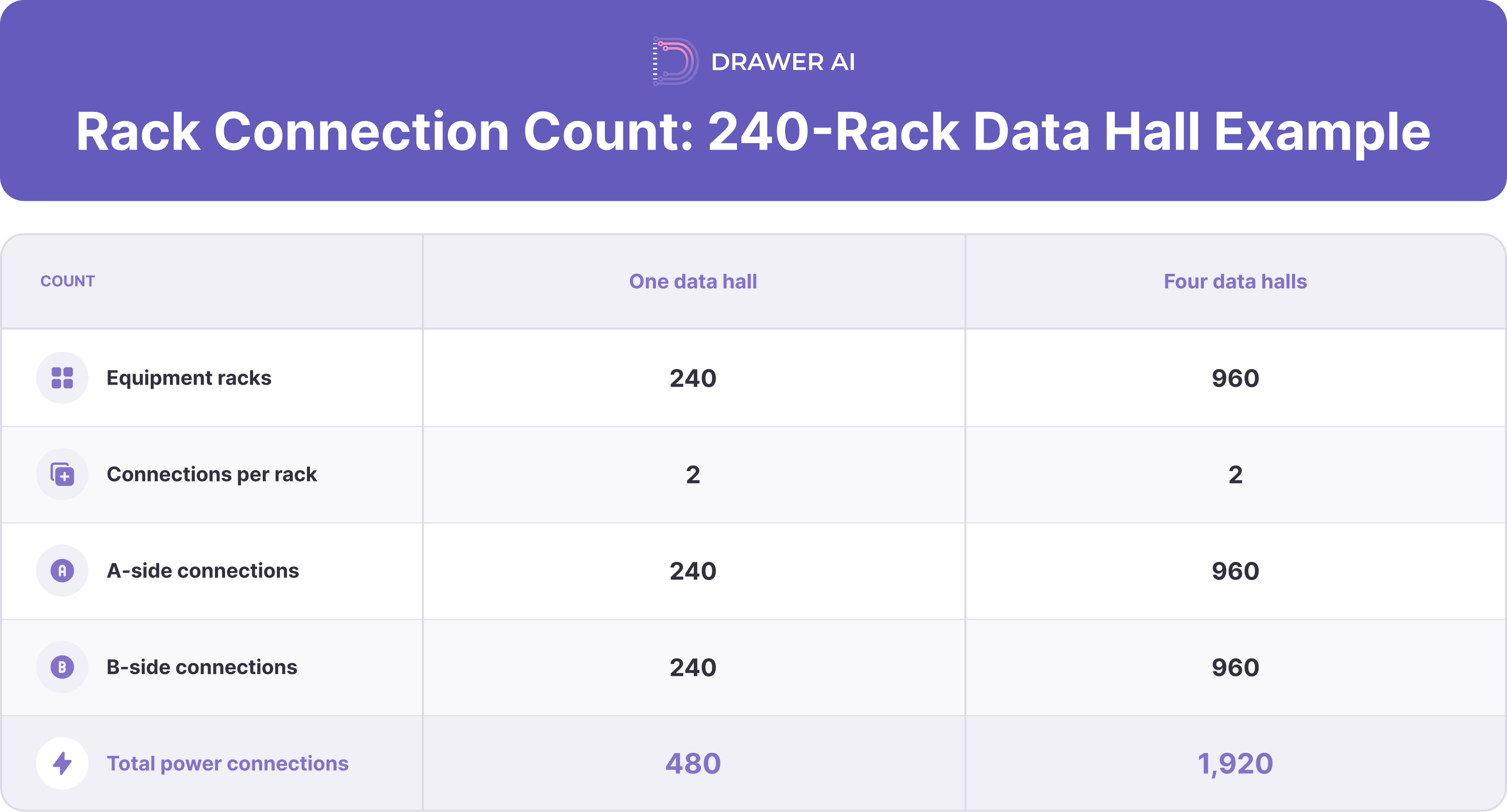
Across four comparable data halls, that becomes 1,920 rack power connections before upstream distribution, auxiliary devices, and supporting systems. These quantities illustrate the counting workload; they are not a project design.
Each connection may require a receptacle or connector, conductors, a raceway assembly, fittings, identification, termination labor, and testing. A manual estimator must track every connection across multiple sheets, verify its assigned circuit, and ensure the correct distribution path is included.
Simply multiplying a typical rack assembly by the total number of racks can overlook differences in circuit ratings, equipment configurations, connection lengths, and installation conditions. This is where automated detection and structured quantity management become particularly valuable.
For quality control, divide the hall into rack rows or zones and maintain separate A-side and B-side count registers. Cross-check each row total against the rack schedule and mark duplicate representations on enlarged plans. A repeatable quantity register makes it possible to isolate the effect of a changed rack layout without restarting the entire package.
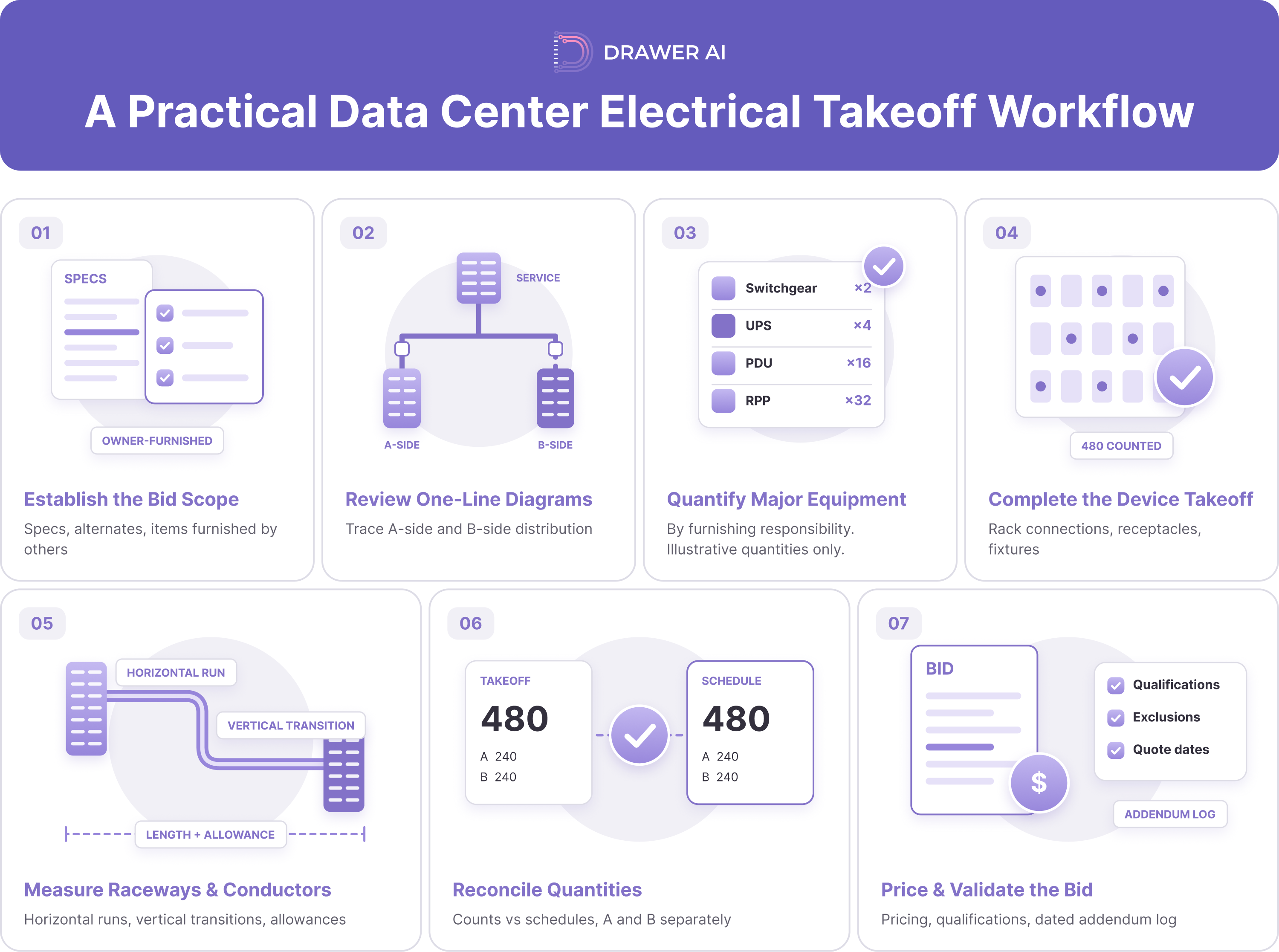
Review the specifications, drawing index, alternates, procurement responsibilities, and electrical scope boundaries. Identify owner-furnished equipment, vendor-supplied systems, installation responsibilities, and any required commissioning support.
Trace the distribution architecture from the service entrance through the critical power systems to the data halls. Identify A-side and B-side distribution, equipment ratings, feeder relationships, and redundancy requirements. Record discrepancies between the one-line diagrams and equipment schedules.
Prepare equipment quantities for switchgear, transformers, UPS-related equipment, distribution panels, PDUs, RPPs, and other electrical assemblies. Maintain separate categories for equipment furnished by the contractor and equipment furnished by others.
Count rack connections, receptacles, lighting fixtures, disconnects, and other devices across the electrical plans. Associate each item with its symbol, equipment type, schedule reference, and distribution system.
Develop routing quantities using the drawings, installation requirements, and anticipated pathway constraints. Account for horizontal runs, vertical transitions, equipment connections, and installation allowances.
Compare device counts, panel schedules, branch circuits, equipment schedules, and one-line diagrams. Review A-side and B-side quantities independently before consolidating the estimate.
Apply material pricing, labor units, equipment costs, testing, commissioning responsibilities, overhead, and margin. Document qualifications, exclusions, alternates, and unresolved scope assumptions before submission.
Before release, perform a final drawing-revision check and compare the estimate with its exclusions and supplier quotation coverage. Flag unresolved design assumptions in the bid rather than silently filling gaps with generic allowances. Confirm quotation validity dates, long-lead equipment assumptions, and subcontractor interfaces before submission. Maintain a dated change log identifying each addendum, its affected drawing sheets, the revised quantities, and the person responsible for review.
For the broader process, see our Electrical Estimating Guide: Commercial & Industrial [2026].
AI-assisted data center electrical estimating addresses a major bottleneck: converting extensive electrical drawing packages into structured quantities. Instead of manually identifying every repeated symbol, estimators can use automated detection to establish an initial count and focus on exceptions, system assignments, and project-specific requirements.
At Drawer AI, we analyze PDF electrical drawings to identify and quantify lighting fixtures and power devices. Our workflow links detected items to tags, panels, circuit information, and schedules for review. Estimators still verify device types, similar symbols, and project-specific assignments.
Counting devices is only part of the takeoff. Our branch-routing tools generate proposed conduit paths, support conductor sizing, and calculate voltage drop. For data center work, estimators must verify these results against the specified A/B architecture, equipment assignments, and installation constraints. Automated routing does not independently validate a mission-critical electrical design.
Our reviewed quantities can be exported in Excel reports and marked-up PDFs to support the contractor’s pricing workflow. Organize and review outputs by floor, area, equipment category, and distribution path.
Structured digital quantities provide a manageable starting point when drawings change. A new rack configuration may alter circuit assignments, conductor quantities, and routing assumptions, all of which require technical review.
When an addendum changes an equipment row, compare the revised sheet with the previous takeoff, verify its tags and panel assignments, and record the drawing revision used for each quantity.
At Drawer AI, we automate repetitive electrical takeoff work—not the entire engineering, procurement, or commercial bidding process.
Review our takeoff and branch-routing features and watch our product demonstrations. Estimators remain responsible for project-specific feeder takeoff, procurement packages, and critical-system interpretation.
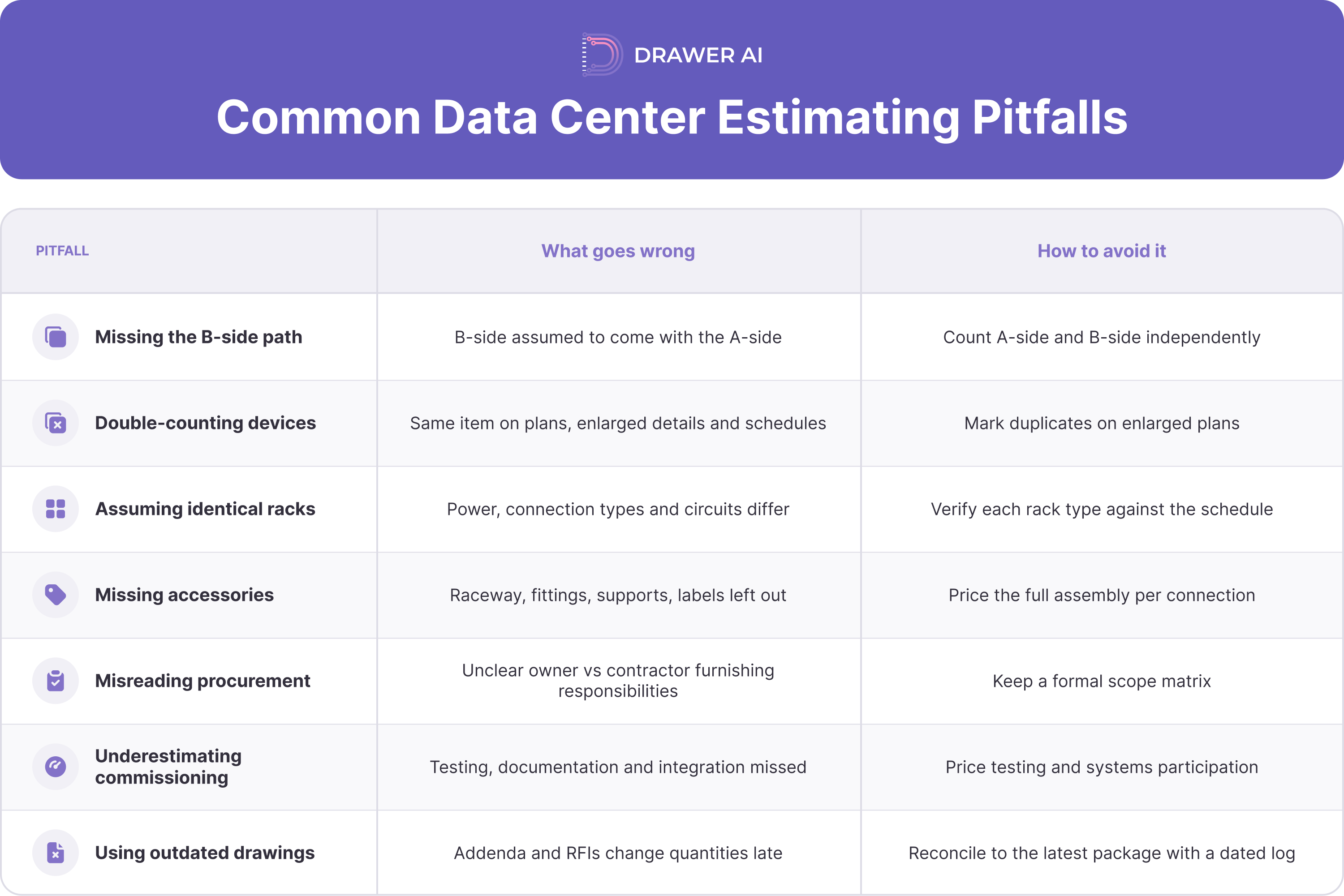
Also check whether equipment procurement, factory services, temporary power, energization, and integrated systems testing are priced in the right package. Maintain a formal scope matrix and a dated addendum log so that late changes can be traced to revised quantities and qualifications. Review potential change-order exposure before bid release.
A reliable bid depends on complete quantities, clear scope boundaries, and documented assumptions.
Data center electrical estimating is a quantity-management and scope-control challenge as much as a pricing exercise. The complexity comes from combining large distribution systems, redundant power architecture, dense rack layouts, and repeated electrical connections within one coordinated estimate.
An effective workflow separates A-side and B-side quantities, reconciles counts against schedules, and establishes reliable material quantities before pricing. AI-assisted takeoff can reduce repetitive counting and routing while preserving the estimator’s role in technical review and bid preparation.
Ready to streamline your next data center electrical takeoff? Explore Drawer AI or book a demonstration to see how our device detection and branch routing support your next commercial or mission-critical electrical bid.

14425 Falcon Head Blvd
Building E, Suite 100,
Austin, TX 78738
Created by Estimators, Powered by AI and Innovation
Copyright © 2026 Drawer AI. All rights reserved.