
AI



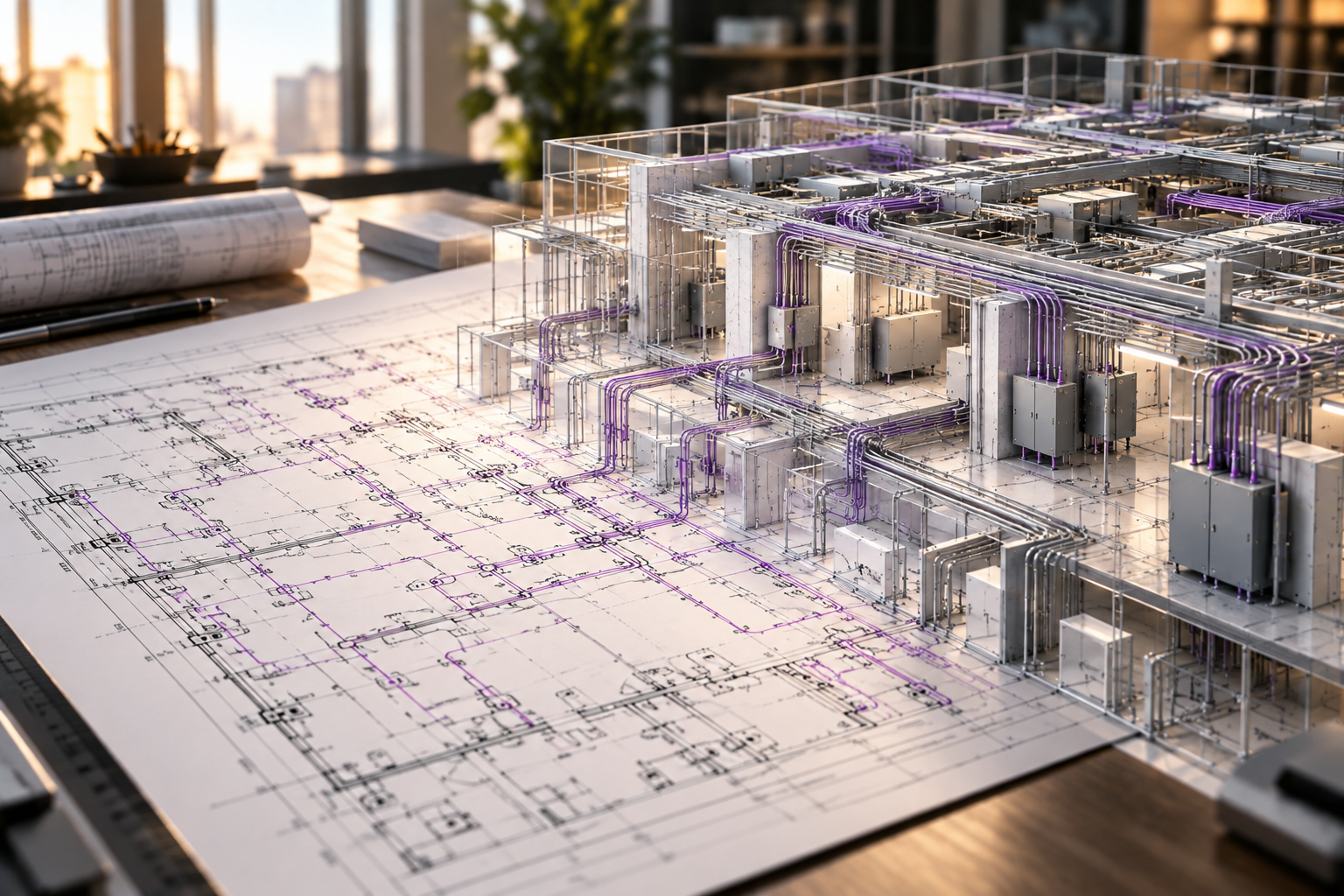

A GC has required a coordinated electrical model. The project is moving, the drawings are imperfect, and somebody has to turn panel schedules, circuit intent, homeruns, feeders, and conduit paths into a model the coordination team can use. The question is not simply who can operate Revit. It is who owns the routing decisions, who can defend them in coordination, and how quickly they can be revised.
Table of Сontents
For electrical contractors evaluating electrical BIM services, there are three practical delivery models: build the capability in-house, use an outsourced BIM or CAD service, or use AI-generated modeling with human review. Each can be the right answer. The choice depends on workload, internal VDC maturity, project schedule, routing complexity, and how much electrical judgment needs to stay inside the company.
.png?width=1500&height=1073&name=02_why_electrical_bim_is_different%20(1).png)
Electrical BIM is not just 3D drafting. A usable contractor model has to preserve the logic behind the electrical system: which devices belong to which circuits, which panel serves them, how homeruns are grouped, where feeders should travel, what elevations make sense, and how conduit shares space with ductwork, piping, structure, and other electrical runs.
That is why BIM services for electrical contractors should be evaluated differently from generic modeling support. A model can be geometrically clean and still be electrically wrong: the wrong panel, a missed circuit revision, an impractical bend sequence, or feeder space consumed by branch conduit.
Revit supports electrical circuits, panel schedules, loads, conduit, and related model information, but the software does not decide every project-specific routing choice for the contractor. The team still has to interpret the source documents and make constructability decisions. In other words, BIM for electrical contractors sits between design information and field installation. The value is not only producing geometry; it is producing geometry that reflects electrical intent and can survive coordination.
That difference should drive the resourcing decision. Ask who will interpret panel schedules, who will resolve conflicting plan information, who will decide whether branch conduits share a rack, who will protect feeder space, and who will respond when an addendum changes the circuiting after the first coordination round.
An in-house modeler gives the contractor the most direct control over standards, communication, and routing decisions. That person can learn how the company prefers conduit racks, bends, sleeves, elevations, family standards, shared parameters, naming conventions, and coordination priorities. They can also work closely with estimators, PMs, foremen, and field leadership instead of receiving information through a formal external handoff.
For contractors with steady BIM volume, that continuity can be a major advantage. The electrical BIM drafting process becomes part of the operating system of the company rather than a project-by-project purchase. A strong internal modeler also accumulates institutional knowledge: which details repeatedly cause field issues, how a particular GC runs coordination meetings, which prefabrication standards the field team expects, and what the company considers an acceptable route.
The trade-off is cost structure and utilization. An employee is a fixed commitment when model volume slows. The contractor also has to recruit, train, equip, and support the role. If several BIM-heavy jobs land at once, one modeler can still become the bottleneck.
This option is strongest when BIM demand is consistent, the contractor wants routing judgment to remain internal, and there is enough VDC work to keep the role productive. It is also a good fit when coordination is tightly connected to prefabrication or field planning and the modeler needs daily access to operations staff.
What is included in an electrical BIM deliverable will vary by contract, but the contractor should define it before staffing the work: native model requirements, panel and circuit data, feeders, homeruns, branch conduit, coordination views, layouts, schedules, required level of detail, and responsibility for revisions.
Outsourcing turns much of the modeling commitment from fixed capacity into variable capacity. Instead of carrying a full-time position through every workload cycle, a contractor can add modeling resources when a BIM-required project lands. That can be especially useful for a company that wins only a few coordinated projects each year or needs temporary help during a peak.
The real BIM outsourcing vs in-house question is not which category is more professional. Good external providers can become reliable extensions of a contractor. The issue is how much electrical context survives the handoff.
If the provider receives a drawing set and a broad instruction to "model the electrical," the contractor may still have to supply the decisions that matter most: how to interpret conflicting panel information, how circuits should be grouped, where homeruns should converge, which feeder route takes priority, how much rack space to reserve, and what constructability rules the field team expects. External teams are most effective when those expectations are explicit and when the provider has real electrical coordination experience.
There is also a communication cycle to manage. Questions must be raised, answered, incorporated, reviewed, and often revised after coordination. Time-zone differences may help work continue overnight or may delay a routing decision. The result depends on the provider and review process.
Contractors using an external BIM team should define turnaround expectations for both the first model and revisions. The first delivery is only part of the workload. Coordination generates changes, and slow rerouting after another trade moves can still create schedule pressure.
How much does outsourced electrical BIM cost? There is no responsible universal number. Pricing can be hourly, project-based, milestone-based, or tied to scope. More important than a generic market rate is what the quote includes: initial modeling, coordination revisions, meetings, QA/QC, model standards, clash resolution support, and final deliverables. The lowest production price is not necessarily the lowest total cost if internal staff must spend substantial time translating electrical intent back into the model.
For firms that need flexible capacity and have a strong internal reviewer, choosing to outsource electrical BIM can work very well. The contractor retains electrical ownership while the external team supplies production bandwidth.
AI-generated modeling changes a different part of the equation. Instead of deciding whether a human employee or an external human team drafts every run, the production step can be automated while people retain responsibility for project-specific decisions and review.
That distinction matters. The best AI electrical modeling tool for contractors is not the one that simply draws the most conduit. It is the one that can start from the contractor's actual electrical information, preserve panel and circuit relationships, follow routing preferences, produce usable model outputs, and leave a clear review path for exceptions.
The review loop is the important part. Generated routing still has to be checked against company standards, available rack space, feeder priority, constructability, and coordination changes. The useful automation target is repetitive production: translating known electrical relationships into model content and regenerating that content when approved routing assumptions change. That preserves a human decision point without requiring a person to draft every run manually.
That makes AI-generated modeling a capacity model rather than a replacement for electrical judgment. Estimators, PMs, VDC leads, or internal modelers can spend less time on repetitive population and more on circuit relationships, routing exceptions, constructability, and coordination. Existing VDC teams can use it for throughput; firms without a BIM department can use it without first building a full production team.
Before adopting AI route generation, define the same standards you would give a person: governing drawings, required model detail, allowable elevations, routing preferences, family and parameter standards, review authority, and revision process. Automation only accelerates a usable workflow when the electrical inputs and acceptance criteria are explicit; otherwise it can accelerate rework just as easily.
At Drawer AI, our current BIM workflow starts from the 2D electrical PDFs contractors already receive. The workflow develops electrical data and routed conduit, then produces a native Revit model along with PDF layouts and an Excel conduit schedule. Project-specific routing preferences and review remain part of the process.
Do I need an existing Revit model to get started? Not necessarily. Our workflow can begin with 2D electrical PDFs and produce Revit deliverables without an existing electrical model as the starting point.
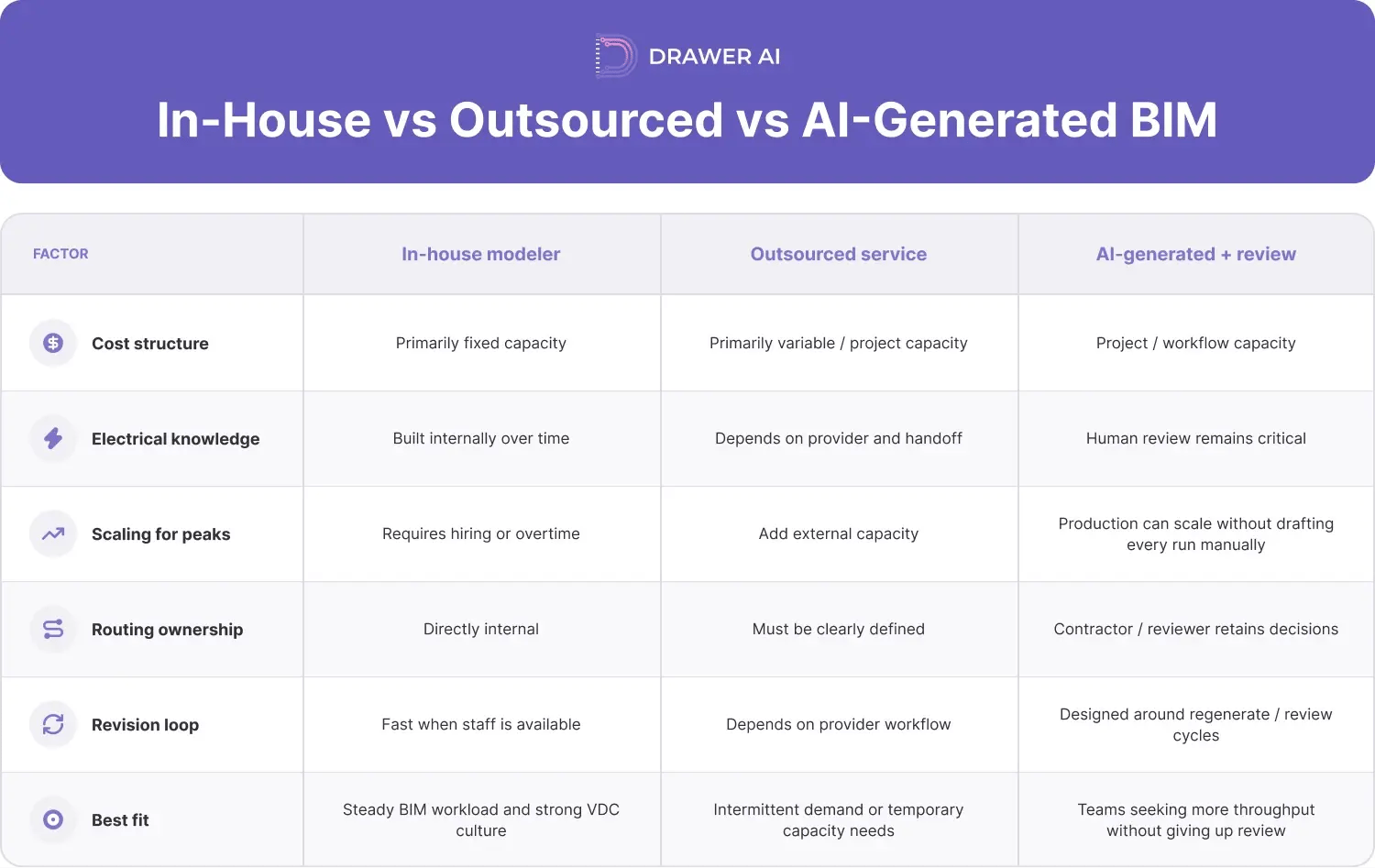
Electrical BIM outsourcing is not a binary alternative to hiring. AI adds a third model that can also be combined with either of the first two.
Start with workload. If coordinated BIM is required on a steady stream of projects, an internal electrical BIM modeler can be a strategic capability. If demand is intermittent, outsourcing may prevent idle fixed capacity. If the bottleneck is the amount of repetitive routing and model population rather than the quality of internal decisions, AI-assisted production may provide the better leverage.
Then look at ownership. Who understands the company's routing standards well enough to approve a congested corridor? Who can resolve a panel schedule conflict? Who can decide that the shortest path is not the best path because the field team needs a shared rack or prefabricated bends? Whatever delivery model you choose, that responsibility has to exist somewhere.
Finally, evaluate revision speed. Addenda, RFIs, trade movement, equipment changes, and coordination comments force rerouting. Choose a delivery model that can absorb change without making the project wait.
Before signing with an electrical BIM designer or service, as
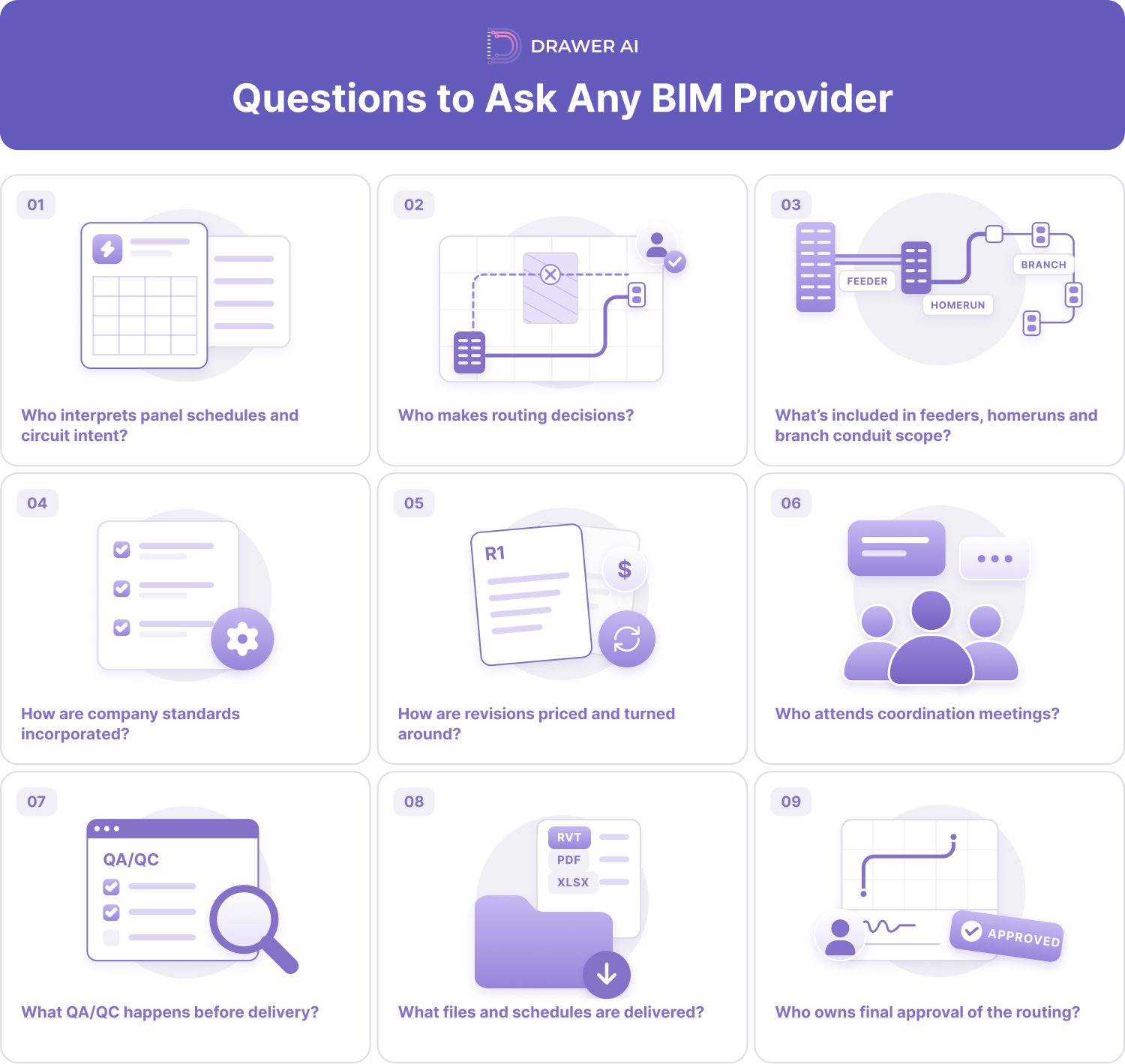
There is no single right answer. Steady BIM volume rewards an in-house modeler; intermittent demand suits an outsourced service; and where the bottleneck is repetitive routing and model population, AI-generated modeling with review adds throughput without giving up electrical judgment. Whatever you choose, keep routing ownership, standards, and revision speed explicit.
See how Drawer AI's BIM Wizard turns your 2D electrical PDFs into a native Revit model, PDF layouts, and an Excel conduit schedule. Book a demo.

14425 Falcon Head Blvd
Building E, Suite 100,
Austin, TX 78738
Created by Estimators, Powered by AI and Innovation
Copyright © 2026 Drawer AI. All rights reserved.