
AI



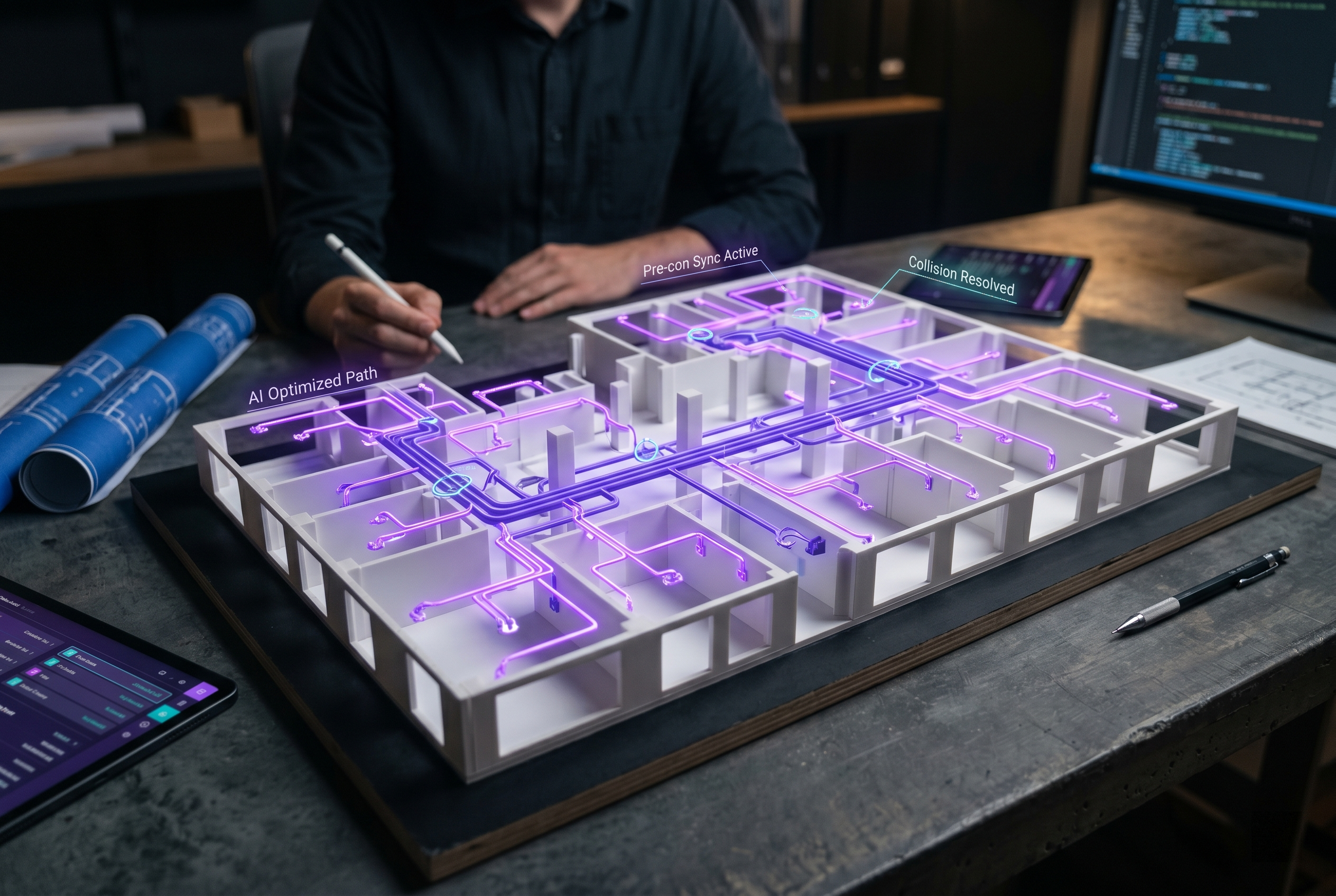

Electrical preconstruction is the planning, analysis, and coordination work that happens before a single conduit gets bent. It's where the project's scope, budget, and constructability get defined, and where most of the real margin protection happens.
Table of Сontents
For electrical contractors, this phase has more impact on the project margin than any other. Get the scope, system selection, and early budget right, and the rest of the job runs cleaner. Get them wrong, and no amount of field hustle later will save it.
In general construction, preconstruction services cover the work that happens before field crews arrive on site:
For electrical contractors, the work gets more specific:
Good preconstruction produces a concrete set of artifacts the owner and GC can act on. The deliverables below are what separates a paid preconstruction service from a vague "we'll help you bid it" promise.
These deliverables collectively demonstrate that electrical preconstruction is a value-added service. Rather than being perceived as “free work,” preconstruction outputs provide tangible benefits —improving project clarity, reducing risk, and driving better outcomes for all stakeholders.
AI takeoff earns its place during preconstruction precisely because the drawings keep changing. Every design revision, every VE round, every owner change of mind triggers a re-quantification. Doing that by hand is what burns out preconstruction teams. AI takeoff turns each round into minutes instead of days.
It also makes side-by-side option comparison practical. Pricing three fixture packages or two distribution strategies used to be a luxury nobody had time for. With AI takeoff, generating quantities for each option is fast enough that the owner actually gets real choices to evaluate.
Risk analysis benefits too. With current device, panel, and circuit counts on hand, the team can quickly model how a scope change ripples through the budget, instead of guessing at the impact and discovering the truth at GMP.
The typical loop:
1. Import the latest PDF drawing set into the AI platform.
2. The software auto-detects devices, panels, and circuits.
3. The estimator reviews, corrects, and approves the count.
4. Quantity tables export directly into the budget and VE comparison sheets.
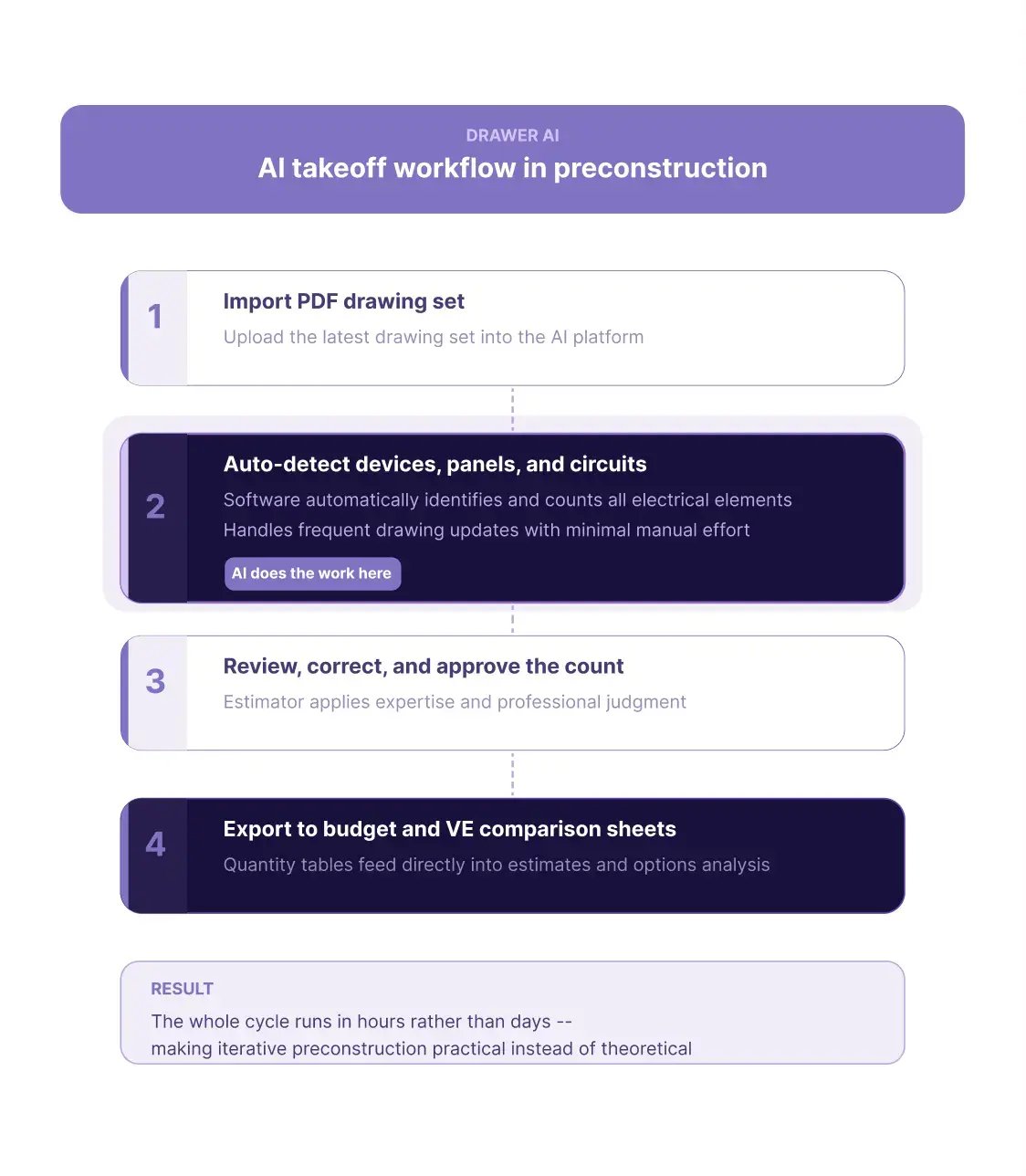
The whole cycle runs in hours rather than days, which is what makes iterative preconstruction practical instead of theoretical.
The main advantages of AI takeoff are speed, consistency, and the ability to handle frequent drawing updates with minimal manual effort. These benefits allow preconstruction teams to respond quickly to changes, compare options efficiently, and maintain greater accuracy throughout the process.
It is important to note, however, that AI takeoff is a supportive tool within preconstruction. It does not replace the need for human expertise and decision-making regarding system selection, routing strategies, or constructability considerations. The technology enhances the workflow, but final judgments and project direction remain the responsibility of experienced professionals.
Electrical contractors often blur the line between estimating and preconstruction, but the distinction matters financially. Estimating prices of a defined set of drawings at a single point in time. Preconstruction is an ongoing service that helps shape the project before the design is finalized, combining cost insight, technical input, coordination, and decision support.
· Bid estimating: Pricing a largely defined set of drawings once to support a bid or proposal.
· Preconstruction services: Iterative, collaborative planning that includes early budgeting, design-assist input, value engineering, coordination, and scope refinement before the drawings are complete.
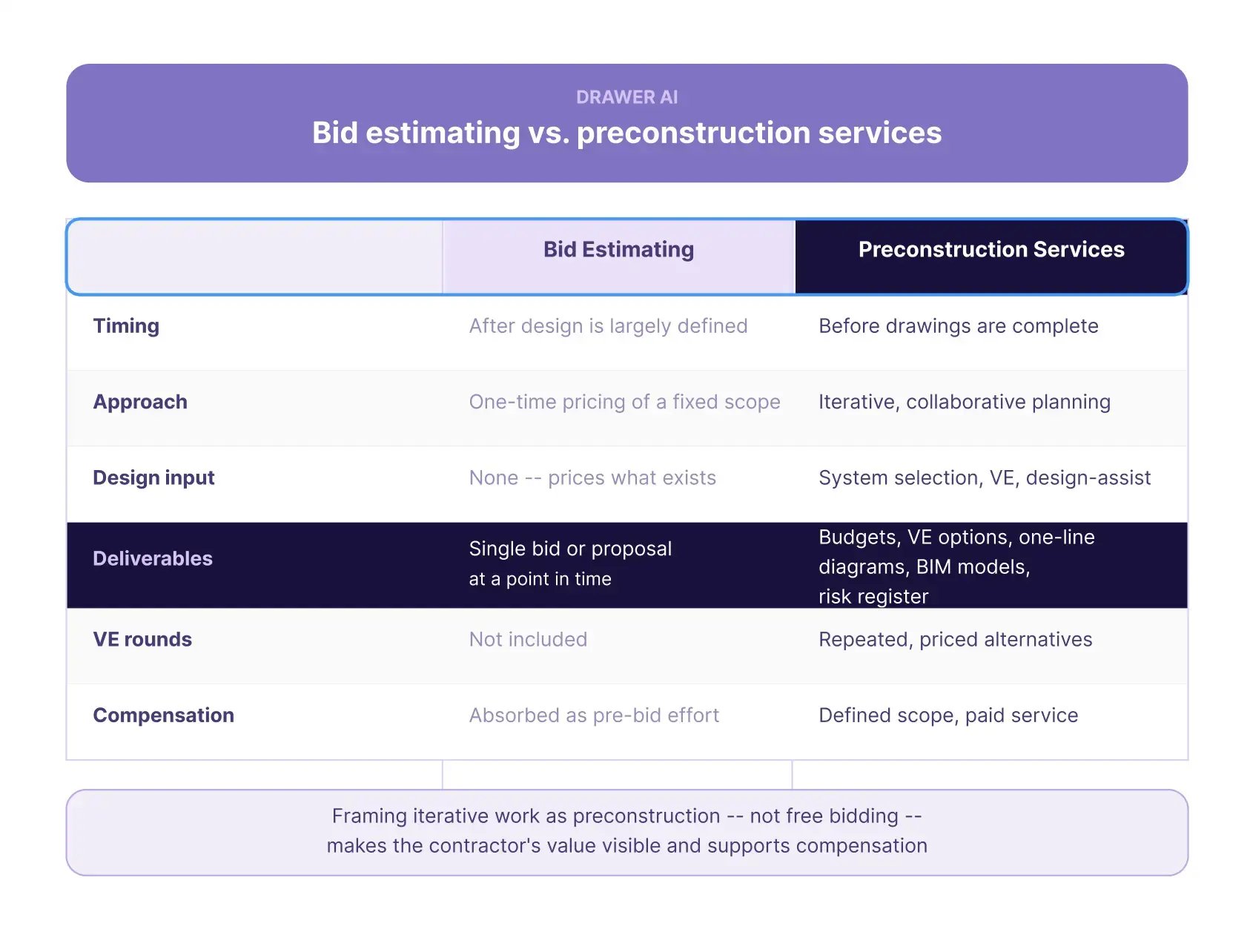
That distinction matters because many high-value contractor activities go well beyond a one-time estimate. Repeated value engineering, design-assist collaboration, and early budgeting require time, expertise, and coordination with the design team and general contractor. Framing this work as preconstruction rather than informal support makes its value clear, sets expectations, and supports compensation instead of unpaid effort.
A practical approach is to define these services as a separate preconstruction scope with clear deliverables, such as conceptual budgets, estimate updates, value engineering options, coordination input, layout reviews, and risk identification. Focusing on outcomes cost clarity, fewer redesigns, better coordination, and smoother execution helps owners and GCs see preconstruction as a strategic service, not just an extension of bidding. This strengthens the contractor’s role as a project partner.
Done well, electrical preconstruction pays for itself many times over. The benefits split between the electrical contractor and the owner/GC, and they compound across the project.
For ECs, real preconstruction work is what separates a strategic partner from a price provider. Repeated VE rounds, design-assist conversations, and early budgeting let the contractor influence design decisions before they harden into RFIs and change orders. It also makes the value of the work visible, so it gets paid for instead of absorbed as pre-bid effort. The downstream wins: more accurate bids, better cost control on labor and materials, and stronger repeat relationships with GCs and owners.
Owners and GCs get project clarity and earlier visibility into the risks that hurt construction projects most. Bringing the electrical contractor into design and budgeting early surfaces problems while they're still cheap to fix. Structured deliverables (a documented budget, real VE options, a coordination model, a risk register) give the owner a defensible plan instead of a number on a bid form. Fewer change orders, fewer surprises, fewer delays.
AI takeoff is what makes the iterative preconstruction model practical. Without it, every design revision is a multi-day re-quantification, which is why traditional preconstruction either skips the iteration or charges a premium for it. With AI takeoff, the loop runs in hours and the work stays current with the design. The contractor delivers more value per hour invested; the owner gets real options instead of a single locked-in bid.
Small and mid-size ECs don't need a 50-page playbook to start charging for preconstruction. The fastest path is to pick one or two high-impact services, run them well on a few projects, and add to the offering from there. AI-assisted takeoff and structured value engineering are the easiest two to start with: both have visible deliverables, both produce measurable cost impact, and both are repeatable.
Start where the value is most visible to the GC and owner. AI takeoff speeds up quantity work and reduces missed items. Structured VE produces priced design alternatives the team can actually compare. Both produce concrete deliverables; both are easy to point to when the time comes to charge for the service.
Run those two well for a quarter or two, then expand the playbook as the team gains reps. Add coordination input, then early budgeting, then prefab planning, then risk register work. Each addition makes the next conversation with an owner easier, because there's a track record behind it.
Start with those two, deliver well, and expand from there. The playbook builds itself once owners and GCs see the impact on actual projects.
Electrical preconstruction is the highest-impact phase of any commercial or industrial electrical project, and AI takeoff is what makes the iterative, multi-revision version of preconstruction actually practical. Contractors who formalize even one or two preconstruction services (AI takeoff and structured VE are the easiest entry points) start showing up to GCs as project partners instead of bid providers.
See how Drawer AI fits into your preconstruction workflow. Book a demo and run AI takeoff on a real project drawing set. You'll know within an hour whether it earns a place in your stack.

14425 Falcon Head Blvd
Building E, Suite 100,
Austin, TX 78738
Created by Estimators, Powered by AI and Innovation
Copyright © 2026 Drawer AI. All rights reserved.