



AI
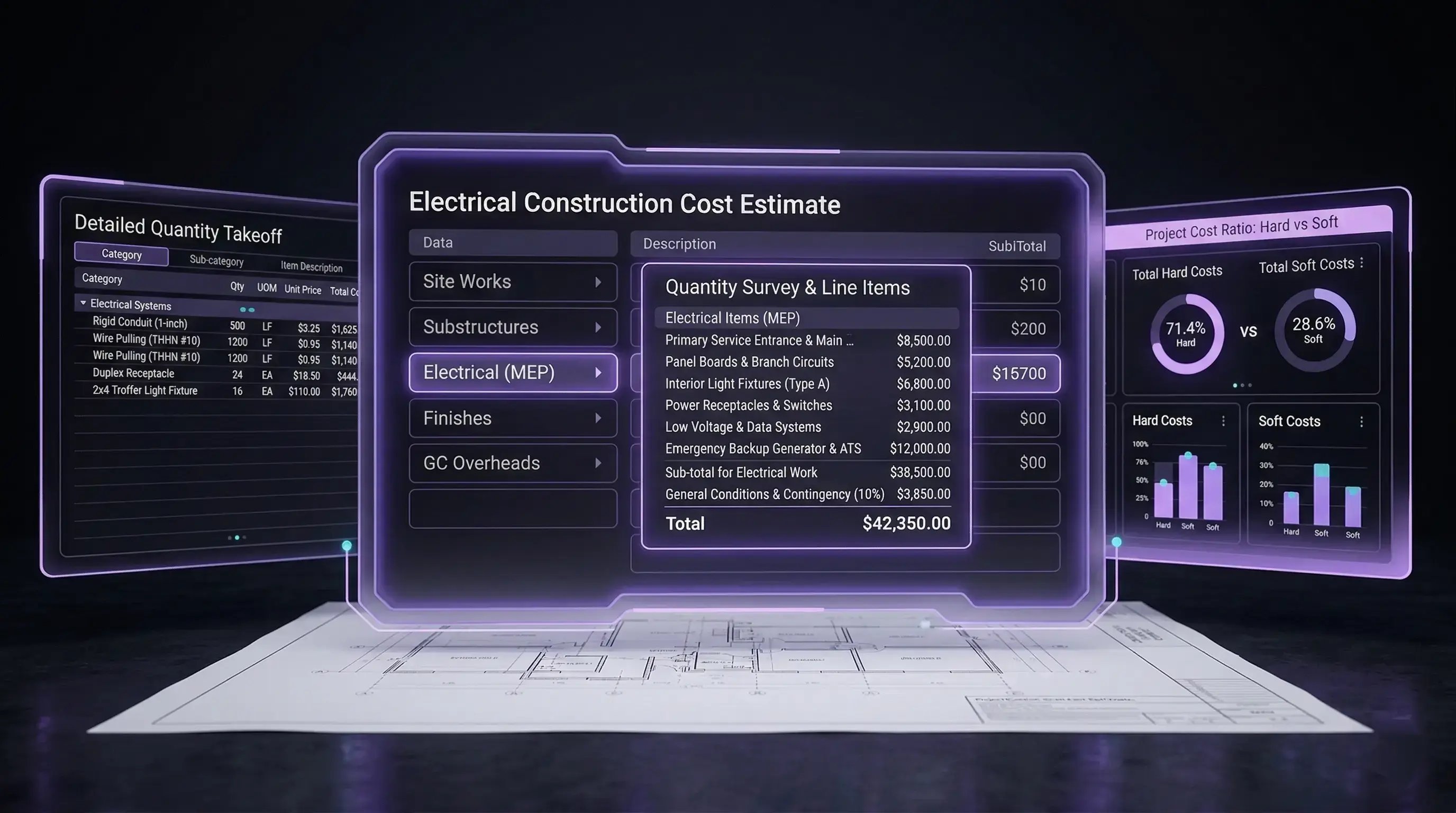
Construction cost estimating is the process of forecasting the expenses associated with a building project. Accurate estimates are crucial for ensuring profitability, minimizing risks, and maintaining client trust. When estimates are precise, companies can better control costs, avoid unexpected overruns, and build lasting relationships with their clients.
Table of Сontents
This article is structured around three essential pillars:
Construction costs can be categorized into two primary groups: hard costs and soft costs.
Clearly distinguishing between hard and soft costs in estimates is essential for accurate budgeting and effective cash-flow planning. By splitting these categories, project teams can better track spending, anticipate funding needs, and minimize the risk of unexpected financial shortfalls.
A high-level breakdown of construction costs typically includes the following categories, each representing a distinct aspect of project expenses:
This breakdown helps ensure that all aspects of the project are accounted for, supporting comprehensive cost planning in construction. By identifying each component, project managers and stakeholders can better understand resource allocation and enhance transparency throughout the project lifecycle.
Accurately estimating construction costs is essential for successful project planning and execution. The following workflow outlines a practical, step-by-step approach for calculating construction costs and provides clear guidance for project managers, estimators, and stakeholders.
Begin by carefully examining all architectural drawings, technical specifications, and the defined scope of work. This comprehensive review ensures you understand every component and requirement of the project before you start quantifying or pricing any elements.
Next, conduct a detailed quantity takeoff for major trades and systems. This can be done manually or with estimating software. The goal is to measure and list the quantities of materials, components, and elements required for the project.
Once quantities are established, assign unit costs based on up-to-date price lists, supplier quotes, and relevant historical cost data. This step translates material and system quantities into direct costs.
Incorporate labor productivity factors and current labor rates to calculate the total labor cost for each scope of work. This should reflect the complexity and location-specific conditions of the project.
Add the cost of necessary equipment and factor in subcontractor quotes for specialized work. Be sure to include general contractor overhead and a reasonable profit margin as part of the overall estimate.
Identify and calculate soft costs, such as design fees, permits, and insurance, either as a percentage of construction costs or as itemized lines. These are indirect expenses that are essential for project delivery.
Finally, include contingencies based on the class of estimate and the specific risks associated with the project. This provides a financial buffer for unforeseen circumstances and helps maintain budget control.
Suppose your quantity takeoff calculates 1,000 square feet of finished flooring. The unit cost for flooring material and installation is $8 per square foot, and labor rates total $2 per square foot. The direct cost is (1,000 sq ft × $8) + (1,000 sq ft × $2) = $8,000 + $2,000 = $10,000. If you add 10% overhead and profit ($1,000), 5% for soft costs ($500), and a 5% contingency ($500), the total estimated cost for this scope is $12,000.
To further detail the calculation, let's say the project also requires the use of specialized equipment for the flooring installation, costing $300. Additionally, you receive a subcontractor quote for moisture barrier installation at $700. Include these as direct costs:
The new subtotal is $10,000 + $300 + $700 = $11,000.
Next, apply 10% for overhead and profit ($1,100), 5% for soft costs ($550), and 5% for contingency ($550):
The revised total estimated cost for this scope is $13,200.
This example illustrates how including equipment costs and subcontractor quotes, along with overhead, soft costs, and contingencies, provides a more comprehensive and accurate construction cost estimate.
Construction estimating templates play a crucial role in project planning and execution. By standardizing the estimate process, these templates offer multiple benefits: they promote consistency across projects, reduce the chance of missing important items, make estimate reviews more straightforward, allow for faster updates, and ensure a smoother handover from preconstruction to project controls teams.
Using well-designed templates brings structure and reliability to the estimating process. Consistency means that every estimate follows a familiar format, making it easier for teams to understand and compare costs. Templates also help prevent oversight by including all typical cost items, streamline review processes, speed up updates when project details change, and facilitate seamless handover of information as the project moves from preconstruction to active management.
A construction price list, which sets out standard unit costs for materials and labor, can be directly integrated into estimating templates. This approach ensures that cost data remains consistent and up to date across projects.
Aligning the structure of estimates with the construction invoice format also makes progress billing and cost tracking more efficient. When estimate line items match invoice categories, it simplifies reporting and ensures that billing aligns with project progress.
A well-structured construction project estimate template should incorporate specific fields to ensure clarity, transparency, and accuracy throughout the estimating process. These fields are not presented as a literal template but serve as essential guidance for template creation and review.
Construction estimate templates provide organized, efficient solutions for managing project costs. By categorizing expenses and ensuring clear communication, they streamline budgeting and decision-making. Using standardized systems, updated price lists, and documented assumptions, templates reduce errors and drive consistency. For both general contractors and specialty subcontractors, these tools enhance cost control, accountability, and project efficiency from start to finish. Below are two scenarios that highlight their practical applications in the industry.
A commercial general contractor (GC) working on a mid-size office or healthcare project can benefit from a construction bid estimate template organized by trades or CSI divisions. This approach streamlines the breakdown of costs, enabling the GC to allocate labor, materials, equipment, and subcontractor expenses efficiently. Organizing the estimate by recognized divisions also simplifies tracking and reporting for both internal teams and clients, supporting transparency and accurate forecasting throughout the project.
An electrical or mechanical subcontractor can use a construction project estimate template linked to a construction price list to prepare bids for tenant improvements or light industrial upgrades. By tying estimate line items directly to up-to-date pricing, the subcontractor ensures accuracy and consistency. This connection to the price list also reduces the risk of missing scope items and supports a smoother handover to project controls teams, as the template’s structure makes cost tracking and updates straightforward.
A reliable construction cost estimating process relies on the integration of structured templates, disciplined workflows, and current pricing data. This combination ensures that every estimate is both accurate and comprehensive, laying a solid foundation for successful project delivery. By using standardized templates and maintaining up-to-date information, construction professionals can reduce errors and improve the consistency and transparency of their estimates.
Professionals are encouraged to adopt or continuously refine their estimating templates and related best practices. Doing so can enhance the accuracy of cost projections, boost profitability, and strengthen communication with clients. Consistent improvement in these areas benefits both individual projects and the organization.
To further streamline your estimating process, consider leveraging Drawer AI. This tool can help automate tasks, keep your pricing data current, and support your efforts to maintain best-in-class estimating practices. Book a Drawer AI demo today to see how it can simplify your estimating workflow and improve project cost management.
Calculating a construction cost estimate involves systematically identifying all required resources and tasks for a project. This includes breaking down the project into individual components such as labor, materials, equipment, and subcontractor costs. By organizing these categories, estimators can assign up-to-date prices and quantities to each line item, ensuring the overall estimate reflects the true scope of work. Clear documentation and a structured approach help improve accuracy and transparency throughout the estimating process.
The typical formula for cost estimation involves summing the costs of all necessary resources. This can be expressed as: Total Estimated Cost = Cost of Labor + Cost of Materials + Cost of Equipment + Cost of Subcontractors + Overheads + Contingencies. Using standardized templates and updated price lists helps ensure the calculations are consistent and reliable.
Thumb rules in construction cost estimates refer to general guidelines or quick reference values commonly used by estimators. These can include cost per square foot, standard labor hours per unit, or average material costs for specific tasks. While these rules provide a starting point, it is important to adjust them based on the unique aspects of each project to maintain estimate accuracy.
The rule of thumb for construction costs typically involves referencing average industry costs for similar projects. For example, estimators may use an average cost per square foot as a benchmark, adjusting for project-specific variables. These rules help with rapid assessments but should be supplemented with detailed breakdowns for precise budgeting and tracking.
To calculate a building estimate, begin by dividing the project into its core components and scope items. Assign accurate quantities and current unit prices to each element, covering all materials, labor, equipment, and subcontracted work. Summing these values provides the total estimated cost. Consistent use of structured templates supports clarity and accountability throughout the process.
There are specialized software tools designed to help estimate construction costs. These tools, such as Drawer AI, can automate repetitive tasks, keep pricing information up to date, and streamline the overall estimating workflow. Leveraging such solutions can improve accuracy, efficiency, and consistency within the estimating process.

14425 Falcon Head Blvd
Building E, Suite 100,
Austin, TX 78738
Created by Estimators, Powered by AI and Innovation
Copyright © 2026 Drawer AI. All rights reserved.