



AI
Construction submittals are formal documents that contractors send for review and approval before any fabrication or installation begins. These submittals play a critical role in the construction process, ensuring that all materials, products, and systems proposed for use on a project align with the requirements set forth in the design documents, specifications, and applicable codes.
Table of Сontents
For electrical contractors, the submittal process is particularly crucial. It is the mechanism by which products are locked in, providing certainty that the components installed will meet the project’s needs and comply with all relevant standards. This process also helps avoid disputes by clarifying expectations and preventing situations where the wrong products are installed, which could lead to costly rework or delays.
This will guide you through the journey of construction submittals from the initial device takeoffs all the way to assembling a complete, approved package. By understanding each step, electrical contractors can streamline their workflow, ensure compliance, and protect themselves from potential conflicts during the project.
A submittal in construction is a formal document or collection of documents that contractors provide for review and approval before proceeding with fabrication or installation. These documents are essential for verifying that the materials, products, and systems intended for use on a project meet the requirements outlined in the design documents, specifications, and applicable codes. Submittals serve as a safeguard, helping contractors ensure that what will be installed matches the project’s expectations and complies with industry standards. By submitting these documents, contractors can prevent misunderstandings, minimize the risk of installing incorrect products, and avoid costly rework or delays. The submittal process is a vital step in maintaining quality control and ensuring compliance throughout the construction project. It involves a collaborative review with architects, engineers, and other stakeholders, who check the proposed items against the project requirements before granting approval. This process is particularly crucial for electrical contractors, as it locks in approved products and clarifies expectations for all parties involved.
In construction, a submittal is a document or set of documents submitted by contractors to the design team or project owner for approval. Its purpose is to demonstrate that the materials and products proposed for installation meet the project’s specifications, codes, and standards. Submittals typically include product data, material samples, shop drawings, and other relevant documentation. They are reviewed and approved before any work begins, ensuring that the project progresses according to the agreed-upon requirements.
While the terms “submittal” and “submission” are often used interchangeably, they have distinct meanings in the construction context. A “submittal” refers specifically to the documents or items presented for approval within the construction process. It is the content being reviewed. “Submission,” on the other hand, is the act of sending or delivering the submittal documents to the appropriate party for review. In summary, a submittal is what is reviewed; submission is the action of providing it.
In electrical construction, submittals are vital for verifying that the proposed materials, products, and systems meet the project requirements and comply with relevant codes. Electrical contractors must prepare and present various types of submittals, each serving a distinct purpose in the approval and installation process. The following outlines the main types of submittals encountered from an electrical perspective.
Product data submittals consist of detailed information about specific electrical products and components intended for use on the project. They typically include manufacturer specifications, catalog sheets, performance data, and installation instructions. These submittals allow the design team to confirm that the proposed products match the project’s requirements and are suitable for the intended application.
Shop drawings provide detailed, project-specific diagrams or layouts prepared by the contractor or supplier. They illustrate how electrical systems, equipment, or assemblies will be fabricated and installed within the project. Shop drawings are essential for verifying coordination with other trades, ensuring proper fit, and confirming compliance with design intent.
Engineering calculations demonstrate that the proposed electrical systems and components will perform as required. These calculations may cover load analysis, short-circuit studies, voltage drop, and other technical aspects. They help establish that the design meets safety standards, code requirements, and project specifications.
Samples and mockups are physical examples of materials or products submitted for approval. They allow the design team to inspect the actual appearance, quality, and compatibility of items before full-scale installation. Samples and mockups are especially important for finishes, fixtures, or custom elements where visual and physical properties must be confirmed.
Certificates and sustainability submittals include documentation that verifies compliance with project requirements related to safety, quality, and environmental standards. Examples include certificates of compliance, warranties, and documentation supporting sustainability goals such as energy efficiency or recycled content. These submittals provide assurance that products meet regulatory, contractual, and environmental criteria.
A successful device and fixture takeoff is the foundation of the submittal process for electrical projects. It ensures that all necessary products and components are identified from the outset, setting the stage for a seamless transition into the creation of submittal logs and registers.
The process begins with a thorough device and fixture takeoff. This step involves accurately quantifying and listing all devices, lighting fixtures, and equipment required for the project. Estimators use this information to generate detailed schedules that specify the types and quantities of each item. These schedules are essential for tracking what needs to be submitted and installed.
Once the schedules have been prepared, they are used to populate the submittal register or log. Each line item in these schedules corresponds to a required submittal, such as product data, shop drawings, and certificates. This systematic approach ensures that every item is accounted for and that all necessary documentation is prepared for review and approval.
The device takeoff to submittal log workflow for electrical projects involves a series of clearly defined steps, each contributing to the accuracy and completeness of project documentation and material procurement.
This structured process streamlines the submittal workflow, helping the project team maintain compliance, reduces errors, and ensures efficient communication between all stakeholders. Ultimately, it supports timely procurement and installation of devices and fixtures, contributing to successful project delivery.
The submittal process for electrical packages is a critical workflow in the management of construction projects, ensuring that all required materials, products, and systems meet project specifications and are properly documented. This process is typically driven by the electrical project manager (PM) or project engineer (PE), who is responsible for coordinating and tracking all submittal activities from start to finish.
At the outset, the PM/PE carefully examines the project specifications and submittal requirements. This involves reviewing various divisions, electrical sections, and general requirements to identify what needs to be submitted. The goal is to ensure a thorough understanding of the documentation, testing, and product standards expected for each item.
A submittal log is created and maintained, listing all required items according to specification sections and drawing references. This log acts as a central tracking tool, helping maintain accountability and transparency throughout the process.
The PM/PE prepares the submittal packages by gathering necessary documents. This includes collecting product cut sheets, filling out relevant data forms, highlighting applicable options, and compiling any required calculations or shop drawings. Each package is assembled to address the specific requirements outlined in the specifications.
Before submission, internal quality control checks are performed. The PM/PE verifies that model numbers match estimates and purchase orders, ensures options align with the specifications, and confirms that quantities are consistent across all documents.
Submittal packages are sent to the general contractor (GC) and design team for review and comment. Responses may include “approved as noted,” “revise and resubmit,” or “rejected,” which guide the next steps in the workflow.
If revisions are required, the PM/PE updates the submittal packages and resubmits them, tracking their status in the log. This iterative process continues until approvals are secured.
Once submittals receive final approval, “approved for construction” packages are issued to the field team and procurement. This step authorizes the use and installation of the specified devices and materials on the project site.
Throughout this process, the electrical PM/PE ensures that submittals are accurate, complete, and compliant with project requirements, supporting successful project delivery.
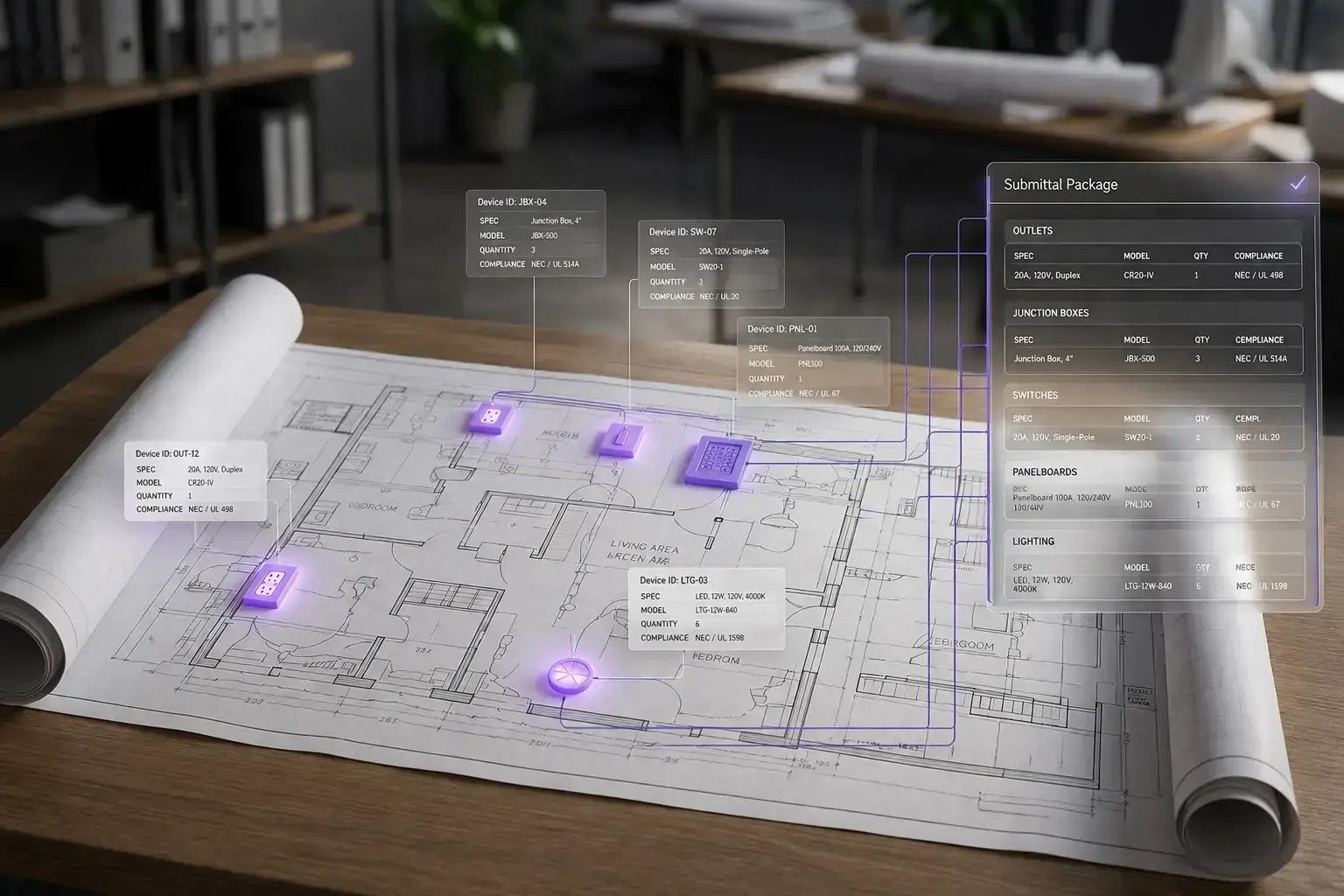
Electrical submittal packages are structured collections of documents prepared to meet project specifications and streamline the submittal process. By grouping related materials and information into packages, the review process is simplified and ensures that all relevant submittals remain consistent and aligned throughout the project cycle.
Grouping related submittals into packages streamlines the review process by providing clear, organized documentation for each system or equipment category. This approach keeps all associated materials together, minimizing the risk of discrepancies and facilitating efficient communication between the project team, general contractor, and design reviewers. As a result, the workflow remains aligned and submittal accuracy is maintained, supporting successful project delivery.
In the electrical submittal process, several recurring pitfalls can hinder project progress and compromise accuracy. Understanding these common issues—and knowing how to address them—helps ensure that submittals meet project requirements and support efficient review.
By being mindful of these pitfalls and following the suggested approaches, project teams can streamline the electrical submittal process and support successful project delivery.
Digital tools and AI-driven solutions are transforming the way electrical submittals are managed, offering significant advantages throughout the process. These technologies help streamline workflow, improve accuracy, and facilitate collaboration among stakeholders.
AI-powered takeoff tools enable precise device counting and scheduling by automatically extracting information from project drawings and specifications. This reduces manual errors and ensures that device counts and schedules are consistent throughout the project, supporting compliance and minimizing discrepancies.
Centralized document management platforms make it easier to assemble, track, and revise submittals. By keeping all related materials organized in one place, these tools simplify the review process and help ensure that documentation is complete, current, and easily accessible for all parties involved.
Drawer AI provides enhanced takeoff capabilities, leading to fewer mismatches between design, estimates, and submittal content. By automating and refining the front-end process, Drawer AI helps project teams maintain alignment and accuracy from the outset, supporting smoother project delivery and more reliable outcomes.
In summary, digital tools and AI-driven solutions have become essential for efficient electrical submittal management. By leveraging AI-powered takeoff tools, project teams can achieve more accurate device counts and schedules, reducing manual errors and ensuring consistency across the project. Centralized document management platforms further simplify the assembly and tracking of submittals, making critical information readily accessible to all stakeholders.
Drawer AI, with its advanced takeoff and front-end automation capabilities, stands out as a solution that minimizes mismatches and keeps projects aligned from the start. To experience smoother project delivery and more reliable outcomes, consider integrating Drawer AI into your workflow—request a demo to see it in action and how it can transform your electrical submittal process.
An example of a submittal could be a shop drawing for electrical devices, which provides detailed information about the layout, installation, and specifications of those devices for review by the design team.
The term "submittal" refers specifically to documents or samples provided for approval during a construction project, while "submission" is a broader term that can mean sending any document or item for consideration or review.
A construction submittal is provided to demonstrate compliance with project requirements, whereas an RFI (Request for Information) is a formal question sent to clarify project details or resolve ambiguities in the plans or specifications.
The contractor is typically responsible for preparing and submitting the required submittals. These are then reviewed by the architect, engineer, or other project stakeholders to ensure they meet the project's specifications.
To create a construction submittal, the contractor gathers relevant documentation, drawings, or samples, organizes them according to project requirements, and submits them to the design team for review and approval.

14425 Falcon Head Blvd
Building E, Suite 100,
Austin, TX 78738
Created by Estimators, Powered by AI and Innovation
Copyright © 2026 Drawer AI. All rights reserved.