
AI





Every electrical contractor faces tough decisions when bidding on projects. Sometimes, you win the bid but barely break even, leaving little to show for your hard work. In other cases, you lose out because your price was 15% higher than the winning contractor’s. Both scenarios are common in the industry and can be frustrating, especially when you know your team delivers quality work and deserves a fair profit.
Table of Сontents
The root cause behind these outcomes often lies in not knowing your actual overhead costs and failing to calculate markup correctly. These mistakes can lead to either underpricing your services or pricing yourself out of the market. Understanding your overhead, markup, and profit margins is essential if you want to stay competitive and profitable.
This article breaks down the math behind overhead, markup, and profit margins, helping you gain clarity and confidence in your pricing strategies. With the right calculations, you can ensure that your bids are accurate, competitive, and profitable, setting your business up for long-term success.
In the electrical contracting business, understanding the distinctions between overhead, markup, and profit is crucial for accurate pricing and long-term success. While these terms are often used together, each represents a different aspect of your financial structure and influences how you should approach bids and project estimates.
Overhead refers to the ongoing costs required to operate your electrical contracting business, regardless of whether you are actively working on a project. Common overhead expenses include office rent, estimating software, vehicle fleet maintenance, insurance, and non-billable labor such as administrative staff. These costs are not directly tied to any single job, but they are necessary for keeping your business running smoothly.
Direct costs are those expenses that can be traced back to a specific project. This category includes materials used for the job, field labor, subcontractors, and equipment rentals or purchases required for that particular work. Unlike overhead, direct costs are unique to each project and form the foundation of your bid calculations.
Markup is the percentage added to the direct costs of a job. This serves a dual purpose: it covers your overhead expenses and helps generate profit. Markup ensures that you are not only reimbursed for the direct costs but also for the business expenses incurred in supporting and executing the project. The right markup keeps your bids competitive while making sure you don't undercut yourself.
Profit is what remains after all expenses, both direct costs and overhead—have been paid. This is the actual financial gain your business receives from a project. Profit is essential for growth, reinvestment, and providing a cushion during lean periods.
It is important to emphasize that overhead is not profitable. Many small electrical contractors mistakenly combine these concepts, which can lead to pricing errors and financial problems. Overhead represents the cost of doing business, while profit is the reward for your risk, expertise, and effort. Keeping these categories separate in your calculations will help you make informed decisions and ensure your business remains healthy and sustainable.
One of the biggest pitfalls for electrical contractors is misunderstanding the difference between markup and margin. Many believe that marking up their costs by a certain percentage guarantees that same percentage as profit. However, this is not the case—and failing to recognize the distinction can lead to costly mistakes.
Formulas:
Markup % = (Price – Cost) / Cost × 100
Margin % = (Price – Cost) / Price × 100
Let’s look at a clear example: Suppose your direct job costs are $100,000. If you apply a 20% markup, your bid price becomes $120,000. You might assume that you’re making a 20% profit, but the actual profit margin is calculated differently. Using the margin formula, your margin is ($120,000 – $100,000) / $120,000 × 100 = 16.7%. So, while you marked up costs by 20%, your true margin is only 16.7%.
Markup and Margin Conversion Table:
|
Markup % |
Margin % |
Bid Price (Assuming $100,000 Cost) |
Profit (Assuming $100,000 Cost) |
|
10% |
9.1% |
$110,000 |
$10,000 |
|
20% |
16.7% |
$120,000 |
$20,000 |
|
25% |
20% |
$125,000 |
$25,000 |
|
30% |
23.1 |
$130,000 |
$30,000 |
|
40% |
28.6% |
$140,000 |
$40,000 |
|
50% |
33.3% |
$150,000 |
$50,000 |
|
Margin % |
Markup % |
Bid Price (Assuming $100,000 Cost) |
Profit (Assuming $100,000 Cost) |
|
10% |
11.1% |
$111,100 |
$11,100 |
|
16.7% |
20% |
$120,000 |
$20,000 |
|
20% |
25% |
$125,000 |
$25,000 |
|
23.1% |
30% |
$130,000 |
$30,000 |
|
28.6% |
40% |
$140,000 |
$40,000 |
|
33.3% |
50% |
$150,000 |
$50,000 |
Why does this matter? If a contractor believes they are earning a 20% profit but their margin is actually 16.7%, they may be losing money on every project if their overhead exceeds 16.7%. For example, suppose a contractor marks up costs by 20%—they might expect a 20% profit, but their actual margin is calculated as profit divided by revenue, not cost. If overhead costs are underestimated or ignored, the business might not generate enough profit to cover those expenses, leading to losses over time.
Accurately distinguishing between markup and margin is vital to ensure your business covers its costs and achieves the desired profit. Markup refers to the percentage added to the cost price to arrive at the selling price, while margin measures the percentage of revenue that is profit. Misunderstanding these terms can cause a business to set prices too low, failing to account for overhead, labor, materials, and other indirect costs.
Otherwise, you could be underestimating your expenses and sacrificing profitability without realizing it. This could impact your cash flow, ability to invest in growth, and even threaten the long-term viability of your company. Regularly reviewing and understanding your pricing structure helps prevent these issues and ensures you are meeting your financial goals.
Understanding industry benchmarks for overhead and profit is essential for electrical contractors who want to ensure their pricing strategies are competitive and sustainable. These benchmarks provide valuable insight into what top performers and industry averages look like, helping contractors gauge their own financial performance.
According to the Construction Financial Management Association (CFMA), top-performing contractors report net margins around 12%. The National Association of Home Builders (NAHB) finds that the average net margin for home builders is approximately 9%. Global data from Turner & Townsend shows an average net margin of 7%, with the United States averaging closer to 5%.
A commonly referenced benchmark in construction is the "10-and-10" rule, meaning contractors aim for 10% overhead and 10% profit. This guideline is often used as a baseline in estimating and contract negotiations, though actual percentages may vary based on company size, market conditions, and project complexity.
Specialty electrical subcontractors typically achieve gross margins ranging from 26% to 34%, according to Hubstaff. This gross margin encompasses both overhead and profit and reflects the additional costs and risks associated with specialized electrical work.
For electrical subcontractors, net profit margins usually fall between 5% and 10%. These figures represent the earnings left after accounting for all project costs, overhead, and taxes.
Overhead rates for electrical contractors generally range from 10% to 20%. The specific rate often depends on the size and structure of the company, as well as the complexity of the projects undertaken.
While these benchmarks provide a useful reference point, it is important to remember that they are averages. Ultimately, your own financial data and performance metrics matter more than industry benchmarks. Contractors should regularly evaluate their unique overhead and profit margins to ensure they are setting prices accurately and achieving their business goals.
Understanding your overhead rate is essential for accurate pricing and financial management. Here’s a practical walkthrough to help you determine your overhead rate for your electrical contracting business.
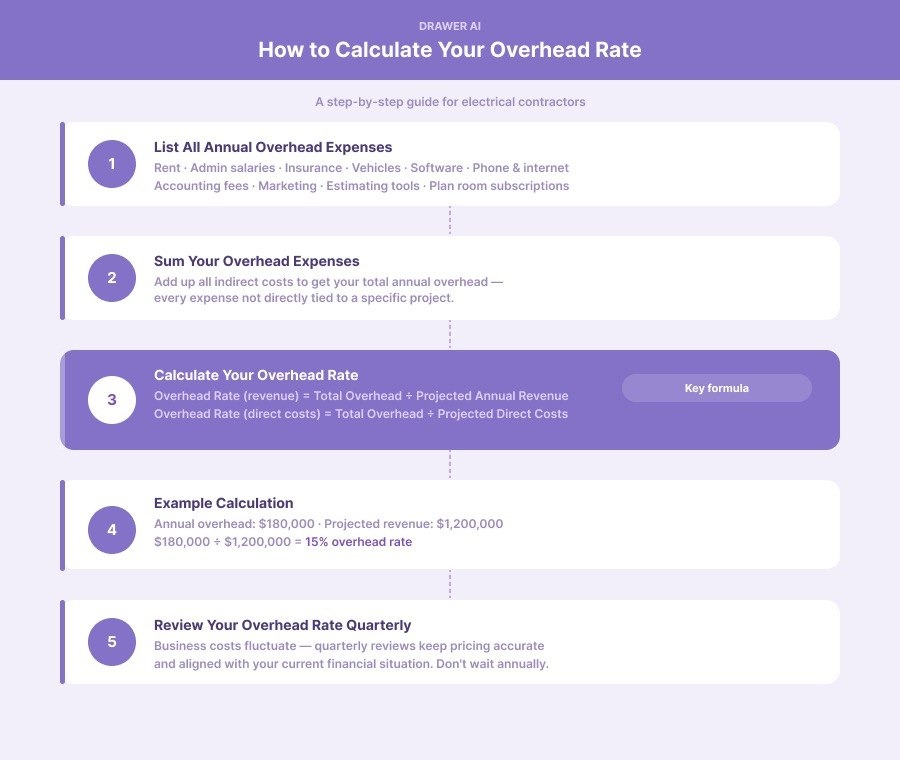
Begin by identifying every annual overhead expense your business incurs. Typical overhead costs include rent, administrative salaries, insurance, vehicles, software subscriptions, phone and internet services, accounting and legal fees, marketing expenses, estimating tools, plan room subscriptions, and testing equipment. Make sure to account for all recurring expenses that aren’t directly tied to specific projects.
Once you’ve listed your overhead costs, add them up to get your total annual overhead. This sum represents the total amount spent on indirect business expenses over the course of a year.
To determine your overhead rate, divide your total annual overhead by either your projected annual revenue or your projected direct costs. This ratio gives you a percentage that reflects the proportion of revenue or direct costs consumed by overhead.
For instance, if your annual overhead is $180,000 and your projected annual revenue is $1,200,000, your overhead rate would be 15%:
It’s important to review your overhead rate regularly, on a quarterly basis rather than annually. Business costs can fluctuate, and frequent reviews help ensure your pricing remains accurate and aligned with your current financial situation.
Establishing the right markup is essential for achieving your desired profit margin and ensuring all overhead costs are covered. Your overhead rate directly impacts pricing decisions. For example, if your overhead rate is 15% and your goal is an 8% net profit, your total margin needs to be 23%. This combined margin accounts for both the indirect business expenses and your target profit, guiding you in setting prices that meet your financial objectives.
Translating your desired margin into a markup percentage is a crucial step. In this scenario, a 23% margin converts to a 29.9% markup. Understanding this relationship helps ensure that your pricing strategy will cover all costs and deliver your target profit.
To calculate the markup percentage required for a specific margin, use the following formula:
Consider a real-world example: You have a $100,000 project with direct costs of $77,000. By applying a 29.9% markup, your final price is $100,000. When you subtract the direct costs from the final price ($100,000 – $77,000), you get $23,000. This difference represents your margin, which is 23% of the total price ($23,000 / $100,000 = 23%). Of this margin, $15,000 covers overhead (15%), and the remaining $8,000 is your net profit (8%). This breakdown verifies that your pricing strategy successfully covers overhead and achieves your profit target.
It is also important to understand the differences between contract types. With a Guaranteed Maximum Price (GMP), the general contractor may cap your markup, limiting how much you can add. In contrast, with a lump-sum contract, your markup is included in the total price and is not explicitly disclosed. Knowing these distinctions helps you navigate pricing strategies for different contract arrangements.
Accurate takeoff is essential for maintaining healthy margins in construction and contracting projects. The takeoff process determines your cost basis, which forms the foundation for pricing and applying markup. When the initial counts and measurements are correct, your pricing strategy remains reliable and ensures your overhead and profit targets are met. However, even small errors in takeoff can have significant financial consequences. Because markup acts as a multiplier, any mistake in your cost basis is amplified throughout your pricing calculations.
For example, if your takeoff underestimates materials or labor by 10%, your markup will magnify that error. You may price a job at $100,000, but actual costs reach $85,000 instead of the anticipated $77,000. As a result, your projected 8% profit evaporates, leaving you with zero profit. On the other hand, overestimating your takeoff by 10% raises your bid price, making it uncompetitive and causing you to lose the project. These scenarios illustrate how critical it is to ensure your takeoff is as accurate as possible before applying markup.
Drawer AI provides an AI-powered solution for takeoff, automatically counting devices, routing branches, and sizing wire. By using Drawer AI, contractors can ensure their cost basis is accurate before applying markup. The automation not only reduces human error but also saves substantial time, with reports of up to 70%-time savings compared to manual processes. This efficiency allows for more reliable pricing, protects profit margins, and helps contractors remain competitive.
Understanding your overhead costs, calculating markup correctly, and starting with precise takeoff data are essential steps for achieving profitability and maintaining a competitive edge as a contractor. By diligently tracking indirect expenses, applying markup thoughtfully to cover all business needs, and using reliable data from the outset, you can ensure your pricing strategy aligns with your goals and market demands.
Interested in enhancing your workflow and elevating your business outcomes?Book a demo with Drawer AI today to discover how precise takeoff and efficient cost management can drive your success.
14425 Falcon Head Blvd
Building E, Suite 100,
Austin, TX 78738
Created by Estimators, Powered by AI and Innovation
Copyright © 2026 Drawer AI. All rights reserved.