AI





A detailed estimate is a comprehensive, late-stage estimate developed when the project scope is well defined. This type of estimate is typically used for competitive bids, establishing Guaranteed Maximum Prices (GMPs), and creating control budgets for construction projects.
Table of Сontents
Unlike conceptual or budget estimates, which are generally prepared at the order-of-magnitude or schematic design stage with limited project information, detailed estimates require a high degree of scope definition and specificity. Conceptual estimates are used for initial project feasibility and early budgeting, while detailed estimates are essential for final pricing and project control.
A detailed estimate in construction is a comprehensive, highly accurate assessment of project costs that is developed when the project scope is well defined. It relies on near-final drawings and specifications, as well as a clearly established scope of work. The estimate serves as a practical and precise forecast of expenses, reflecting the actual quantities and types of materials, labor, and equipment required for the project.
Detailed estimating divides the project into specific line items for systems, trades, or cost codes, using the Work Breakdown Structure (WBS). Each section is analyzed for its materials, labor, equipment, and subcontractor costs. Unit costs are assigned based on market data, and adjustments are made for project-specific factors.
Estimators also document key assumptions and allowances. The sum of these line items, with added contingencies, results in a thorough and reliable project cost estimate that supports accurate tracking and effective cost management.
A detailed estimate is sufficiently robust to support a variety of critical project functions. These include preparing contracts, establishing control budgets, securing project financing, and guiding procurement activities. In practice, detailed estimates are commonly used for competitive bidding processes, negotiating Guaranteed Maximum Prices (GMPs), preparing an owner’s detailed project budget, and submitting cost documentation to banks or lenders.
The accuracy of a detailed estimate is generally high, as it is based on well-developed drawings and a defined scope. While some variability remains, the expectation is that costs will closely reflect actual project expenditures, providing confidence for decision-making and financial planning.
Estimating in construction is an evolving process that progresses through several distinct stages as project information becomes more defined. These levels—conceptual, design development, and detailed—each serve unique purposes and are characterized by differing inputs, levels of detail, and risk assumptions.
At the earliest stage, the conceptual or Rough Order of Magnitude (ROM) estimate is prepared. This estimate relies on minimal design information, often using area or parametric factors to generate a broad cost range. Because inputs are high-level and generalized, the estimate’s granularity is low and risk assumptions are broad. This phase is useful for feasibility studies but carries significant uncertainty given the lack of detailed scope.
As the project progresses and design details emerge, the estimate shifts to the design development or systems level. Here, inputs include preliminary drawings and outline specifications, allowing costs to be broken down by major systems or assemblies. Granularity increases, and risk assumptions are adjusted to reflect better-defined project components. This phase offers improved accuracy but still relies on allowances and assumptions for incomplete scope elements.
In the final stage, when the scope is well defined, the detailed or pre-construction estimate is developed. Using near-final drawings and specifications, this estimate breaks the project into specific work packages and line items. Quantities and unit costs are applied with a high degree of accuracy, and risk assumptions are narrowed to focus on known uncertainties. This estimate supports budget control and contract negotiations, reflecting the most reliable forecast of project costs.
As estimating moves from conceptual to detailed, the nature of the input data shifts from generic to project-specific, the granularity of breakdowns increases, and risk assumptions become more refined. Early estimates make broad assumptions to compensate for unknowns, while detailed estimates address specific quantities and costs, reducing overall risk.
Many project teams encounter challenges when they treat a budget-level estimate as if it were a detailed one. This mistake often leads to missed scope items and inadequate breakdowns, ultimately resulting in cost overruns and unreliable forecasts. Recognizing the limitations and appropriate uses of each estimating level is crucial for accurate project planning and successful financial management.
A well-structured detailed construction estimate is essential for accurate project pricing, risk management, and successful project delivery. The following elements outline the recommended approach to developing a comprehensive and reliable detailed estimate.
Each cost item in a detailed estimate should be assigned a unique cost code. Commonly, industry standards such as the Construction Specifications Institute (CSI) MasterFormat are used, though some organizations may opt for custom internal codes. These codes provide consistency and allow for organized tracking and reporting of costs throughout the project lifecycle.
An effective detailed estimate relies on a clear work breakdown structure (WBS). The project is divided into logical divisions, trades, or systems. For example, electrical work might be separated into lighting, power, and branch circuits. The WBS can also be organized by location or zone within the project, enabling a granular view of costs and facilitating focused management of specific areas or systems.
Detailed estimates must clearly distinguish between labor, material, equipment, subcontract, and indirect costs. By separating these categories, estimators can more accurately allocate resources, identify cost drivers, and adjust for market changes. Indirect costs, such as supervision, temporary facilities, or insurance, should also be itemized to ensure complete coverage of all project expenses.
Any alternates, unit rates, or optional scopes should be explicitly broken out in the estimate. This practice allows project stakeholders to evaluate the cost impact of different design or procurement options and supports informed decision-making during value engineering or negotiation phases.
For instance, a line item for “Lighting – First Floor” would be coded according to the selected cost coding system, fall under the Electrical division in the WBS, and be further broken down into labor, material, and equipment components. Alternates, such as an upgraded lighting fixture, would be listed separately with its own unit rate and cost breakdown.
Maintaining the same cost coding and estimate structure across projects is crucial. Consistency enables benchmarking and facilitates historical comparison, providing valuable data to refine future estimates, track performance, and improve overall project delivery.
Unlike simplified estimating methods, a detailed workflow begins with comprehensive inputs. These include fully coordinated drawings, specifications, addenda, responses to RFIs (Requests for Information), and vendor quotes. Such thorough documentation ensures that every component and requirement of the project is accounted for before the estimating process begins.
One practical example of how detailed estimating influences decisions: By tracking labor hours by system, estimators may discover that the lighting system on the first floor requires 1,200 hours, compared to only 600 hours on other floors. This visibility reveals a high-risk area and prompts management to investigate further, potentially adjusting crew sizes or construction sequencing to mitigate risk.
This workflow maintains an advanced level of granularity throughout, avoiding the oversimplified high-level steps such as “clarify scope, perform takeoff, add risk, use software.” Instead, it supports precise cost allocation, risk identification, and informed decision-making by stakeholders at every phase.
Quality assurance (QA) and peer review are critical steps in the preparation of detailed estimates, ensuring accuracy and reliability before submission or use in project decision-making. A systematic approach to these activities safeguards against errors, omissions, and misinterpretations that could compromise project outcomes.
A robust QA process begins with the use of an internal checklist tailored to detailed estimating. This checklist should confirm comprehensive scope coverage, verify that all relevant drawings, specifications, and addenda have been captured, and ensure that allowances and escalation have been properly included. Additionally, the checklist must address the inclusion of general conditions and other indirect costs to provide a complete and defensible estimate.
Peer review is often conducted through dedicated estimating review meetings. These sessions involve key stakeholders such as project managers and field superintendents, whose operational insights help identify gaps or inconsistencies. By collaboratively scrutinizing the estimate, the team enhances its accuracy and ensures alignment with practical execution strategies.
An essential component of QA is performing cross-checks against historical projects. This includes comparing cost per unit and labor productivity rates, as well as benchmarking against earlier budget estimates. Such comparisons help to validate assumptions and highlight any significant deviations that may need further investigation.
Stress testing involves evaluating best, likely, and worst-case scenarios for key cost drivers. By modeling these variations, estimators can assess the estimate’s sensitivity to changes, anticipate potential risks, and inform contingency planning.
A thorough estimate package must document all underlying assumptions and clarifications. This documentation feeds directly into bid qualifications and contract negotiations, ensuring that all parties share a clear understanding of the basis for the estimate.
The transition from a detailed estimate to project setup begins with converting the estimate's breakdown into specific job cost codes and budget line items. Each component of the estimate—whether it is for materials, labor, equipment, or subcontracted work—is assigned a corresponding cost code. These codes and line items form the building blocks for financial management throughout the project, ensuring that every dollar is tracked against a well-defined scope.
The detailed estimate serves as the baseline for all subsequent cost tracking, forecasting, and change management activities. Once the estimate is finalized and approved, it becomes the control budget against which actual expenditures are compared. This baseline enables project teams to monitor progress, identify variances, and make informed decisions when changes arise, supporting proactive management and minimizing the risk of budget overruns.
In addition to setting the financial baseline, the detailed estimate is a crucial resource for developing the buyout strategy. It helps identify which scopes of work should be tendered as separate packages and highlights areas where alternate approaches or value engineering may yield cost savings. By referencing the estimate, teams can strategically approach procurement and maximize value for the project.
A well-structured detailed estimate streamlines the handoff to control budget and project setup. Its clarity and organization ensure that all project components are captured, reducing the likelihood of gaps, misallocations, or omissions. Conversely, a messy or poorly organized estimate can lead to confusion, missed costs, and overruns, undermining the success of the project from the outset. Careful preparation of the detailed estimate is therefore essential for a smooth transition into project execution and financial control.
Digital tools and artificial intelligence (AI) are reshaping the landscape of detailed estimating, bringing greater accuracy, efficiency, and organization to the process. By integrating advanced technologies into estimating workflows, teams can automate routine tasks, reduce manual errors, and ensure that the estimate captures all required project details.
Drawer AI exemplifies this technological advancement by offering specialized solutions tailored to the unique requirements of construction estimating. Its capabilities streamline the breakdown of project components, helping estimators assign cost codes and line items with precision and ease. This alignment with modern estimating practices supports a smooth transition from estimate preparation to project financial management.
High-quality data is the foundation of reliable detailed estimates. Digital platforms and AI-driven tools enhance data quality by systematically capturing, organizing, and verifying quantities, measurements, and specifications. This results in a clear, well-structured estimate that minimizes the risk of omissions and misallocations, reinforcing the control budget and supporting accurate cost tracking throughout the project.
Automated takeoff solutions for electrical systems—covering devices, branch circuits, wire sizing, and panels—enable precise extraction of quantities and specifications from project documents. This data is fed directly into the estimate at the line-item level, ensuring that every component is accounted for and linked to the appropriate cost code, ultimately streamlining the estimating process and supporting comprehensive project setup.
Improved quantity and routing data, enabled by digital and AI-driven tools, allow estimators to produce more accurate labor and material splits. With detailed insights into the quantities and paths required for installation, teams can allocate resources more precisely, reducing contingencies and supporting informed decisions during procurement and execution.
For readers seeking a broader overview of the general estimating process and further details on Drawer AI’s capabilities, refer to the following article: Construction Estimating Process: Steps and Tips.
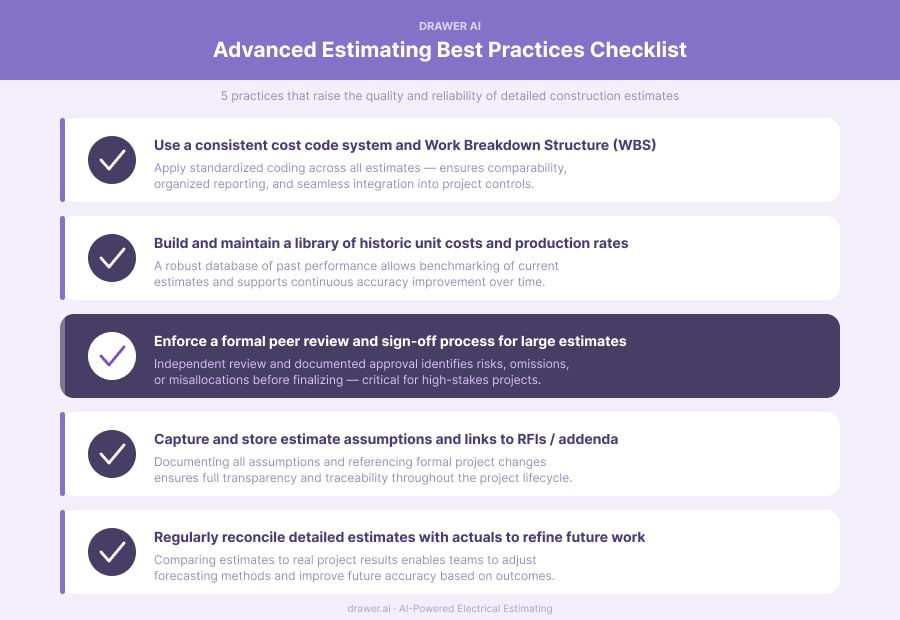
Detailed Estimating Best Practices Checklist
A highly detailed estimate is critical for effective project management and financial control in construction. The following checklist outlines advanced best practices, focusing exclusively on methods that raise the quality and reliability of detailed estimates. These practices go beyond basic approaches and leverage systematic, data-driven techniques to deliver greater precision and accountability.
Applying these advanced practices establishes a strong foundation for reliable, actionable estimates, ultimately supporting better project delivery and cost management.
In construction, detailed estimating serves as the backbone of profitable and low-risk projects. It is far more than just an expanded spreadsheet; it is a disciplined process that underpins sound decision-making and project success. By investing in thorough and systematic estimating practices, organizations can anticipate challenges, control costs, and safeguard project outcomes.
To maximize the value of detailed estimating, it is essential to standardize the structure, quality assurance, and handoff processes. Consistency across these areas lays the groundwork for accuracy and transparency throughout the project lifecycle. Additionally, leveraging modern tools and technologies enables teams to efficiently populate, manage, and update detailed estimates at scale, ensuring ongoing reliability and continuous improvement.
Ready to take your estimating process to the next level? Discover how Drawer AI can streamline detailed estimating, enhance collaboration, and support your project management goals. Request a demo to see how Drawer AI helps teams build more accurate estimates and improve project outcomes.

14425 Falcon Head Blvd
Building E, Suite 100,
Austin, TX 78738
Created by Estimators, Powered by AI and Innovation
Copyright © 2026 Drawer AI. All rights reserved.