AI





Procurement and bidding are essential processes in construction projects. Their significance lies in shaping how projects are awarded, managed, and executed. Effective procurement ensures that the right materials, services, and contractors are selected, while a well-structured bidding process allows for fair competition and transparent selection of project partners.
Construction procurement refers to the process of acquiring goods, services, and works necessary for a construction project. This includes sourcing materials, hiring subcontractors, and engaging suppliers. Construction bidding is the method by which contractors submit proposals or offers to undertake specific work within a project. Through bidding, contractors compete to secure contracts based on price, quality, and capability.
Table of Сontents
Construction procurement is the process of obtaining the goods, services, and works required for a construction project. In practice, this means sourcing materials, selecting subcontractors, and engaging suppliers to ensure that all necessary components are available for the project’s successful completion. The procurement process is essential for determining who will provide these items and services, and how they will be delivered throughout the project timeline.
The procurement phase typically occurs after the project planning and design stages, but before construction begins.
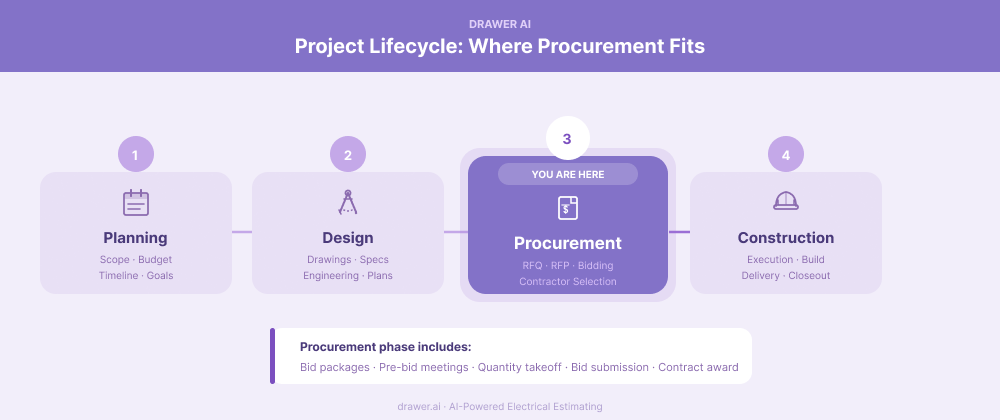
During this phase, key decisions are made regarding the scope of work, the delivery method (such as design-bid-build or design-build), and the approach to soliciting bids from contractors and suppliers. These decisions shape the structure of the project and influence how contractors are selected, ultimately impacting project outcomes.
Several documents are commonly used in the procurement phase. These include Requests for Qualifications (RFQs), Requests for Proposals (RFPs), bid packages, specifications, and drawings.
Together, these documents help ensure that the procurement process is fair, transparent, and efficient. They provide the necessary information for contractors to accurately estimate costs, understand technical requirements, and comply with the project's standards. Properly prepared procurement documents reduce the risk of disputes, support competitive bidding, and contribute to the successful delivery of construction projects.
There are several primary procurement models commonly used in the construction industry. Each method offers a distinct approach to project delivery and contractor selection.
The bidding process begins when a project is announced and a bid opportunity is identified. Contractors may discover opportunities through bid boards, invitations from general contractors, or direct requests from project owners.
Once a project is announced, essential documents are released to prospective bidders. These include drawings, specifications, and any addenda, providing the information needed to prepare accurate and competitive bids.
Pre-bid meetings are often held to clarify project requirements and address any questions. Contractors can submit RFIs to resolve uncertainties and ensure their bids align with the project's expectations.
Bidders perform a quantity takeoff to determine the materials and labor needed, followed by pricing. This step is critical for preparing a competitive bid and can involve tools such as Drawer AI to streamline calculations.
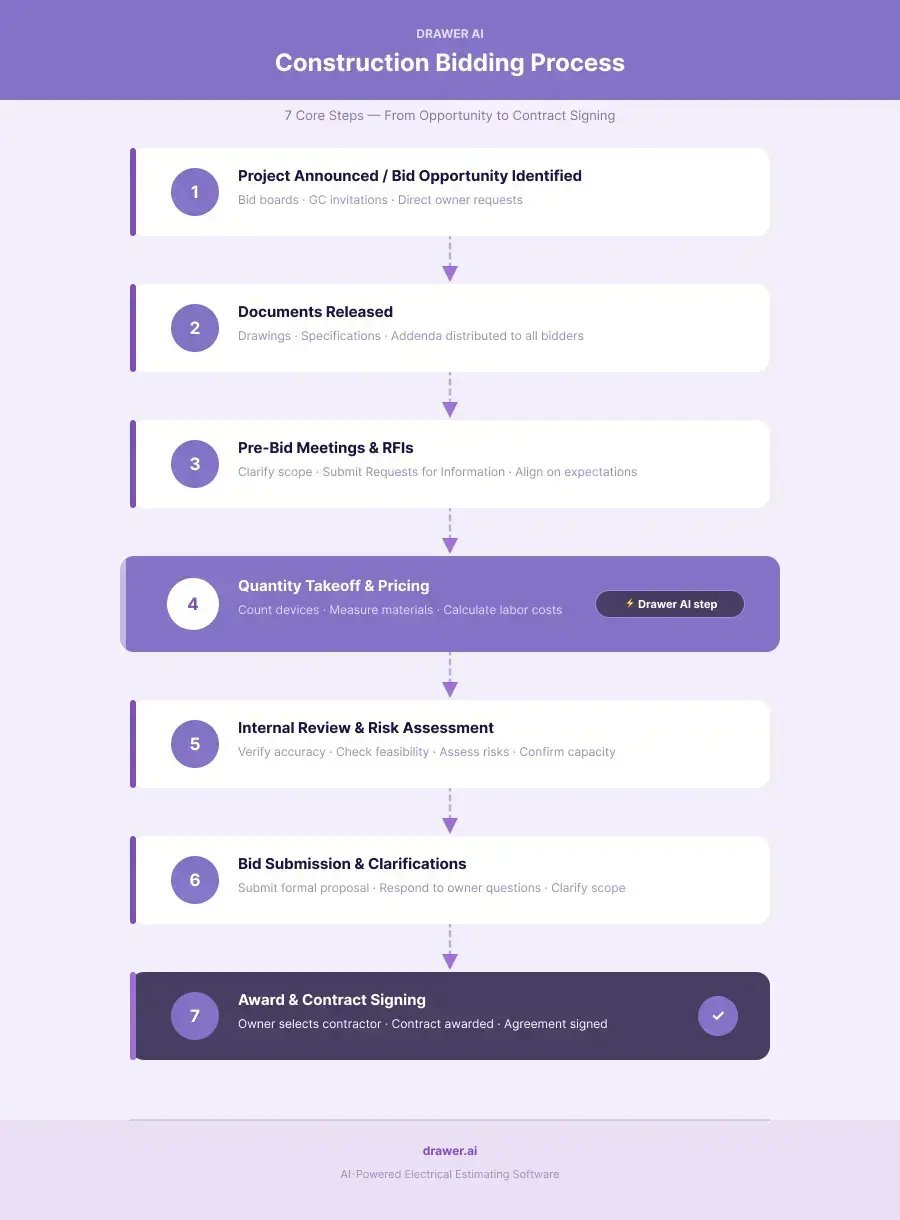
Before submitting the bid, contractors conduct an internal review and assess potential risks. This process helps ensure that the bid is accurate, feasible, and aligns with the contractor's capabilities.
Once the bid is finalized, it is submitted to the project owner. Clarifications may be requested to address any ambiguities or additional questions about the bid.
The bidding process concludes when the project owner selects a contractor, awards the contract, and completes the signing of agreement documents.
To bid effectively, start by qualifying opportunities based on fit, capacity, and profitability. Assess whether the project aligns with your company’s expertise and resources, ensure you have the capacity to deliver, and evaluate the potential for profitability. This initial screening helps focus your efforts on projects that match your strengths and business goals.
Carefully review bid documents to understand the project scope, alternates, and exclusions. Make sure you identify all requirements and clarify any ambiguities. Understanding these details will prevent misunderstandings and ensure your bid addresses everything required.
A well-structured contractor bid and construction bid proposal should clearly outline your approach, pricing, timeline, and any assumptions. Organize your proposal to make it easy for the project owner to evaluate your offer and understand how you plan to meet the project’s needs.
Utilize construction RFP templates and standard forms to ensure consistency and completeness in your bids. These documents help streamline the process, making it easier to respond to requirements and maintain a professional presentation.
In a lump-sum or fixed price contract, the contractor agrees to complete the project for a predetermined total price. This contract type places significant risk on the contractor, as any cost overruns or unforeseen expenses are their responsibility.
The contractor must carefully estimate costs, include appropriate contingencies, and clarify the scope of work to avoid misunderstandings. Pricing should be precise, and all assumptions and exclusions need to be clearly documented.
Contingency should be incorporated to cover potential risks or unknowns, and scope clarifications are essential to prevent scope creep or disputes.
Unit price contracts specify payment based on a set rate for each unit of work. The contractor’s risk is tied to the accuracy of quantities estimated and provided by the project owner.
If actual quantities differ from estimates, the contractor may face increased or decreased costs. Pricing should reflect the unit rates, and contingencies can be added for potential quantity variations.
Scope clarifications should address what is included in each unit and how changes in quantities will be managed.
Cost-plus contracts reimburse the contractor for actual costs incurred plus an agreed-upon fee. If a Guaranteed Maximum Price (GMP) is included, the contractor’s risk increases, as costs above the GMP are not reimbursed.
Without a GMP, risk is lower, but contractors must track costs closely and communicate clearly with owners. Pricing should detail markups and fees, and contingencies may be less necessary unless a GMP is set.
Scope clarifications are important to define reimbursable costs and any exclusions. If a GMP applies, clarify what is included in the maximum price.
Time and materials contracts compensate the contractor based on labor hours and materials used. The contractor’s risk is relatively low, as they are paid for what is actually expended.
However, owners may require a not-to-exceed amount to limit exposure. Pricing should specify labor rates, material markups, and any limits. Contingencies may not be needed, but clear scope clarifications help prevent disputes over what constitutes billable work.
Successful procurement and bidding for electrical contractors depend on a combination of careful planning, leveraging technology, and maintaining clear communication. The right approach helps minimize risks, control costs, and ensure accurate project delivery. Below are expanded recommendations and common mistakes to avoid, along with best practices to adopt.
To improve outcomes in procurement and bidding, electrical contractors should:
Additionally, contractors should maintain open communication with owners and clearly define pricing methods, markups, and contingencies for each contract type. This prevents misunderstandings and ensures fair compensation.
Avoiding common pitfalls is key to improving bidding accuracy and project outcomes. The following provides examples of mistakes and corresponding better practices:
1. Common Mistake: Failing to clarify contract scope, inclusions/exclusions, and how changes will be managed.
2. Common Mistake: Neglecting to communicate pricing details, markups, or contingencies.
By incorporating these expanded best practices and avoiding common mistakes, electrical contractors can achieve greater accuracy in bidding, better risk management, and improved project outcomes.
The procurement and bidding stages are critical to the financial success of every project—this is where profit is ultimately made or lost. By focusing on accuracy and transparency throughout these phases, electrical contractors can secure fair compensation and minimize the risk of costly misunderstandings.
We encourage you to apply the steps and best practices outlined above to modernize your bidding and procurement processes. Incorporating these strategies will help you achieve greater accuracy, improve risk management, and deliver better outcomes for your projects.
Ready to take your process to the next level? Request a demo to streamline procurement and bidding, and discover how our tools can help you optimize profitability and efficiency.

14425 Falcon Head Blvd
Building E, Suite 100,
Austin, TX 78738
Created by Estimators, Powered by AI and Innovation
Copyright © 2026 Drawer AI. All rights reserved.