AI



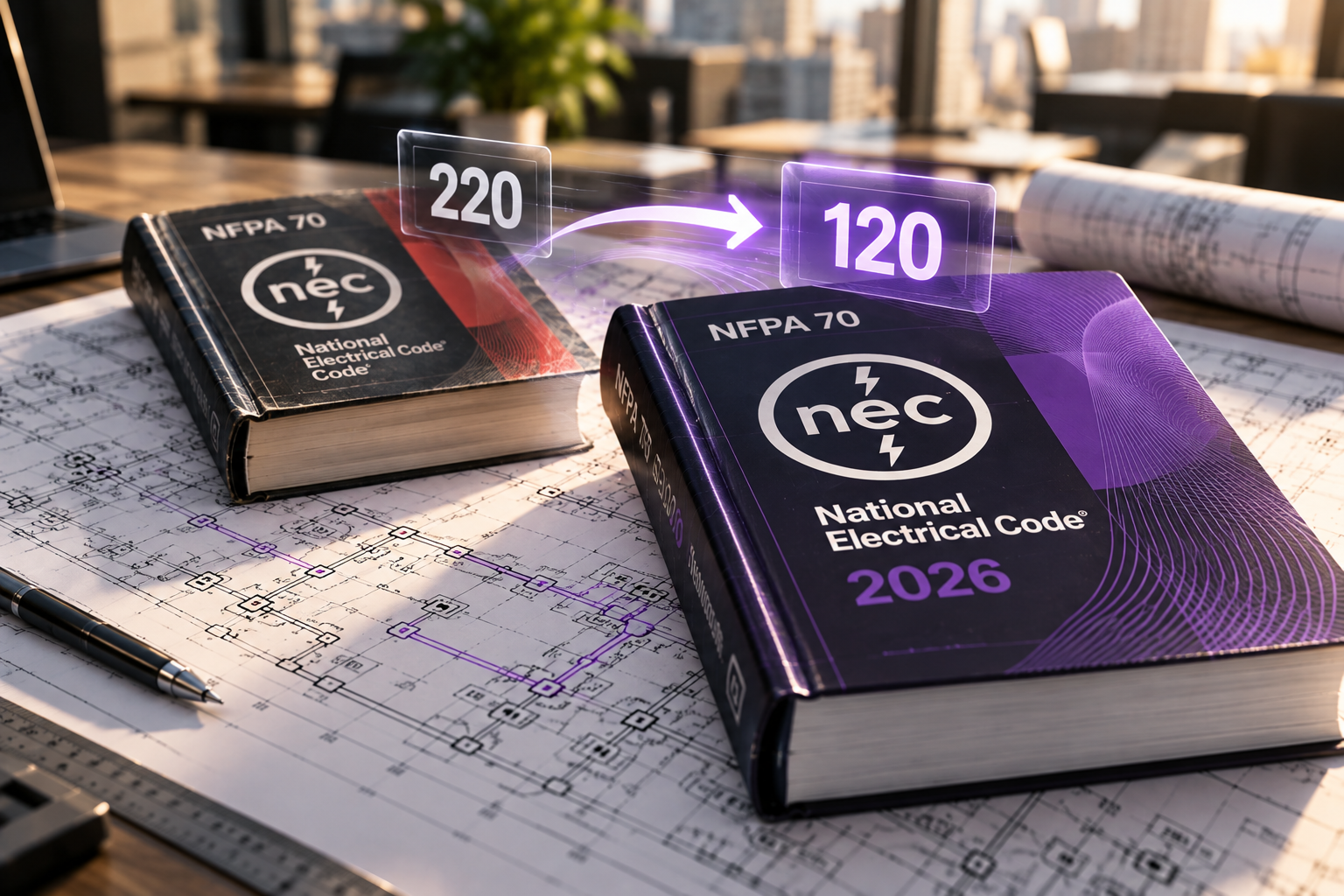

An estimator can finish a technically accurate commercial bid yet use the wrong code edition. Picture pricing an office project in Texas and one in California in 2026: the same team may face different adopted editions. NEC 2026, published by NFPA in 2025, is rolling out state by state through 2026-2028.
Table of Сontents
For electrical estimators, the practical question is which NEC code changes affect quantities, labor, equipment, or bid assumptions. Just as important is when the authority having jurisdiction enforces them. Across states, one contractor can legitimately encounter NEC 2017, 2020, 2023, and 2026 on opportunities.
This article walks through the NEC 2026 changes that matter for estimating, when jurisdictions adopt them, and how AI takeoff tools should handle code-rule updates. Before takeoff, confirm the adopted edition, local amendments, permit basis, and AHJ requirements. Use the changes below as an estimating checklist, not as a substitute for the adopted code.
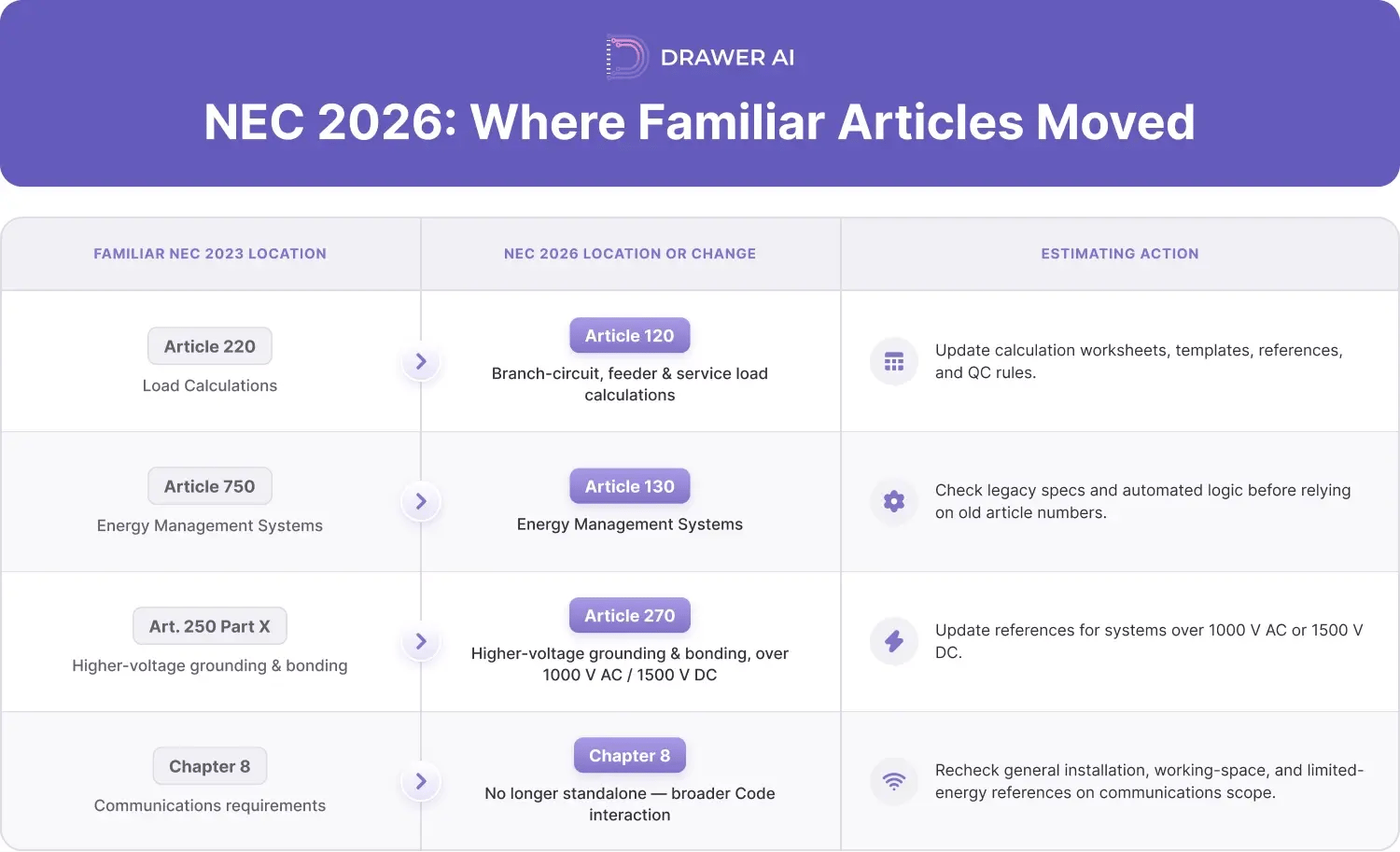
NEC 2026 is notable for structural reorganization. Load calculations formerly associated with Article 220 moved to Article 120, while energy-management-system requirements from Article 750 moved to Article 130. An otherwise correct worksheet or scope note can therefore carry an obsolete citation if it was built around an earlier edition.
Higher-voltage grounding and bonding requirements were reorganized into Article 270 for systems over 1000 volts AC or 1500 volts DC. Section 90.3 also removed Chapter 8's former independence: communications requirements now interact with the broader Code structure, while much limited-energy material sits in Chapter 7. Commercial communications scopes deserve a fresh cross-reference check rather than assumptions based on older exceptions.
For estimators, update worksheets, standard notes, training material, and automated rules that use NEC article numbers. Treat repeated old references on a 2026 project as a document-control flag. This overview is directional; the sections below focus on verified changes with plausible commercial or industrial estimating impact, not on cataloging every revision.
The National Electrical Code follows a three-year revision cycle: 2017, 2020, 2023, 2026, with 2029 expected next. That cadence matters because contractors rarely work in a single-code environment. A new edition can be published while one state is adopting it, another enforces the prior edition, and a city or project authority applies amendments.
Each full cycle moves through NFPA's standards-development process, including public input, public comment, technical committee work and balloting, and final issuance. That process is separate from adoption. Publication makes the model code available; it does not automatically make the edition enforceable on every U.S. project. Publication date and enforcement date are different estimating control points.
Between full editions, NFPA can also issue errata and Tentative Interim Amendments, or TIAs. Those electrical code updates and corrections matter because the NEC is not a static three-year snapshot. When a project depends on a specific section, verify current published material in NFPA LiNK or another official NFPA source instead of an old internal note or third-party summary.
Before takeoff, record the governing edition in the estimate basis and keep it visible through review. If it changes after bid documents are issued, recheck every rule-sensitive item that can change equipment, conductors, raceway, protection, layout, or labor. For broader NEC organization and navigation, use our practical guide to navigating the National Electrical Code rather than repeating that background here. That keeps post-bid review anchored to the same controlled input and keeps edition assumptions aligned across estimating, preconstruction, and final project handoff.
For decades, estimators learned to associate the national electrical code Article 220 with branch-circuit, feeder, and service load calculations. In NEC 2026, that subject is relocated to Article 120, titled Branch-Circuit, Feeder, and Service Load Calculations. The move matters anywhere article references are embedded in spreadsheets, design criteria, calculation notes, estimating assemblies, QA checklists, training material, or software rules.
The familiar feeder and service calculation material previously found in the 220.40 through 220.61 series now appears in the Article 120 structure. That continuity helps navigation, but it is not a reason for blind find-and-replace. NEC 2026 also includes Section 120.7 for Power Control Systems, so project-specific calculations still require verification against the adopted edition.
The practical effect reaches feeder and service calculations because citations are part of the calculation record. On design-build office, hospital, data center, or mixed-use projects, reviewers compare assumptions with engineer notes, panel schedules, one-lines, and permit documents. If one set uses NEC 2023 Article 220 and another uses NEC 2026 Article 120, the team must determine whether it is a legacy reference or a different code basis.
A company workbook developed under NEC 2023 may still produce a familiar result while its notes point to 220.40, 220.42, 220.50, or 220.61. On a project governed by NEC 2026, validate the corresponding Article 120 references before release. Identify legacy references, map them deliberately, check substantive 2026 changes that affect the calculation, and record the edition on the estimate. This gives reviewers a clear audit trail when an addendum changes connected load, feeder arrangement, or equipment assumptions.
Apply the same discipline to estimating databases and assemblies. If a load-calculation rule drives feeder size, overcurrent protection, equipment rating, or downstream quantities, the source edition must be traceable. A global text replacement can make a template look current without proving its logic. The same check applies to historical projects and copied design-build calculation sheets.
For multi-jurisdiction contractors, dual references can help during transition. A NEC 2023 project can point to Article 220, while a NEC 2026 project should use Article 120. The estimator must clearly identify which rule set is being applied and trace code-sensitive assumptions to the project's governing edition. Older worksheets may still be labeled "Article 220 NEC"; keep that wording only as a legacy search cue, then map the calculation to the adopted edition before release.
Article 120 is the most visible reorganization, but other 2026 revisions can move an estimate. The shortlist below is selective. Check each item against the 2026 text in NFPA LiNK and the project’s adopted edition before turning it into a bid rule.
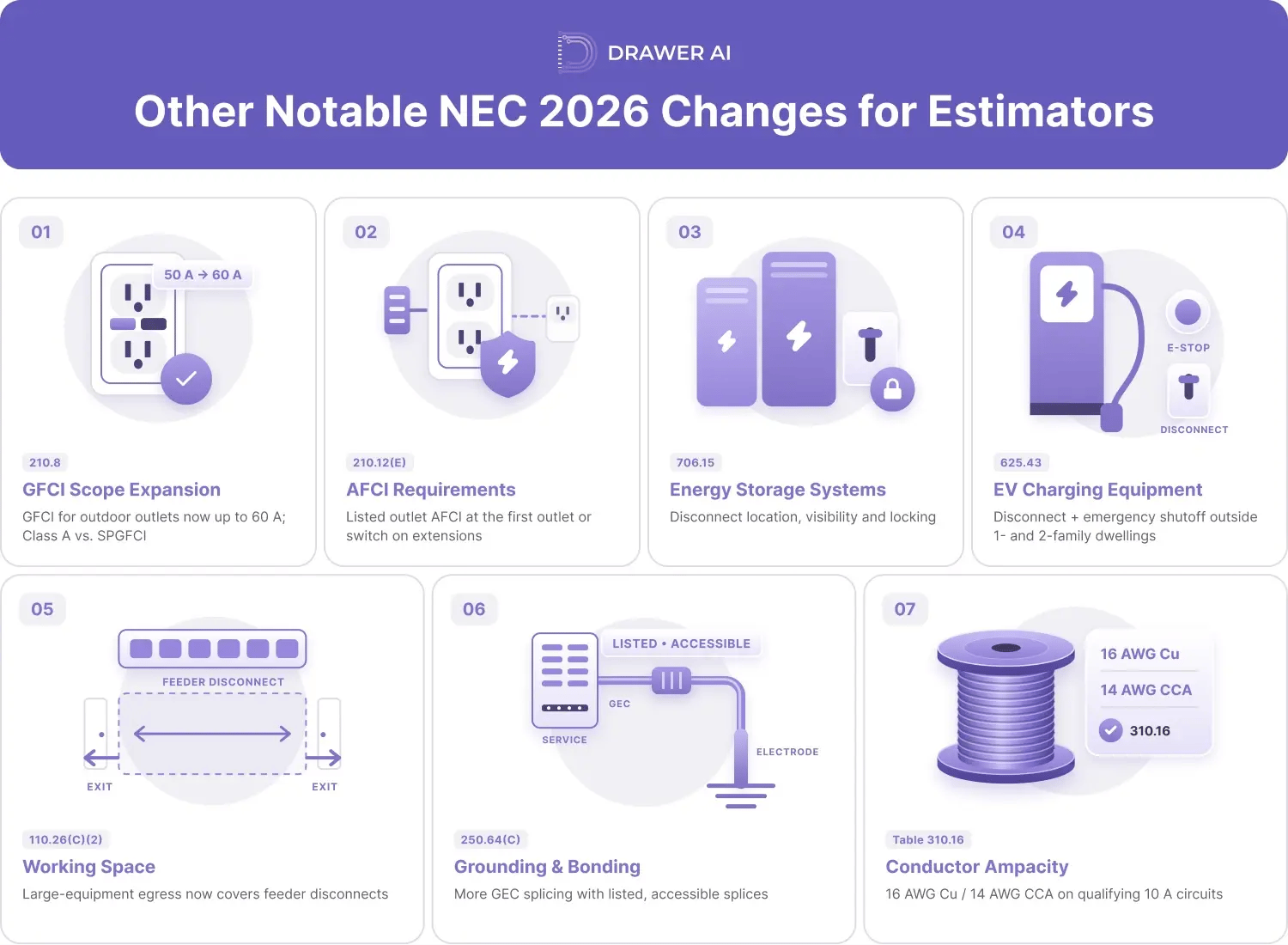
In NEC 2026, Section 210.8 does more than continue a trend: it reorganizes GFCI requirements across dwelling and nondwelling occupancies, clarifies indoor damp and wet locations, adds specific provisions for aquariums and similar vessels, and formally distinguishes Class A GFCIs from special-purpose GFCIs (SPGFCIs). Section 210.8(F) also increases the outdoor-outlet limit from 50 A to 60 A and adds an HVAC-related Class C SPGFCI exception. For commercial and industrial takeoff, recheck required protection, device type, ratings, labeling, testing, coordination, equipment allowances, and field labor.
Section 210.12(E), covering branch-circuit wiring extensions, modifications, or replacements, was revised for 2026 and permits a listed outlet branch-circuit AFCI at the first receptacle outlet or switch under the applicable conditions. On hotels, dormitories, and other commercial-grade spaces where AFCI rules apply, confirm occupancy, circuit condition, and alteration scope. Then verify the adopted language before carrying device count and labor.
Battery storage is expanding. Section 706.15 refines ESS disconnecting-means location and control requirements, including visibility and locking concepts. Recheck disconnect equipment, location, access, controls, signage, interconnections, and labor rather than copying a prior-edition detail.
Article 625 continues evolving with EV charging. Section 625.43 includes revised disconnecting-means requirements and emergency shutoff for qualifying permanently connected EV equipment outside one- and two-family dwellings. On fleet depots, workplaces, and parking structures, that can affect control equipment, shutoff location, marking, feeder routing, raceway length, and equipment cost.
Article 110 affects layout and price. NEC 2026 Section 110.26(C)(2) expands the large-equipment egress rule to feeder disconnects supplying a building or structure. In tight rooms, that can require relocation, feeders, raceway, or labor.
Grounding and bonding changed in more than one place. Higher-voltage requirements moved to Article 270, while 250.64(C) now permits additional grounding-electrode-conductor splicing when accessible splices use listed equipment. Recheck connector type, accessibility, routing, bonding jumpers, hardware, and installation labor instead of copying a legacy detail.
Conductor rules deserve a separate check. NEC 2026 permits 16 AWG copper and 14 AWG copper-clad aluminum in qualifying 10-ampere branch-circuit applications and adds Table 310.16 ampacity values. This is not blanket permission to downsize: circuit rules, overcurrent protection, listings, terminations, wiring method, load, adjustment factors, and adopted code govern quantities.
NEC 2026 is a model code, not federal law. States and municipalities adopt requirements on their own timelines, often with amendments. For estimators, the question is not "What is newest?" but "What edition does the AHJ enforce on this permit?" Record it before quantities are finalized.
Major states are on different baselines, and a current calendar year does not mean a 2026 NEC code basis. Verify the currently adopted edition, permit date, local amendments, and transition provisions before pricing, especially when design and permitting cross an adoption change.
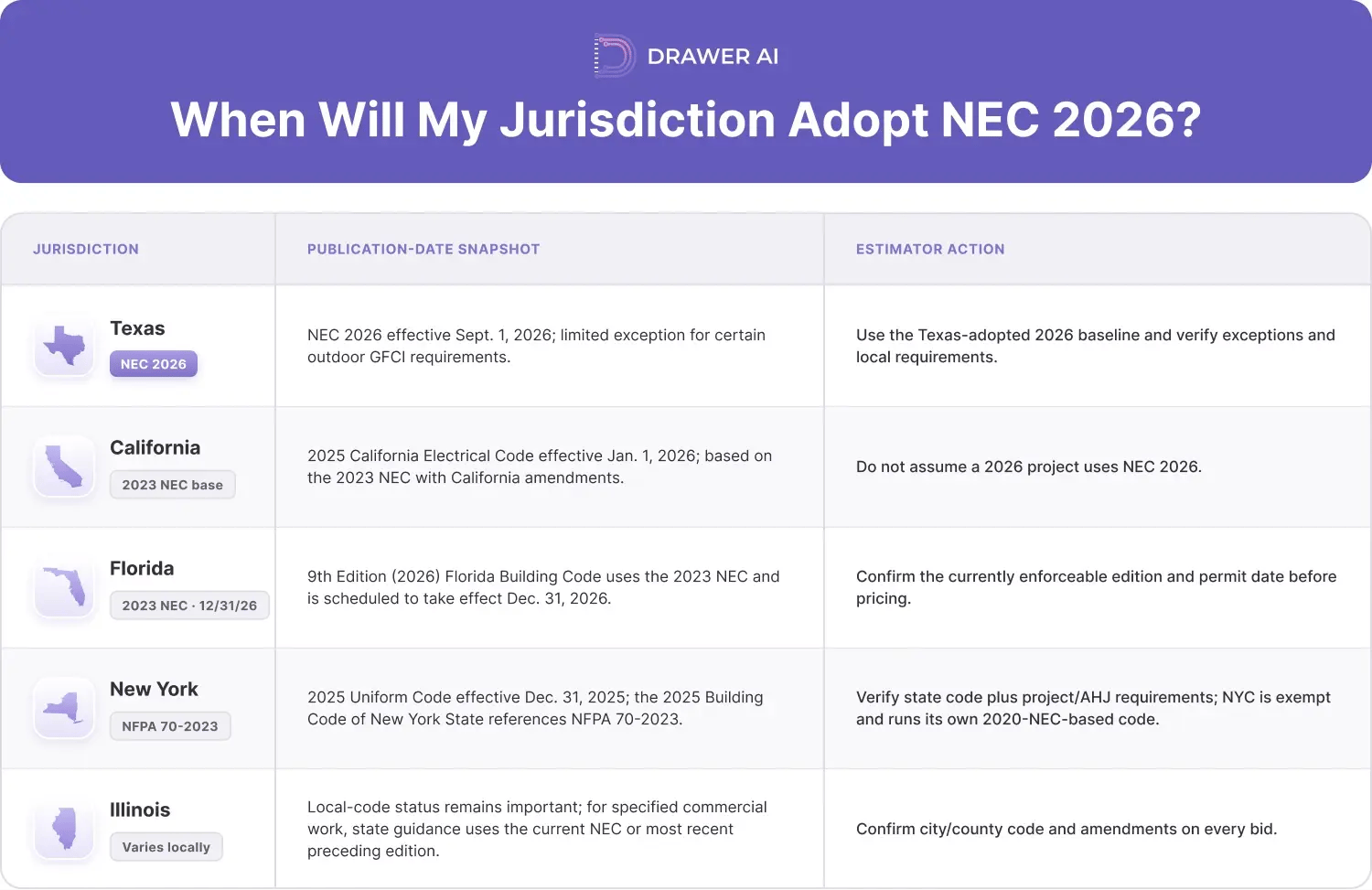
Use NFPA's state adoption resources as a starting point, then confirm the agency and AHJ. A contractor can bid NEC 2017, 2020, 2023, and 2026 work during the same period. Keep the governing edition in the estimate basis and review notes so handoff does not silently change rules.
This is a snapshot, not a substitute for AHJ confirmation. Adoption and local amendments can change. Software and reference libraries should preserve edition-specific logic.
At Drawer AI, we see the code-change problem as a workflow problem as much as a reference problem. Manual lookup is slow when an estimator must connect the governing edition to hundreds of circuits, routing decisions, conductor selections, and scope assumptions. During an adoption transition, two projects on the same desk may legitimately require different NEC editions, so a familiar rule can be correct for one bid and wrong for the next. That difference has to remain explicit throughout the full estimating workflow.
The useful role of an AI takeoff tool is to apply the right project rules consistently, not to assume the newest published edition governs everywhere. Our workflow applies NEC-based logic to circuit grouping, branch routing, and wire sizing while the estimator establishes the governing edition, jurisdiction, local amendments, and project criteria. That reduces repetitive table lookup without replacing responsibility for confirming the code basis, bid documents, and AHJ requirements. The rule source and project assumptions should remain reviewable from estimate through handoff.
Consider a commercial campus with repeated lighting and power circuits across several buildings. Circuit patterns may repeat, but panel locations, route lengths, conductor requirements, and voltage-drop conditions can differ. Repeatable routing and sizing logic can reduce manual lookup and rework while the estimator controls the code basis and exceptions. For the underlying estimating logic, see our voltage-drop calculation guide and our branch circuits versus feeders guide, keeping application consistent at scale throughout review while the estimator still controls jurisdictional assumptions and project-specific exceptions in practice.
NEC 2026 changes where familiar requirements live and updates rules affecting commercial takeoff, coordination, and pricing. Track the adoption timeline, confirm which articles affect scope, update legacy references only when the project is under NEC 2026, and keep code-sensitive assumptions traceable to the governing edition, permit basis, and AHJ. Treat the code edition as a controlled project input, not a calendar-year default.
Book a demo to see how Drawer AI applies current NEC rules in branch routing and wire sizing.

14425 Falcon Head Blvd
Building E, Suite 100,
Austin, TX 78738
Created by Estimators, Powered by AI and Innovation
Copyright © 2026 Drawer AI. All rights reserved.